Pages

Showing posts with label terrorism. Show all posts

Thursday, May 06, 2010

The case of Faisal Shahzad


Providing an accurate e-mail address to the seller of a vehicle you intend to use as a murder weapon is the sort of mistake that might get a person’s membership card pulled down at the terrorist union hall. No doubt Faisal Shahzad, the man arrested in the Times Square car bomb case, is having a bad day. If not for that e-mail address, Shahzad might already have stepped off an airplane in Karachi, ready to melt away into Pakistan.

Last week, before the Times Square incident, I was talking with a former U.S. intelligence officer who worked extensively on jihadi cases during several overseas tours. He said that when a singleton of Shahzad’s profile—especially a U.S. citizen—turns up in a place like Peshawar, local jihadi groups are much more likely to assess him as a probable U.S. spy than as a genuine volunteer. At best, the jihadi groups might conclude that a particular U.S.-originated individual’s case is uncertain. They might then encourage the person to go home and carry out an attack—without giving him any training or access to higher-up specialists that might compromise their local operations. They would see such a U.S.-based volunteer as a “freebie,” the former officer said—if he returns home to attack, great, but if he merely goes off to report back to his C.I.A. case officer, no harm done.

From The Case of Faisal Shahzad by Steve Coll Read More here

Thursday, March 25, 2010

The Business of Terrorism Flourishes Unabated...!!!


Syed Ali Mujtaba

Syed Ali Mujtaba, Chennai based journalist writes in Mujtaba's Musings:

There is no stopping to the business of terrorism brandishing Muslims as terrorist. Now this idea has caught the imagination of those who conceptualize games for the children.

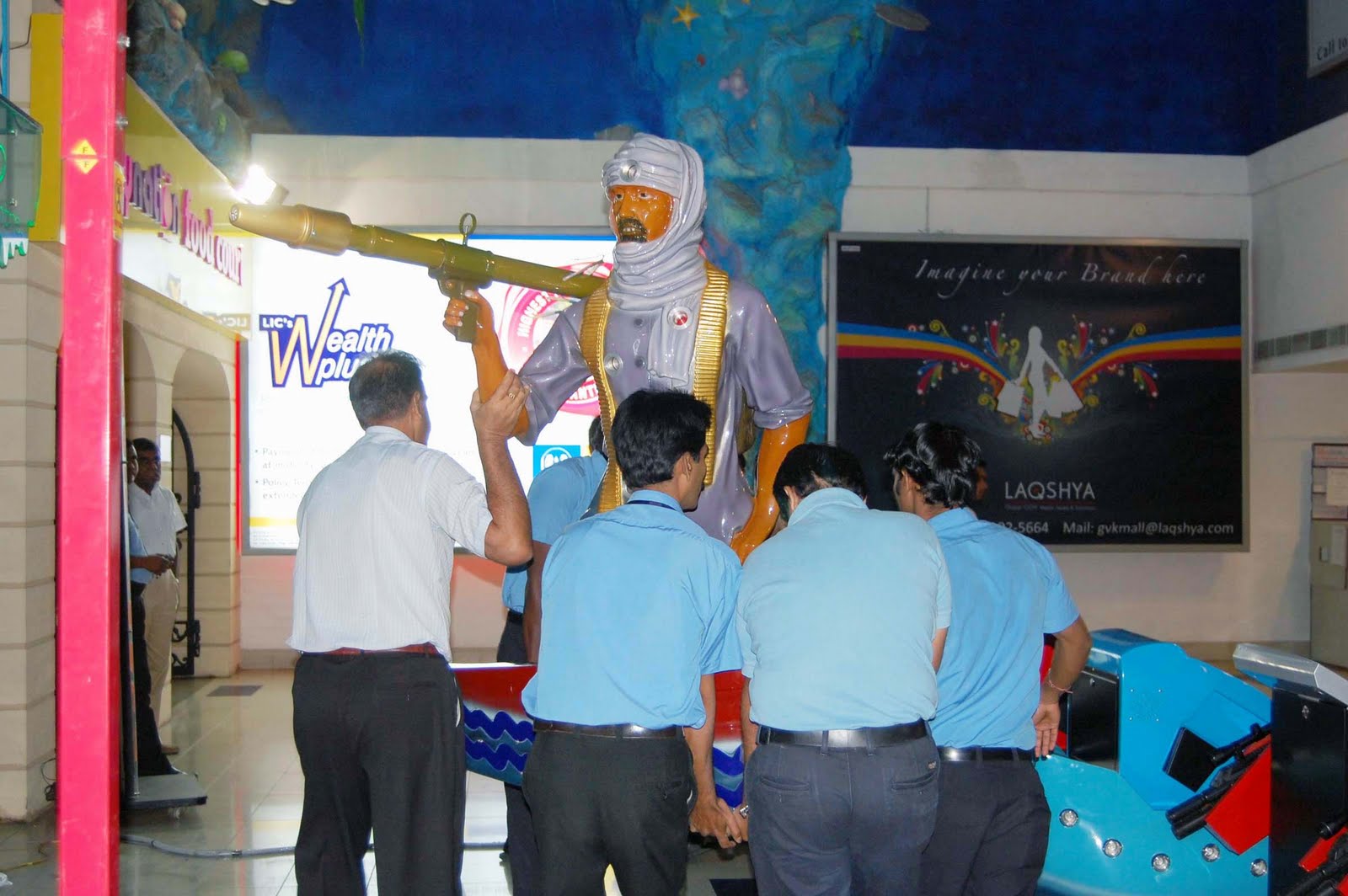
The latest news comes from GVK-1 Shopping Mall in Hyderabad, Deccan where a franchise of an US company named "FUN ZONE" has put up a shooting game stall for children called "Killing a Terrorist."
The inquisitive kids are given a gun and asked to shoot two statues put up in the stall resembling Muslim characters. There dress naturally identifies them as Muslims. One of the statutes wore turban and a long beard and other had skull cap, with clean mustaches and long beard.
... .... ....
It seems that global agenda to fight terrorism is drifting apart and the business of terrorism is busy making hay while sun shines. The buzz word is to create terrorist first and then launch a campaign to lead fight against terrorism! It seems this business is turning out to be billions of dolor industry, and there are could be many stake holders in building this industry.

It´s a vicious circle, where people have lost the beginning of the plot of terrorism and there is no end to it in sight. Each looking at the symptoms of it and none interested in curing the disease. This makes one ponder whether "Killing a Terrorist" may solve the issue of terrorism from the face of the earth?

I think there is no ready made answer to this scourge facing the humanity. The irony is no one is trying to find out answers to it and creating a space where peace and harmony can gain precedence over, conflict and barbarism.

In such vacuum, what is happening is, there is no stopping to the peddlers of the idea hate. The propaganda mill is busy leading the campaign that "all Muslims are not terrorists but all terrorists are Muslims," no matter how much the voices of sanity delivers the punch line; ´My name is Khan and I am not a terrorist´!
To read the full article, click here

Thursday, December 11, 2008

Don't shoot me! I don't want to be a terrorist!!


Look at this photograph. Who are these two gentlemen? They are just ordinary Muslim beggars who are called as Fakirs. In South India they are revered as divine people. They go with their sambirany pugai Camphor and all that and get small change for their favour.

Muhammad Ali of Two circle dot net a popular Muslim internet site wanted to photograph them. Their reaction to his request depicts the ordinary Muslim Psyche of India today.

Excerpts from his article :

Human lives apart, the war against terror has affected human psyche immensely. I had an experience of how even the ordinary members of the Muslim community live under constant fear because of the torture that goes on in the name of the anti-terror campaign. I wanted to shoot a photo of two fakirs.

In loose and colorful gowns and loads of beads around their neck, they, to me, were typical Muslim beggars known as fakirs. Initially excited at the idea of being photographed (probably first time in their life time) the promise of 10 rupees each which came with it was quite a good offer for them.

But the moment they came to know that I am a journalist, they started walking away from me. Now they said they can't let me take their photo even if I promise them 100 rupees each.

"We can't risk being branded a ‘terrorist’” was their straight face reply after my repeated efforts to persuade them for the photo shoot. They feared that their photos may get misused and they may end up being in the newspapers as the "most wanted" and as a result getting picked up by the police.

"humko nahin banna hai terrorist, Sir. Aap isko kahin chhap dijiyega to hum to kuch nahin ker paayenge. Aaj kal to roz hi police masoom longon ko pakadti hai"

And to bear so much torture only for a photo shoot was foolish for them.

After that they became very cautious and suspicious to my questions. So when I asked one of them his name, Toofan Ali was the answer. I wondered whether he gave his real name.

Funny and chilling in equal measure, this incident was an astounding statement on the distorted way in which the war on terror is being waged in this country by a close alliance of the media and the police and how an average Muslim is able to see through this.

Read : Caravan for Peace and Justice!! Tamil Nadu

Read : Caravan for Peace and Justice, Karnataka

Read : Terror has no religion... and no region

Wednesday, December 10, 2008

Shoud we over react..?

We should not over react and fall in the trap placed by the terrorists says, Sunil Adam

Excerpts from his thought provoking article:

It is pertinent here to note that the media coverage of terrorism also has a bearing on the response of the governments. In his seminal work, “Mini Manual of the Urban Guerrilla,” Brazilian terrorist and thinker Carlos Marighella says the whole idea of staging spectacular attacks is to make the target government “overreact.”

The greater the media coverage, the greater the pressure on the government to demonstrate that it is in control, which invariably results in excessive measures that cause inconvenience to and harassment of ordinary citizens. Worse still, overreaction transforms a political situation into a military situation, as Marighella envisages.

That is precisely what the Indian government needs to resist as it contemplates its responses to the Mumbai terror outrage and that is what the Bush administration did not factor in when it declared “war” against the perpetrators of 9/11 attacks. If anything, President Bush compounded the situation by waging a war against Iraq in the mistaken assumption that a demonstration of overwhelming military power against a renegade state will send a message to the nonstate actors.

Counterterrorism’s conceptual lacuna of not factoring in media coverage becomes all the more glaring when we take into consideration that there are no foolproof ways to prevent each and every act of terrorism, let alone suicide attacks that are virtually indefensible.

No amount of intelligence gathering and monitoring of “chatter” or erecting security barriers to secure vulnerable targets can stop every planned attack. Not if all target-rich democracies are potential theaters of terrorist operations. The only option is to neutralize the efficacy of terrorism as an instrument of propaganda.

Nearly 40 years ago, when the Popular Front for the Liberation of Palestine (PFLP) assembled 60 international television networks and blew up three hijacked, but empty, Boeing aircrafts at Dawson airfield in Amman, Jordan, it became obvious that without the media coverage of terrorism would be reduced to what it actually is: a low-intensity and indiscriminate violence perpetrated by a small number of non-state actors with limited resources and reach.

Yet, no effort has ever been made to curtail media coverage on the plea that it would be an affront to the freedom of the press and amount to an undemocratic measure of censorship.

But that wouldn’t be the case, if there is a voluntary effort by the media itself. After all, over the past two decades, and certainly since 9/11, citizens, institutions and businesses in every country that has been a target of terrorism have made sacrifices and accepted restrictions on their freedoms, in an effort to prevent terrorist attacks.

It is only the Fifth Estate that seems to be exempt from contributing to this global effort. If anything, the visual media, particularly the American television networks that broadcast globally, have profited from greater viewership, thanks to the coverage of terrorist activities that have gone up exponentially in recent years.

The visual media and terrorism have a mutually reinforcing relationship, which needs to be broken to the detriment of the latter.

To read the full story, click here.

Sunday, November 16, 2008

Saffron Terror!!!


"The ruling coalition has failed to reaffirm a secular agenda in a credible way. Unless it acts with determination and despatch, Hindutva hatred and prejudices will undermine interreligious harmony and tear this society asunder," says, Praful Bidwai, veteran journalist, activist and columnist in Frontline. Excerpts :

The September 2006 bombings in Malegaon outside a crowded mosque after the Friday prayers fit this pattern to a T. Ironically, the police held Muslims responsible, ignoring all material evidence and important clues: the victims were exclusively Muslims observing Shab-e-Barat, or remembrance of the dead, in an adjoining graveyard; the bicycles in which the bombs were planted had Hindu names painted on them.

Militant majoritarianism has held sway in India over the past 20 years and created great fear and insecurity among Muslims. Hindutva’s rise has deeply affected official thinking and given India’s counter-terrorism strategy an Islamophobic edge. A significant number of police and intelligence officials, both serving and retired, have embraced hard or soft Hindutva. Muslim alienation from the government has never been greater. This is especially so where Muslims have been harassed or treated with suspicion, as after the Batla House episode.

The lion’s share of the responsibility for this unacceptably deplorable state of affairs rests with the Bharatiya Janata Party (BJP), many of whose members seamlessly walk in and out of the front organisations of the RSS, and whom the RSS uses at will. Sadhvi Pragya Thakur, for instance, was a leader of the Akhil Bharatiya Vidyarthi Parishad (ABVP) for nearly a decade and campaigned for the BJP during the last Assembly elections in Gujarat. Her associates have a similar relationship with Sangh Parivar organisations.

To read more, click here.

Also read : Counter Terror by Rana Ayub

Also read : Fighting Fascism by Yoginder Sikand

Also read : Of Dharma Yudh and Jihad by Ishthiyaque Danish

Saturday, November 15, 2008

Is it the tip of the ice berg?

Meena Menon in a thought provoking, tiring article Nanded case: of lost leads and shoddy investigation in The Hindu asks:
For some time now, there is evidence that all the blasts in the country are not the handiwork of terror groups supported by Pakistan or Bangladesh.

What are the resources of this right wing terror network, its reach and implications?

Only a sustained and meticulous investigation can give results and it is time the government and investigation agencies have learnt some lesson from the slip ups in Nanded. Investigations into the terror activities which seem disparate right now have to be coherent.

Those who forget history are condemned to repeat it.

To read the full article, click here.
Also Read : Anatomy of Sangh Parivar by Ram Puniyani
Also read: Communalism and the Myth by Ambrose pinto

Wednesday, November 12, 2008

Injustice is Terror! Justice is Peace!

This is the video clip prepared by the Jamaat-e-Islami Hind in connection with the ongoing nationwide campaign for Peace and Justice from November 10 to November 25.
It is very powerful. It touches the heart. Only hitch is that the snaps from the Gujarat Genocide 2002 have been titled as "Communal violence". I think "terrorism" or "Genocide" or "Fascism" would have been more apt.
Any how, Hats off to the noble souls who conceived, produced and released this clip. Mubarak!!
Jazakallah!

Sunday, November 02, 2008

‘Godse’s way of thinking is alive and influential’


‘Godse’s way of thinking is alive and influential’

The following is the full, unexpurgated text of the convocation address made by the Kannada literatteur Prof U.R. Anantha Murthy at the Jamia Milia Islamia on Thursday, 30 October 2008:

***

Dear Chancellor, Vice-chancellor, Deans of faculties, Teachers and Students,

When I say it is an honour for me to be the chief guest in this convocation of Jamia Milia Islamia, it is not a formal statement prefacing all such addresses. I mean it because in these difficult times for most of us, the vice-chancellor of this great University has shown the courage to act properly, and humanely that would have been the correct action by a head of an institution in normal times. But the hysterical attack on him by his critics prompts me to say that he has defended the ideals that our Constitution upholds and nothing more.

Nobody who is sane can defend the terrorists.

Let us not forget that Gandhiji was killed because he was perceived to be a friend of the Muslims, and an enemy of the Hindus while he strived against the violent actions of both Hindus and Muslims, and fasted to make his own disciples in power to give to Pakistan what was its due, legally.

The stridency with which some top political leaders speak now a days makes one feel that Nathuram Godse’s way of thinking is yet alive and influential in our country. We want not only the terrorists to be punished for their inhumanity, but the political and cultural malaise that gives succour to terrorism to end.

***

I studied in the great Maharaja’s college of Mysore University which had a British principal. This living legend who was opposed to the Quit India movement, did not allow the police to raid the College without his permission. That was the story handed down by generations of students. In his eyes, the “erring” students were under his care. He was of the opinion that all students were under the care of the head of the University, and s/he must play the role of a parent.

I cannot make this point better than my friend and fellow writer Mukul Kesavan:

“I have a son who, in less than two years, will go to university. If, god forbid, he finds himself in police remand for whatever reason (murder, armed robbery, menacing the faculty, fraud), I’d want his University to behave as if it were acting in my place, in loco parentis. I would expect the proctor of the University to liaise with the station house officer to make sure that such rights of visitation as he might have in that ghastly circumstance were given him, to hire a lawyer to see if he could be released on bail, and if the nature of the alleged offence didn’t allow that, to try to have him transferred to judicial custody.

“Police remand is a dreadful form of imprisonment in India; unlike judicial custody where the procedural restraints of prison manuals apply, the police in their station-house lockups have a free hand in working suspects over. Any university that washes its hands of its students the moment they are arrested by the police because it doesn’t want to be associated with notoriety or (as in this case) the taint of terrorism is a cringing and wretched institution undeserving of a citizen’s respect or a parent’s trust.”


Prof. Mushirul Hasan, as vice-chancellor, has stood by the traditions of this great University. The founding fathers of this institution were inspired not only by the anti-colonial Islamic activism of Khilafat, but some of them belonged to the politically radical section of Western educated Indian Muslim intelligentsia.

It is important for me that both Gurudev Rabindranath Tagore and Mahatma Gandhi, who were skeptical of the European ideal of a strong, centralized nation-state, built on the notion of ‘one language, one religion, one race’, imagined India as a great civilization of multiple cultures and religions and yet united in an advaitic sense: they blessed this institution.

Let me quote again Mukul Kesavan to make clear what is at stake in our times now:

“When people, policemen and political parties buy into the narrative of a priori Muslim guilt, they run the risk of turning this remarkable republic into an ordinary, ugly, majoritarian State.”

I know how some of my Muslims friends have begun to feel these days. The media is largely responsible for this.

When any arrest is made for suspected terrorism, you invariably hear a Muslim name. Then you are told that the arrested have confessed.

Who will not confess under police torture?

I do not know if I would not confess to acts that I am not guilty of if I am subjected to physical and mental torture. This so-called “confession” is not valid evidence, however, in a court. By the time we learn that the arrested person is not guilty, the damage has been done.

It is an assault on our psyche to be informed everyday that a Muslim has been caught by the police or killed in an ‘encounter’. We never know whether the encounter could have been avoided. How can the dead speak of what really took place? There is a constitutional guarantee that every ‘encounter’ killing is homicide unless proved otherwise through an impartial and transparent enquiry.

Our nation-state does not seem to take this provision seriously for everything is okay if you can generate a mass hysteria.

In my state of Karnataka, I now hear everyday that the “master-mind” of the terror attacks has been caught. If we doubt the authenticity of the story we are considered unpatriotic and anti-national. This surely is the beginning of fascism.

As a citizen I want to ask this question: Why should the media give out names of all the arrested under suspicion before they are proved to be guilty? Some restraint is necessary in a civil society, for, even after they are cleared of their guilt, the damage is done. Many like me have begun to feel that we are living in a nightmarish Kafkaesque world.
The whole nation seems to be neurotic.

The rulers have to prove that they are efficient and therefore I have a suspicion that they randomly pick someone to create an illusion of safety among the citizens. (Any party in power or in opposition desiring to capture power has the next election in view.)

This feeling “safe and secure” is also a momentary illusion, for, tomorrow you hear again of some terrorist attack and of more Muslim names getting arrested. We are also shown on TV channels dangerous explosive material supposed to be in their possession for bomb making.

Do we believe in the much-hyped “Breaking News” of the TV channels? Yes and No. Feeling torn between belief and suspicion, even as one recognizes their need to sensationalize and closely compete for TRP ratings, is itself a mental harassment for common citizens like me.

Don’t we have children whom we want to return safely from school?

The harassed police are also under pressure from their nervous political bosses to find the guilty as quickly as they can. The inhuman terrorists, who abuse the word ‘Islam’, also know how poor the intelligence network in the country is; and the State seems to be serving their interest in arresting anybody who has a Muslim name, for, the terrorists hope to demoralize the rest of the Muslim community in the hope that they would join them, or at least sympathize with them. They carry such attacks in a Muslim country like Pakistan too. This is the story of powerful Bhasmasura, who tries to destroy his creator. This is true of the policy pursued by the USA for hegemony in the world; they have to now suffer for their karma.

The minorities are thus alienated from the mainstream of our nation.

If you are a Muslim you can hardly get a rented house in a decent middle-class locality in the IT city of Bangalore. On learning the name, they are politely told that the house has already been taken.

With the elections round the corner, Hindu rioters—a safe word for the Hindu communalists to mark their difference from Islamic fundamentalists—are attacking churches.

In a Kannada newspaper, one with the largest circulation and owned by a prominent Indian newspaper group, published a few days ago an irrational and abusive article on the evil designs of Christians to annihilate the Hindu religion, which had the full support of their leader Sonia Gandhi. The article was right in the front page, which continued in the inner pages. The excuse was that by publishing the article the issue of conversion had been opened for impartial debate. Some months ago, the same paper conducted an SMS campaign against me for criticizing a communally poisonous novel against Islam by this very author, who has now launched himself against the Christians.

I must however observe here that despite such psychological war, thousands of our fellow citizens go about living their lives and caring for their children and the old. The truly religious—among both Muslims and Hindus—are pious and compassionate. Otherwise there would have been utter chaos and anarchy in our country.

I feel it is also time all of us, Muslims and non-Muslims alike, did a serious exploration of what constitutes the fundamentals of Islam. This is necessary to understand the core of Islam, and, more importantly, to extricate Islam and Muslims all over the world from the clutches of religious bigots; protect it from misrepresentations of the Western media and all its lackeys; and to highlight the dynamism of Islam as religion and philosophy.

Great scholars like Maxime Rodinson, Edward Said, Mohammad Arakoun, Ziauddin Sardar, Alam Khundmiri, Maulana Wahiduddin Khan and activists like Asghar Ali Engineer have all done this. Only such an attempt would ever resituate (sic) Islam for all concerned without which ugly stereotypes and distortions and misrepresentations about Islam and Muslims cannot be confronted.

It is also equally significant to erase the unfortunate gap that exists now between well-meaning secularists and traditional believers, often dubbed as religious fanatics. In difficult times such as ours the conflicts/ tensions/ antagonism between genuine secularists and profoundly religious people have to be removed for the good of all. Our great crisis revolves round this aspect too. Otherwise, stereotypes and prejudices would make the situation almost impossible to deal with.

The Christians have at least the West to speak for them, but Indian Muslims have none. President Bush in a Freudian slip perhaps had declared a crusade against them with the support of feudally ruled Muslim states. Hindus like me who have come under the influence of Gandhi, Ramana, and Paramahamsa who in search of a spiritual realm went beyond any organized religion, now feel threatened. The nature of Hindu civilization, nurtured for more than 2,000 years by disbelievers, for instance like the Buddha, may also be destroyed by cynical supporters of a majoritarian state.

There is a cynical calculation, more so in some parties, less so in others, in dividing Indian people on communal lines for the sake of creating safe vote-banks. It is difficult to create a solid Hindu vote bank for they are divided on caste lines.

In the past, during the struggle for freedom and even earlier, there were many reformative movements to fight against casteist hegemony among the Hindus and unite them as a people.

One of the greatest of them, Sri Narayana Guru of Kerala got self-esteem and dignity for what was then a semi-untouchable community of toddy tappers. The Guru was a great advaitin himself. For him the untouchable Chandala who brought about a change of heart in the great Adi Shankara was not Shiva in disguise as the myth tells us, but literally a Chandala. Thus he was a “literalist” advaitin.

In Karnataka we had a great movement for social justice and unfettered search for spiritual truth in the 12th century. The great poet of that movement, Basava, thought of the dying human body as a temple of the living God which lasts, paradoxically, longer than the seeming solidity of the stone and mortar built temple. He also fought for social justice and equality and got a Brahman girl married to an untouchable. Gandhiji himself was a great reformer.

The paradox is this: now the unity of the Hindus is sought to make our state a majoritarian state. In this seeking of a united Hindu vote bank there is of course no spiritual purpose, although there is a show of festivals and pilgrimages (like the Datta Maala in Chikamagalur).

Last year, in another great institution for which Gandhiji was the founder and Chancellor until his death, the Gujerath Vidyapeeth, I spoke of a genuine search for a spiritual realm, beyond the boundaries of organized religion. This is about the three urges—I call them hungers of the soul following a great saint philosopher Simone Weil— that animated the Gandhian era of our country. They are, hunger for equality, hunger for the spiritual, and hunger for modernity. Writers like me all over the country were inspired by these urges.

Solution to the merely physical hunger for equality appears to be within our reach today. But equality as hunger of the soul is not easily satiated unless it gets coupled, as it does in some great sages of all times — with the other hunger, the spiritual hunger. Both these hungers have their origin in the feeling that all forms of life are sacred and our routine quotidian existence in the temporal world is boring unless it glows with a transcendental meaning.

Consumerist paradise can ultimately prove to be dull and tediously repetitive. Great writers of the West have shown how listless and nauseated the human person is in his civilization.

Therefore, when one is deeply animated by these two hungers, as if the two hungers were the same, one becomes profoundly impatient with the existing social system, the existing structures of religion as well as the developmental dreams unleashed by science and technology, for this world doesn’t belong to man alone.

This twin-hunger is what distinguishes our great saint poets of mediaeval times—Basava, Tukaram, Kabir and Akka Mahadevi. In our own times, Mahatma Gandhi, Martin Luther King and B.R. Ambedkar—to take some examples at random – exemplify this hunger for equality as well as spiritual hunger. Spiritual hunger may be a better term than hunger for God because I can then include a fierce critic of organized religion like Ambedkar in it.

Who is not familiar with the person of Ambedkar in European clothes (symbolizing modernity) who fought an incessant battle for equality and dignity of the Dalits? But it is the same Ambedkar who in his later years embraced the compassionate Buddha. This was not in contradiction to his social commitment but as a continuation of his struggle on another timeless dimension.

There is a moving picture of him, although not so popular as the Ambedkar in western dress, in Buddhist robes and shaven head. Those who consider both these pictures of Ambedkar as intensely connected would understand how difficult, yet how beautiful, it is to connect the hunger for equality and human dignity which seeks ruthless political action in the temporal world outside, with spiritual hunger which seeks fulfillment in an inward silent struggle. This is what makes Gandhiji and Ambedkar complementary, despite their differences.

I am not able to say the same about the contradiction between the ideas of Veer Savarkar for a strong nation state, and Gandhiji’s dream of gram swaraj. They are irreconcilable, and we see enough proof of that in our troubled times in India.

The last point I wish to make is this: After such trauma and violence in Gujarat, the country seems to have forgotten the role played by Narendra Modi in making Gandhi’s Gujarat almost a nightmare for Muslims. He is now a hero for all those who believe in Development.

Every political party speaks of Development and the industrialists and multinationals know that a majoritarian state where dissent is curbed is the best site for development. No political party seems to speak of Gandhiji’s ideal of Sarvodaya, an economic policy that would even benefit the last poor person. The suicides of agriculturists are not taken seriously; their death does not affect the sensex.

Those of you who graduate today from this great institution should ponder over what we as citizens can do to combine development with the welfare of all. Development should disassociate itself from an unabashed consumption and its need of an authoritarian state where the majority can rule ruthlessly, suppressing every form of dissent.

Please don’t think of what I just said as a cliché ridden advice; the whole world is in an economic crisis following the American model of development and consumption; an ecological disaster is ahead of us arising from our greed-driven consumption; violence in our societies has never been effectively curbed by counter-violence.

Gandhiji’s faith in non-violence and truth being the same is not just an ideal; it is a practical and sensible path for not only individuals, as perceived conveniently by many of us, but for nation-states too.

Thank you for listening to my words spoken with a feeling of anxiety and personal urgency. Forgive me for not being able to give you a proper academic talk suiting the solemn occasion.
Source : Churumuri
Thank you Churumuri...!!!!

Thursday, June 26, 2008

Hardliner Hindu groups under scanner for bomb blasts.


At last, it seems the national security apparatus has woken up. A front page news story published in DNA e-paper reports that intelligence agencies suspect the hands of Hindu radical groups in bomb blasts.
The signals were there. First it came from Nanded. Then the samjohta express incident. Then the Tenkasi happened. Let us hope for the best.
The report submitted by Josy Joseph, New Delhi deals with these questions.
Excerpts from the report is given below.
For full report click DNA.
Is a fringe hindu fundamentalist group, or groups, behind at least some of the bomb blasts across the country?
the security establishment is once again seriously probing this angle in the wake of the arrest of several members of the sanatan sanstha and the hindu janajagruti samiti for crude bombs planted in mumbai in recent days.
an official closely involved with anti-terror investigations all over india says, "we are aware that some fringe hindu groups want to carry out blasts, but we still don't know their spread and expertise. as of now we believe they don't have the training to make sophisticated explosives."
the official, and at least two others, told dna that there are at least a few blasts in recent years in which hindu groups cannot be ruled out as suspects.
for the past several years, some dependable intelligence sources have had a nagging suspicion that such outfits were active underground. in april 2006, a blast in nanded gave evidence of their suspicions coming true. two hindu fanatics were killed and four injured in the blast, which happened when they were assembling bombs.
over the past two years, more evidence came in. the bombs that were going off at regular intervals all over india suddenly became locally assembled, no more was rdx - a key ingredient of the bombs - smuggled from pakistan.
"at least two of the blasts gave us further reason to believe that the hindu fringe elements are involved," says a senior intelligence hand, referring to the blasts in malegaon and delhi's jama masjid in 2006.

but with no concrete evidence emerging and nanded remaining an isolated case, the security establishment had been back to focusing its energies on islamist groups such as harkat-ul-jihad-islami and lashkar-e-taiba.
the cbi has yet not been able to make any credible breakthroughs in their probe into the blast in a malegaon mosque in september 2006. similarly, there are no publicly stated culprits behind the blasts in jama masjid. in both the cases, agencies suspected some fringe hindu group.
investigations into the nanded blast had given credible inputs to prove that in april 2006, hindu fanatics planted a bomb in a parbhani mosque in which at least 25 people were injured. the same people were involved in the nanded blasts.
in november 2007, as multiple bombs went off in the court premises of up most pointed fingers at the islamist groups. but a minority in the security establishment was not convinced, given the errors in the email warning sent out to media houses minutes before the blasts. someone well versed in islam had not drafted the mail, and it was more linked to the local politics of india than to the larger jehad goals, some point out.
with the maharashtra ats now establishing the bomb making capabilities of the fringe hindu groups, intelligence analysts are taking a second look at the possibility of their involvement in some blasts of the recent past.

Wednesday, June 25, 2008

Thank God, they were not Muslims....!


Take this fact. A fact which is so disgusting, annoying and revolting. It is a fact which is slapped at your face when you open those newspapers every morning. The fact is the Indian Media is biased. Blatantly one sided. It looks one side of the picture, willingly, happily and alarmingly. It is biased against Muslims.
Mr. Yoginder Sikand, a renowned research scholar, specialist on terrorism, columnist and sociologist exposes this open secret in his own way.
Read on. It appeared in countercurrents.org


The arrest of some activists associated with the
Sanatan Sanstha, a radical Hindu group, for planting
bombs in theatres in two towns in Maharashtra
recently, has barely been given any attention in the
Indian media. Had the men behind these planned attacks
been Muslims, obviously the Indian media would have
reacted very differently-furiously, fervently. This
clearly shows the sharply skewed manner in which the
debate on 'terrorism' is being conducted. That the
routine killings of Muslims, such as in pogroms
orchestrated by Hindu groups, are never attributed by
the media to Hindu 'terrorists' but simply to faceless
and nameless 'emotionally charged mobs' is yet another
illustration of this greatly skewed perspective.

Bomb attacks that have occurred in numerous Indian
cities in recent years are, without proper or full
investigation, somehow automatically assumed to be the
handiwork of Muslims. But, as the attacks that the
Sanatan Sanstha volunteers had planned, as also the
earlier attack planned by members of the Bajrang Dal,
also in Maharashtra, clearly show, the range of those
who might be behind the wave of bomb attacks in the
country has to be expanded some Muslim ultras to
include their Hindu counterparts as well, who have
obviously have a vested interested in promoting
communal clashes and thereby consolidating Hindu
votes. And, in addition, as numerous Urdu papers have
been repeatedly suggesting, the possible role of other
forces, such as the Israeli and American secret
services, behind some of these attacks must also be
investigated, for, clearly, these attacks aim at
further dividing Hindus and Muslims and thereby
promoting inflaming anti-Muslim passions in the
country, something that Israel and the
neo-conservatives in America would probably warmly
welcome as it would force India to enter more tightly
into their deadly embrace.

Yet another clear instance of the completely warped
way in which the Indian media and policy-making
circles discuss terrorism is evident from their
reaction to Shiv Sena supreme Bal Thackeray's recent
pronouncement calling for Hindus to set up killer
suicide squads. The 'mainstream' media is not branding
him a 'terrorist' for this, although he openly
advocates terrorism, and nor will the state take any
action against him under the draconian anti-terrorist
laws that it has framed. Imagine if a Muslim leader
had issued a similar call. That would have hit the
headlines for well over a week and would have led to
numerous arrests, but Thackeray's outpourings merit
just a corner in the middle pages of our 'national'
newspapers.

My point is simple: we need an even-handed approach in
discussing (and dealing with) 'terrorism'. Turning a
blind eye to one form of it, just because it claims to
speak for the majority of Indians, can only make the
situation even more precarious for all of us. And,
although of late most religious leaders have begun to
depress me no end, here I take inspiration from an
essay I recently read by an Indian Muslim cleric whose
passion for the welfare of his country, irrespective
of religion, is something that every Hindu, Muslim or
other sort of Indian could certainly emulate, and
whose approach, if seriously adopted, could go a long
way in countering all forms of terrorism, be it by
radical Hindus or Muslims or others or by the state
itself..

A recently reprinted Urdu booklet, titled 'Hamara
Hindustan Aur Uske Fazail' ('Our India and Its
Glories'), contains a brilliant essay o by the late
Maulana Syed Muhammad Miyan, who served for many
years, before and after 1947, as the general secretary
of the Jamiat ul-Ulema-e Hind, a leading body of
Indian maulvis primarily associated with the Deobandi
school of thought (It is the same organization that
vehemently opposed the Partition of India and that, in
recent months, has organized literally dozens of
public rallies against terrorism). The essay was first
published sometime in the early 1940s in order to
oppose the Muslim League's demand for a separate
Muslim state and to counter the claim of many Hindus
leaders that Indian nationalism was necessarily
synonymous with Brahminical Hinduism.

Miyan's essay, titled 'Sarzamin-i Hindustan Ke Fazail'
('The Blessings of India'), argues that Muslims are
bound to 'love' and 'serve' India primarily because
Islam commands them to do so. Miyan claims that India
has been accorded a special status by God Himself.
Hence, he argues, Muslims are required by their faith
to work for India's unity and welfare.


Miyan's's thesis is based on an Arabic text written by
the eighteenth century north Indian Muslim scholar,
Ghulam Azad Bilgrami, which puts together Hadith
reports attributed to the Prophet Muhammad and Quranic
verses that are said to refer to the 'glories'
(fazail) of India. Quoting Bilgrami, Miyan writes that
while undoubtedly Mecca, Medina and Jerusalem are the
'most holy' places in the world, Islamic tradition has
it that India, too, is a 'blessed land' (mutabarruk
sarzamin). According to such revered Muslim figures as
Imam Ali (cousin and son-in-law of the Prophet),
Hazrat Ayesha (one of the Prophet's wives), and
leading companions of the Prophet such as Hazrat Ibn
Abbas, Hazrat Anas and Hazrat Abdullah ibn Umar, Adam
was sent down to earth to India, to the island of
Serendip or modern-day Sri Lanka, while Eve was sent
to Jeddah.

Adam then travelled to Arabia, where he met Eve at a
place near Mecca. After building the Kaaba at Mecca,
Adam took Eve with him and returned to India, where
they settled down and had children. The famous
incident involving the sons of Adam, Cain (Qabil) and
Abel (Habil), occurred, or so Miyan says, in India.
After Abel was killed by Cain, Adam had another son,
Sheesh, who, according to some accounts, is buried in
the town of Ayodhya, which is sacred to many Hindus
today. Adam is said to have undertaken forty
pilgrimages (haj) from India to Mecca on foot. He is
also said, some ulema claim, so Miyan tells us, to
have died in India and to have been buried here.

This close connection between Adam and India points to
what Miyan claims to be the obvious fact that Islamic
tradition accords to India the status of a 'blessed
land'. This suggests, Miyan writes, that India had a
special place in God's scheme of things for the world,
which Muslims living in the country need to recognise.
The fact that Adam first appeared in the world in
India means that the world's first dar ul-khilafa
('abode of the Caliphate') was India, because this was
where God's first khalifa or deputy was sent down. The
island of Serendip or modern-day Sri Lanka, which can
be said to be, in some sense, part of 'greater India',
was the first place in the world where God sent his
revelation. Adam, the first man and the first prophet,
was made out of 'Indian soil'. Since Adam is the
father of all human beings, including all the other
prophets and the saints, the rest of humanity was also
fashioned out of the 'mud of India', or so Miyan
claims.

To reinforce his argument of India being accorded the
status of a 'blessed land' in the Islamic tradition
itself, Miyan notes that some Muslim scholars believe
that the oath (ahd) of 'alast', which the Quran refers
to, also took place in India. On that occasion, God
gathered all the souls of men who would appear in the
world till the Day of Judgment and addressed them,
asking them if He was not their Lord (alasto bi
rabbikum). All the souls answered that He indeed was.
This shows, Miyan writes, that India was the country
where the 'slaves' (bande) of God first acknowledged
Him as Sustainer, from which started the long chain of
spiritual advancement of humanity. Through this
incident the land of India was 'brightened (munawwar)
by the 'light of all the prophets', Miyan contends.

According to the Quran, Miyan adds, at the time of
taking the above-mentioned oath, another oath was
taken from all the prophets, in which each prophet
testified to the prophet who would succeed him. Since
the chain of prophets ended with Muhammad, every other
prophet testified on that occasion to Muhammad being a
prophet, reposing faith in him and promising to help
him. This second oath, too, was taken in India, Miyan
claims. Hence, Miyan writes, 'India is that holy
(muqaddas) land where the chain of religious
instruction (rashd-o hidayat), and knowledge of the
closeness of God (marif-i qurb-i ilahi) and salvation
in the hereafter (nijat-i akhiravi)' had their
origins.

The claim of God having chosen India to send Adam to
has other crucial implications, Miyan suggests, which
reinforce the special place that India is said to
occupy in the Islamic tradition. Miyan writes, echoing
a view held by many Sufis, that the first thing that
God created was the nur-i muhammadi or the 'light of
Muhammad'. This light was first put into Adam and was
then transferred through all the prophets till it
reached the Prophet Muhammad when he appeared in
Mecca. Because Adam lived in India, the first time
that the nur-i muhammadi appeared on earth was in
India, and the last time that it appeared was in
Arabia, this establishing a firm spiritual link
between the two lands.

In support of this argument, and to underline his
assertion of India being a particularly 'blessed
land', Miyan quotes a verse by Kaab bin Zaheer, a
famous poet and a companion of the Prophet:
'Undoubtedly, the Prophet is a light (nur) from which
light is obtained. [He] is God's sword which was made
in India'. In this regard, and to further stress his
point, Miyan refers to another story, one related by
Abu Huraira, a companion of the Prophet, according to
which the Prophet is said to have declared that when
God sent Gabriel to comfort Adam, Gabriel mentioned to
Adam the name of Muhammad, telling him that Muhammad
would be the last prophet from among Adam's children.
This shows, Miyan writes, that it was in India that
for the first time the Holy Spirit (ruh-i muqaddas)
appeared on earth, that the glory (azmat) and unity
(tauhid) of God was mentioned, and that Muhammad's
prophethood was announced.

This further stresses the need, Miyan says, for the
Indian Muslims to recognise that 'it is our good
fortune that this India is our beloved country
(watan-i aziz)'. Because India is said to have held a
special place in God's plan for the world, Miyan
argues, God has blessed it with numerous assets. The
source of all good things (nimat) is heaven, and
whatever good things are found on earth are a limited
reflection of their heavenly counterparts. All good
things that are found in the world were first brought
by Adam to India, from where they spread to the rest
of the world, so Miyan claims.

This explains, Miyan argues, why India has the
'largest store of heavenly blessings in the world',
including 'sweet-smelling plants, spices and fruits'.
Adam, Miyan tells us, was also taught various crafts,
which is the reason why India has always excelled in
these fields and hence can rightfully claim to be the
'first teacher' (ustad-e awwal) of the world in many
crafts and industries.

Besides the alleged Adam connection, Miyan marshals
other 'evidence' to put forward his claim of India's
special status in Islamic terms. Thus, he writes that
some Muslim scholars believe that Noah built his ark
in India, and that India was unaffected by the Great
Flood in Noah's time. In addition, several companions
of the prophet, thousands of Muslim saints (awliya,
abdal), martyrs (shuhada) and pious ulema made India
their home and died and were buried here. All these
facts clearly suggest, Miyan contends, that from the
Islamic point of view the 'greatness' of India is
'undeniable'. Hence, he stresses, it is the religious
duty of the Muslims of India to work for the sake of
the unity and prosperity of the country as a whole.
Hence, too, he suggests, the claim of Hindu
chauvinists that only Hindus can be genuine Indian
patriots must be challenged and countered.

I personally do not necessarily agree with all that
Miyan writes in praise of India and nor do I agree
with all his interpretations of Muslim traditions
about India, some of which I find quite outlandish. In
some senses, privileging just a small slice of the
earth as particularly 'blessed' by God, which Miyan
seems to do with regard to India, strikes me as deeply
troubling-either every bit of the world is equally
blessed or not at all, I would believe. But, that
said, I find Miyan's concern for his country and its
people to be genuine, passionate and deeply moving. It
is something that terrorists, Hindu and Muslim and
other, certainly lack, their radical rhetoric
notwithstanding.

Explosives seized at Thane theatre blast accused homes


Here is an interesting news which appeared in popular news website twocircles.net It was reported by Tarique Anwar on 21 June 2008 - 8:14pm.

Mumbai: In a big blow to those who see a Muslim hand in every terror bombing, the Anti-Terrorism Squad (ATS) of Maharashtra has seized huge quantity of explosives from the homes of the Hindu extremists arrested this week in connection with Thane theatre bombings.

ATS had arrested four persons: Mangesh Dinkar Nikam, Ramesh Hanumant Gadkari, Santosh Angre, and Vikram Bhave for planting bombs at the Vishnu Das Bhave Auditorium in Vashi and Gadkari Rangayatan Auditorium in Thane in May. The arrested persons were associated with Hindutva groups Janjagruti Samiti and Sanatan Sanstha.

During raids at the homes and fields of Vikram Bhave and Mangesh Dinkar Nikam in Warsai village in Pen (Raigad district), ATS seized two revolvers, 92 bullets and huge quantity of ammonium nitrate powder, 20 detonators, 19 gelatin sticks, timers, voltage meters, two radio circuits and remote controllers. The police have also arrested one Hari Bhav Devkar for trying to destroy the explosives.

According to the police, during the interrogation Mangesh Dinkar Nikam said a huge stock of explosive materials was kept in a gunny bag in Satara district. A police team went to the district and seized timers, detonators and other materials.

In the bomb explosion at the Gadkari Rangayatan Auditorium in Thane seven people were wounded. In the bombing detonator, gelatin rods and timer were used. A bomb was planted at Vinoba Bhave theatre at Navi Mumbai, which was later diffused.

Monday, June 23, 2008

Torture in Hyderabad


M J Akber has launched a fortnightly. Its name is peculiar one. It is "covert". Only M J Akber could name such a peculiar names.

Anyhow as expected covert is different. When all other magazines are commercialised except one or two, the dawn of covert should be welcomed with open hands. India needs such bold magazines. India needs bold journalists such as MJ.

The following is an article by veteran journalist Seema Mustafa in covert.

I read it with tears flowing down my cheeks. The incidents could happen anywhere. anytime. This gloomy scenario makes covert more relevant.

No other magazine cared to probe the plight of innocent Muslims. Covert has done it. Hats off to Covert, MJ and Seema.

It was 3 September 2007. Abdul Rahim was just finishing dinner with his family when two persons in civilian clothes came and asked him to step out. They led him to an auto, and after a short journey pushed him into a car. Four others were there. He was blindfolded and taken to a police station.

They began interrogating him till the early hours of the morning. They wanted to know whether he had been involved in the twin blasts that had paralysed Hyderabad. They tied his hands, made him lie down and started hitting him on the soles of his feet with a belt. The pain was excruciating. They pulled his beard repeatedly, taking out tufts of hair. They asked him to give names of those who were with him in planning the bomb blasts in Hyderabad. They spoke filth against his religion and his family. The torture that carried on for three days in his case became secondary to the humiliation.

"I thought they were going to kill me, I thought they had killed the others. I was not allowed to sleep for three days and nights. Even now when I think of it I tremble with fear, I cannot sleep," Abdul Rahim says as his old father, a former government employee, cries quietly beside him. His parents cannot forget the week after. "No one told us where he was, whether he was dead or alive, we only got to know when a journalist came and told us that our boy was in jail," his father said. His mother remembers when she saw him, "His face was all swollen. He could not speak. I am a heart patient, I thought I would die."

Abdul was produced before the magistrate after three days. He was in jail for five months and ten days until he was released on bail.

His life is ruined. He was the only bread earner of the family. He drove a rented autorickshaw. No one is willing to hire him now. He was engaged to be married, but the girl's family backed out after the arrest. There is no money to pay the rent for the tiny two-room house. They are in deep debt. There is no furniture. There is a certain desolate look in his eyes, he is still in shock. He has to report before the courts twice a week. "It takes the entire day, I cannot even look for work, no one will allow me two days' off a week," he says quietly.

He has not been booked in the bomb blasts case. There is no evidence.

M

ohammad Shakeel is not at home. He does not want to meet us. He is too scared, under grave threat. His paralysed father is sitting in the tenement, eyes wide, registering fear as he looks at us quietly. Shakeel's mother, Ashabi speaks reluctantly. Two persons in civilian clothes picked up the boy. The family did not know for days where he was. Someone told them after a long time that he was in jail. He is out on bail now, without a job as no one wants to employ him. There is little food in the house for them to eat. What Ashabi did not tell us, even as tears trickled down her face, was that Shakeel was kept in police detention for 21 days without being produced before a magistrate. His hands were tied and he was hung from the ceiling. Heavy weights were placed on his knees, while hefty men pinned his shoulders down. He was given electric shocks on his temples, penis and chest. He fell unconscious repeatedly, but they would pull him out and after a short break resume the "treatment" again.

He has not been booked in the bomb blasts case. There is no evidence.

A

rshad Ali Khan's face has no expression. It is as if he is speaking about someone else, not about himself. But as he continues, his hands start trembling, and the horror of the days in detention is reflected in his eyes.

It was 2 September 2007. Two men banged on the door, came in and took him away. No one could protest. His father is paralysed and a heart patient. "Bahut ghabrahat ho rahi thi," was the only sentence he spoke to us. Arshad's mother Mehrunisa said they had no word of their son for two weeks or more. They heard he was in jail from another family, not from the police.

Arshad says they took him to a city office blindfolded, then to what is referred to by most of the boys as a "farmhouse" on the outskirts of Hyderabad. "In the day they would question me; at night they would drink and start beating me on the soles of my feet. They tied my hands and hung me for two to three minutes, I almost fainted with the pain. They would give electric shocks every day on different parts of my body. I became unconscious many times, and even later there were burn marks on my chest, thighs, near the ears. I could smell burning flesh. I heard screams from other boys in the building, they kept asking me to name others, to admit that I was involved," he says in a voice devoid of emotion, face deadpan except for the eyes. He was taken for narco tests, twice. He does not know the results, but guesses they could get no evidence from these.

He has not been booked in the bomb blasts case. There is no evidence.

M

aulana Abdul Aleem Islahi is a walking tragedy. Originally from Azamgarh, Uttar Pradesh, he made Hyderabad his home decades ago. A learned man — his room is full of books — he is restrained in his dignity. There is an air of resignation around him, as he narrates the story but without a word of protest or acrimony.

It was 2004. His eldest son Mujahid had accompanied a well-known cleric of the locality — Maulana Nasiruddin who was on the watch-list of the Andhra and Gujarat police — to the police station. The Maulana was described as a bad element by the police — although the local people insist his only crime was his courage to protest against the atrocities committed by the police — and had been called to the police station. The Gujarat police was lying in wait and nabbed Nasiruddin. The young Islahi protested, and as the story in the streets of Hyderabad goes, one of the policemen took out his gun and shot the young man dead at point blank range. The police does not deny the death, but claims that Islahi tried to take the Maulana, along with others, out of the van. This is vehemently denied by all those aware of the incident, including another eyewitness who has been targeted by the police.

On 5 March 2008, Maulana Islahi was sitting in his little room from where he could see outside. His younger and only surviving son, an engineering student, Mohtasim was sitting with some friends outside. "They came in a car, they just picked him up, pushed him into the car and left. I ran out but they had disappeared. In the evening we went to the police station but they gave us no information," the Maulana said. It was several days later that they were told he was in jail by an acquaintance, but while his sisters have been to meet him, his father cannot bear it and has decided not to go. Huma, Mohtasim's sister, said she found him to be mentally distressed. He was tortured in police custody, as they repeatedly wanted him to confess to participating in the blasts. But what has become worse for a family that believed in educating their children and living a quiet and decent life, is that the police has been visiting the locality where they live and as Huma said, "They go to the families and say that Mohtasim has named you, and now everyone is very upset with us."

This was not so in the beginning, as the family was very popular. In fact, after news of Mohtasim's arrest broke, 30 women of the locality went to the police station to protest. They were lathicharged, arrested and detained for an entire night before they were produced before a magistrate the next morning and released. Two babies were also kept in detention with their mothers.


To protest is a crime. Ibrahim Ali Junaid had held a press conference along with others after the Mecca Masjid blast in Hyderabad where dozens had died in the attack, and at least six to seven persons had been killed by police firing. Hundreds of Muslim youth were detained. This placed him on the police watch list, although Junaid is a student of Unani medicine with a clean record.

On 3 September 2007, he had just returned from Delhi where he had gone to attend a university seminar. He went straight to the hostel to put his luggage. Two men, again in civilian clothes, emerged, tied his hands and pushed him into a car. "If you speak we will kill you," they said as they blindfolded him. After a two-hour drive they reached a "farmhouse" and started questioning him. He could hear the voices and screams of others. Late at night they stripped him and the torture began. "They started hitting me with a belt … and kept asking why I had held a press conference… They made me recite the Quran as they knew I was a Hafiz, and then hit me whenever I spoke. They beat me mercilessly at regular intervals and after a day started giving me electric shocks on my ears, temples, lips, private parts. I would become unconscious…" As Junaid spoke in a monotone, his mother, sitting beside him, shuddered. His father could barely contain his anger, but admitted his complete helplessness.

The police kept telling him to accept responsibility for the bomb blasts. "They pulled my legs wide open, placed weights on them, pressed down on my shoulders. I don't know how I survived those days," Junaid says. In six days there was blood in his urine, he was running temperature and "I knew if I died, they would put it down to an encounter". He was then taken before the magistrate, and put in jail from where he has just been released on bail after just over five months. "One night they took us somewhere, blindfolded, and took us out and said say your prayers, we were sure we were going to be killed that night…"

He has not been booked in the bomb blasts case. There is no evidence.

R

aeesuddin Khan's crime was that he was witness to the murder of Mujahid Islahi, Maulana Islahi's unfortunate son. On 31 August 2007 a large car with six persons came to his house. He was picked up, blindfolded and after about an hour's drive they reached a building. His was the same story — five days of continuous beating, electric shocks. "I gave them names of maybe 100 persons, all I could think of to get away from the pain, but they carried on. I thought all the other boys were dead, they made me believe that. One night they took me out blindfolded, they asked me to say my prayers, I could hear shots being fired, I thought I was next…"

His mother, a widow, Zaheera Begum said she was beside herself with worry. She had no idea where her son was. Friends informed her that he was in jail many days after he had been taken away. The hair from his beard had all been pulled out, he was passing blood in his urine, she says. He was taken for narco tests, and that has now left him with a permanent headache and allergies that are being treated. He is suffering from memory loss. He was also taken to Delhi by the CBI. "They were very nice, very polite, they took me there and dropped me back," he says. He looks haunted, his eyes are full of tears, more when another person tells us that his mother keeps very unwell now, has high blood sugar. "I am so scared," her voice trembles, "for both my sons. They can pick them up any day."

He has not been booked in the bomb blasts case. There is no evidence.


Iqbal Begum runs into the room breathless. "Where is he, have you found him?" she asks. Her eyes dull when she is told that she had been contacted for an interview, not because the contact person had found her son. She dissolves into tears, and takes out faded newspaper clippings as she tells her story. Her son Farhan had once been involved in some localised dispute over a mosque. The police had picked him up and kept him in custody for three days. He could not walk after the beatings, was put in jail for 15 days and then released on bail. A few days later, at 2 a.m. men came in civilian clothes when everyone was sleeping, and took Farhan away. He sold vegetables for a living. His father died a month after he was taken away. They have not seen the boy since.

T

here is terror in the localities targeted by the police. Sullen youth look at you and turn away. Families are reluctant to talk. After the twin blasts on 25 August 2007 the police rounded up over a hundred young men from the poor and predominantly Muslim localities of Hyderabad. A top police official admitted to "70". Many were interrogated and beaten in police custody, and released without ever being brought before a magistrate. There is no record of this number. About 30 were formally arrested by the police after illegal custody and torture, six or seven are still in jail and the others have been released on bail. They all spent over five months in prison. They remain fearful of being picked up again. "What will we do, they might kill my boy now," the families say as if in a chorus.

Civil rights activists in the city say that the accounts of torture under Rajashekhar Reddy's government in Andhra Pradesh rival those emerging from the prisons in Iraq. The governments at the Centre and the state, despite numerous petitions and fact-finding reports, have not responded. In fact the story itself would not have penetrated the walls of the old city had it not been for an Urdu newspaper, Daily Siasat. The managing editor of the newspaper, Zaheeruddin Ali Khan said that they were convinced that the accounts were completely true, and without intending it to be so, the story became a campaign that angered the administration but did not elicit any action. The Police Commissioner at the time, Balwinder Singh, now cooling his heels in Delhi as he was transferred to get out of the heat, even called the editors to convince them that the police had a case, but did not succeed as the evidence otherwise was overwhelming. The English media ignored the story.

Civil rights activists took up the issue. Nirmala Gopalakrishnan, K. Anuradha, Mohammad Afzal formed a fact finding committee on the arrests after the twin bomb blasts in Hyderabad on 25 August 2007. They found, and the other civil rights activists in Hyderabad confirmed, that any number of petitions had been sent to the President of India, to the Governor of Andhra Pradesh, to the Chief Minister and the state Home Minister, to the National Human Rights Commission, to the state and Central minority commissions and to Congress president Sonia Gandhi. The young men arrested had also sent a letter to the authorities — including the Prime Minister and Mrs Sonia Gandhi — recounting their tales of horror and seeking redressal. Every Constitutional door has been knocked at, but the state government has managed to kill the story and protect its back.

The state minority commission on its own decided to send a team to inquire into the reports. Chairperson Yusuf Qureshi appointed leading advocate L. Ravichander and forensic expert Dr M. Reddy who visited the jail and met the young people. Mrs Gopalakrishnan and Mr Chander both told Covert that they were absolutely horrified at what they heard and saw. The advocate said that he found that the boys were speaking the truth as he spoke to them individually and then met their families. "The accounts were the same, and there was a ring of truth to all that they told us, they had been tortured," he said. He saw marks on their bodies and was surprised to find that many of them had been sent for narco tests to Bangalore which he said "were illegal as the law does not permit you to give evidence against yourself". A top police officer of the state who was directly involved in the arrests, but did not want to be quoted, admitted that the issue was in the Supreme Court and the evidence of narco analysis was not admissible in court. He said that the tests were carried out to ascertain whether any of those arrested knew more than they had revealed.

The state minorities commission submitted a report confirming the torture. After that Mr Qureshi has been completely marginalised by the state government. His staff has been taken away, many have not received their salaries, and he is just sitting back until his term expires in March next year. The National Minorities Commission also sent a team and interviewed the boys. The report notes the violations, but plays down the role of the Congress government. The activists' fact finding committee found that every law had been violated by the state government and the police. Those arrested were not permitted to inform their family of their arrest, nor did the police inform their relatives within the stipulated 24 hours. They were not produced before the court or within the mandatory 24 hours of being picked up, with most reporting a delay of six to ten days. Many of those detained did not have charges booked against them, were kept in police custody and released after several days without being taken to court. Some of the detainees and suspects who have been released were reported as absconding by the police, with their families and friends pointing out to this correspondent that this was usually the precursor to an encounter death. Mohtasim Bilal, for instance, was reported absconding although he was with his family. The civil rights groups then arranged for him to be present at a press conference addressed by the well-known Ram Jethmalani in the city. It was only after this that the police arrested him, with his family pointing out that this was better than finding him dead one day.

Abdul Majid and Mohammad Shakeel were picked up on 31 August and 8 September 2007 respectively. The police announced their arrest only on 29 September at Kachiguda when they were produced in court. Abdul Majid continues to be in jail, and others who met him told the fact finding committee that he was subjected to terrible physical torture. His legs and hands were so swollen that the handcuffs could not be removed. He was vomiting blood. He was given electric shocks repeatedly, and one of the relatives of another family told Covert that the soles of his feet were literally hanging. He was punished for being the brother of a wanted youth, Shahid Bilal, who is reportedly absconding. Shakeel who was also tortured extensively is a friend of Majid. "I just can't believe how well the government has covered this up and has taken no action," Nirmala Gopalakrishnan said.

The police official insisted that they had identified "sleeper cells" and as a routine kept watch over the members. The boys who were arrested, he insisted, were members. Why did you not book them for the blasts? "We are looking for the RDX. Three kilograms were used in the blasts, we have to find the remaining. Once we find this we can get them all," he said. Why were they tortured? That is their story, he said with not a trace of remorse. Presently most of them have been booked under charges such as conspiring in a graveyard and distributing anti-state CDs. A civil rights activist, Latif Mohammad Khan, who has been very active in petitioning the authorities and getting the boys released on bail, has come on the police watch list. Latif knows this, and the police officer confirmed it. "You must have met this Latif, he is HUJI," he said. How do you know that? We have the evidence, was the expected reply. Civil rights activists recognise Latif as a conscientious man, pointing out that he has encouraged the boys to seek justice within the law — through the courts and petitions — and not outside it.

The activists point out that "there is urgent need to allay the sense of insecurity and fear that is growing in the Muslims, particularly the youth". Mr Chander said that the police action and the government's indifference were pushing the youth towards alienation. Meetings are being held by the different groups and concerned individuals to prevent this, but the Congress government remains indifferent and in a state of total denial.

Translate

Related Posts Plugin for WordPress, Blogger...