Pages

Showing posts with label caste system. Show all posts

Monday, February 14, 2011

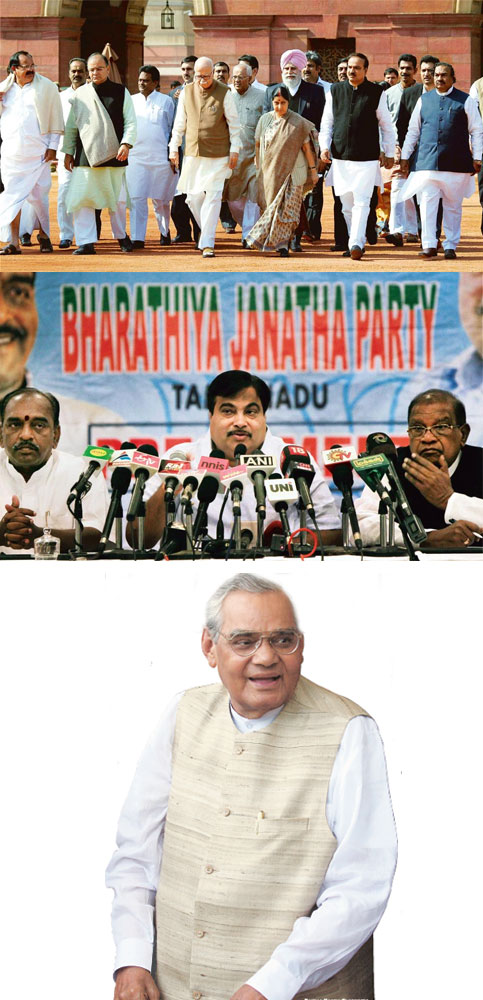
BJP is Brahmin Janata Party : Aakar Patel


The Bharatiya Janata Party (BJP) is sneeringly called the Brahmin-Baniya party, but this isn’t true. It is actually the party of Brahmins. BJP president Nitin Gadkari is Brahmin and so are the party’s leaders in both Lok Sabha (Sushma Swaraj) and Rajya Sabha (Arun Jaitley).

The BJP has always been a party of Brahmins. Founded in 1951 as Jana Sangh, the BJP’s first leader was Brahmin (Syama Prasad Mookerjee), its most important thinker was Brahmin (Deendayal Upadhyaya) and its most successful leader was Brahmin (Vajpayee).

The party’s top leadership is peppered with Brahmins (Murli Manohar Joshi, Ananth Kumar, Seshadri Chari, Kalraj Mishra, Bal Apte).
L.K. Advani is different, and from the Lohana caste.

The Brahmin gene is coded into the BJP by the Rashtriya Swayamsevak Sangh (RSS), whose founder (Hedgewar), most important thinker (Golwalkar), current leader (Bhagwat), and previous leader (Sudarshan) were Brahmin, as was the author of Hindutva (Savarkar).
Except for one man (Rajendra Singh), every RSS sarsanghchalak since its formation in 1925 has been Brahmin.

The RSS’ Hindi weekly Panchjanya is run by a Brahmin (Baldev Sharma) while English weekly Organiser stars the Brahmin duo of Jay Dubashi and M.V. Kamath. The BJP newspaper Kamal Sandesh is also edited by a Brahmin (Prabhat Jha).

The Bajrang Dal’s warriors are led by a Brahmin (Prakash Sharma). Even Bharatiya Mazdoor Sangh’s labourers are led by a Brahmin (Girish Awasthi). The Mazdoor Sangh’s leadership (see www.bms.org.in/representative.htm) is dominated by Brahmins, which is quite remarkable given India’s reality of caste in labour.

The RSS takes its Brahmins seriously and grooms them young. Student wing Akhil Bharatiya Vidyarthi Parishad is run by two Brahmins (Milind Marathe and Vishnudutt Sharma).

The organization’s female wing, Durga Vahini, is however run by a Brahmin (Mala Rawal).This concentration of Brahmins in central positions is for one reason: The Brahmin is the intellectual keeper of the Hindutva flame.


The Brahmin in caricature is wily when seen from the non-Brahmin perspective, and principled and uncompromising when seen from the Brahmin perspective. The Brahmin is also thought to be intellectual. But if intellectual means being open to ideas, he isn’t.

The word “ideologue” that our media uses for BJP leaders is correct. It must be understood in the narrow sense of holding a belief and not letting it go despite evidence. What is that belief? It is that India has one problem: Muslims.

The difference in orientation—Brahmin versus Baniya—shows in the priorities of the BJP and Congress.
The three big Congress ministers—Manmohan, Pranab and Chidambaram—are all economists. The three big BJP leaders—Advani, Swaraj and Jaitley—are none economically inclined.

We can read all 986 pages of Advani’s My Country, My Life and not encounter a thought or idea about his country’s illiteracy and poverty. Someone else will worry about them. Advani’s concerns are emotional—how Mother India is being ravaged by Muslims and Christians in Kashmir, Assam, North-East and so on.
The BJP isn’t interested in economics as a subject of politics, because Hindutva is not constructive but sullen. Though both Manu and Kautilya weigh in on it in their texts, economics has not been a Brahmin concern. The Brahmin’s concern has been keeping his identity pure.

The BJP’s electoral issues—Babri Masjid, Pakistan, uniform civil code and Article 370—are about identity. Specifically, about how Muslims must alter their behaviour. BJP social reform means demanding that others change.

The BJP’s ideology is not positive, in that it does not seek to create, but negative: Muslims should not keep that mosque, Muslims should not keep their civil law, Kashmir should not keep special status.

The BJP is the party of anger, and it represents our sentiment against Muslims, which is deep and universal. In that sense, the BJP has and will always have a larger constituency than the fifth it gets as its share of the vote.
The BJP represents Hindu chauvinism, which is quite ugly and which, as India grows muscular through the economy, the world will encounter with shock.

Like all parties in history that keep pointing to a minority as being the majority’s problem, the BJP’s leaders make their argument in reasonable terms.

The BJP’s rhetoric is calibrated and it always operates one notch below violence, though it understands what the consequences are. The BJP does the mischief and then steps back while violence visits Muslims and Christians.

In his autobiography Advani acquits himself of the murder of 3,000 Indians after his Rath Yatra by saying that the riots happened not along the Yatra’s trail, but elsewhere in India. The BJP sleeps comfortably with its actions, and the great Brahmin Kautilya teaches us in Arthashastra’s eighth chapter that citizens are expendable in the larger interest.

From Aakar Patel's analysis in livemint.com. More Here.

Wednesday, January 19, 2011

Two rapes, two media yardsticks


Perhaps nothing exposes media’s double standards better than the two recent cases of reporting involving two females: one in Bihar and other in Uttar Pradesh.
While media, electronic as well as print, rightly pursued the gang-rape story of a Nishad, an extremely backward caste girl in Uttar Pradesh it virtually blacked out a similar incident in Bihar, where ironically a Brahmin lady principal of school, Rupam Pathak, in her 40s, was allegedly raped several times by a BJP MLA and his aide.
There is one thing common in both the stories: the involvement of ruling party MLAs and their aides. While in UP the chief minister, Mayawati, at last got her own party’s Brahmin MLA arrested and the victim-girl released from jail when the media pursued the story in Bihar the media blacked-out the story so much that the victim woman had to take up the knife herself. On January 4 she stabbed to death the BJP MLA, Raj Kishore Kesri.
What is strange is that in case of UP even after Mayawati got Bahujan Samaj Party MLA Purushottam Naresh Dwivedi arrested, the media, especially the electronic channels, continued to criticize her for taking action one month later.
In Bihar Rupam, an upper caste educated woman had been undergoing trauma for last over three years, yet nobody dared to listen to her. At last when on April 18, 2010 she lodged an FIR against the MLA the deputy chief minister of Bihar, Sushil Kumar Modi, who is the senior most leader of the BJP in the state, dubbed her blackmailer. A Local English weekly of Purnea, the town of Rupam and the MLA, carried a story based on the FIR. The state media grossly underplayed it and the national channels never deemed it fit to give any space to it.
However, the charges levelled by Rupam Pathak were serious. Chief Minister Nitish Kumar, while on his visit to Purnea during Vishwas Yatra after this development, refused to share dais with the said MLA, (now late) Raj Kishore Kesri. However, his deputy Sushil Modi, while delivering his speech from the same dais openly defended the MLA making it loud and clear for the administration not to listen to the victim’s complaints. She was forced to withdraw her statement before the court.

From Soroor Ahmed's blog in newzfirst.com More Here

Wednesday, June 16, 2010

Who's afraid of Caste Census?


If caste census is done, the India democracy would thrive on the firm support of the lower castes who keep hoping of getting their share based on their numbers. The upper castes may feel desolate with the system of democracy itself, if this shift begins to take place. They might call such a shift “castocracy”. But would they call a state or a nation being ruled by women “womenocracy”?

Cognitive social psychology says all such theories are constructed on a convenience known as “comfort zone”. If brown upper castes live in white societies they see brown bashing but black bashing remains hidden in their blind spots. In white societies the browns are not in their comfort zone but in India they are and do not want to see the other’s “discomfort zone”.

Many upper caste intellectuals say that caste was a construction of the colonial census system. They talk as if caste never existed before the British started an enumerative process. By their logic we should come to the conclusion that before the British enumerated people based on religion, there were no religions in India. There are many such blind spots in India and that is why we still remain backward in theories of knowledge.

Let all castes — not just OBCs — be counted for strengthening our democratic system. I know that even mine is a blind-spot theory but it may have the effect of an antidote.

From veteran Dalit activist Kancha Ilaiah's comment in The Asian Age. More Here.

Tuesday, June 01, 2010

What if Rahul Gandhi marries a dalit girl?


Some times we ask to change only one part of our social machine. Parts have no independence actions; they are dependent on big Machines. Honor killing is just one bad product of that social machine of India. 

First abolish the unjust Caste system. If champions of social changes in our country start marrying Dalit families to break the taboos, picture will change. 

That is what Rahul Gandhi can not do. He can visit to condole every devastated family, he can distribute thousands of rupees, government jobs but he can not understand the social pressure under which Brahmin and Dalit families are living. Can Rahul Gandhi, Varun Gandhi, Son of Rajnath Singh, and sons and daughters of our political leaders and RSS leaders come to marry Dalit families? 

Many upper caste people are enjoying social celebrity status speaking for social problems on Televisions, writing in News Papers. This is like championing social reform from dead, burned and raped bodies of Dalits. They can not on Television after they break taboos in their own homes. They can not allow the change which they proclaim on television. 

No social reform can be delivered without recognizing Dalits as respectable Human beings. Give message to society from your homes first, not from TV Shows and New Papers. If people belonging to upper castes like Mishras, Sharmas, Bajpayees, Pathaks and so on start marrying Dalit families, it will be greater than what Raja Ram Mohan Roy had done in his period. Rahul Gandhi and Varun Gandhi and sons of Brahmin political leaders, media pundits, business tycoons and Bolywood set an example by marrying in Dalit familes. The change will happen across the society.

There are many bright matches from both sides but they are divided in two borders of social vertical and horizontal hierarchy. If common Brahmin families find heavy weight people of their society marrying Dalits and all castes without any castiest considerations, they will not fear to be condemned by their relatives. It is the fact that many Brahimn and upper caste families are willing to allow their children to marry whomever they wish to do regardless of caste and creed but they are under immense social pressure.

If heavy weight of Brahmins and other upper caste from politics, business, academics etc have Dalit spouses and brides in their homes, the social stigma will gradually go away. It is irony that people still love to tag their caste tags (Sharma, Warma, Pandaey, etc) with their names. Can they not get rid of it so that other persons of lower caste tags feel it easy to talk and interact with on equal basis? 

Why these people want to make them feel that he/she should take care of his/her caste tag. Once you tell him you are Sharma, the other person fells in inferiority complex. If we are any more civilized people we must throw out t these tags. Our degrees, talents, performance, social achievements are enough to be our identity. (see comments on Ashutosh Ashu's Face Book wall. below. courtesy to Ashu)

I agree with individual liberty. But how can you ensure individual liberty when individuals are chained in a rigid caste system? I am talking about why marrying a lower caste person is still an stigma. If champions of social changes in our society, who have large following across the caste do initiate, things will change. Parents of Nirupama would have allowed her, had they found it a 'common thing' which is being practiced people like like Ghandhis, Bajpyees, Sharmas, Pathakas and so on. To break the stereotypes, change will come from the society, not from the laws. If Brahimns do not feel it easy to marry in Dalits, no Dalit, however is he educated or wealthy, will remain untouchable.

From Omair Anas's thought provoking, amusing and interesting post in his blog
To read the full post click here.

Translate

Related Posts Plugin for WordPress, Blogger...