Pages

Thursday, December 02, 2010

A case of a Muslim reporter meeting a Muslim leader in jail!


Shahina K K, a journalist with Tehelka went to Karnataka to prepare an investigative report on the case on Abdul Nasar Madani, the Chairman of PDP. Madani had spend almost 10 years in Jail as an undertrial in the 1998 Coimbatore blast before he was let off without any charges on 1 August 2007. In her report ( Why is this man still in prison? , Tehelka Magazine, December 4th, 2010) Shahina tried to look into the police story that Madani had conspired in the Bengaluru blasts in separate meetings two years ago — one which took place in Madani’s rented home in Kochi and the other in the Lakkeri estate in Kodaku Karnataka.
Here, she not only talks of the reports about the many people who have questioned the police story - like James Varghese, the owner of Madani’s rented house in Kochi, and Madani’s brother Jamal Mohammed – but she also investigates the witnesses whose accounts have led the court to deny Madani bail. According to her investigations Shahina finds out that many of the witnesses have things to say that goes against the police story. For instance, Yoganand, a BJP worker whose testimony is recorded in the charge sheet, Shahina reports, does not even know that he is a witness in the Madani case !

Now this is a case of good investigative journalism, which has the power to unsettle the stories that are constantly being planted in the media by the police. However, just a few days after her report comes out, the Karnataka police slaps a case against Shahina under IPC 506, for “intimidating the witnesses.” No stretch of imagination allows one to view the attempt of a journalist to talk to the witnesses in a particular case as ‘intimidation.’ Yet, in this age of embedded journalism and paid news and the likes of Praveen Swamy and Burkha Dutt, this critical attempt at investigation which challenges a given police story, can easily be labeled thus and the journalist targeted. More importantly, Shahina’s case is further mediated through other important issues, which includes the political career of Abdul Nasar Madani, whose case she was investigating and her own identity as a Muslim woman.

Shahina’s attempt to investigate goes deep into the whole issue of how Abdul Nasar Madani, who holds a particular and important political position in Kerala, was incarcerated in jail for long years, without trail, and then acquitted with all charges against him unproved. This gross case of injustice was further extended when the police tried to implicate his wife Sufiya in the Bengaluru blasts that took place on 25th July 2008. Three months back, in spite of protests from various quarters in Kerala, Madani was arrested once again for conspiracy as one of the accused in the Bengaluru blasts. Later, his bail application was also dismissed considering what the court called the “nature and gravity of the offence.” The repercussions and the backlash on Shahina’s investigations are clearly connected to the case of Abdul Nazar Madani.

In fact, even to bring up the issue of Madani is to evoke anxieties about Islamic fundamentalism and terrorism. In the words of Charles Hirschkind and Saba Mahmood,
“a whole set of questionable assumptions, anxieties, and prejudices [are] embedded in the notion of Islamic fundamentalism.” (From their article: Feminism, the Taliban, and Politics of Counter-Insurgency.) This then is used as a bogey to deal with any kind of response, activity or political action from the location of a Muslim identity. However, no one worries that this political leader has been in jail for 10 long years without trail and that now, he is back in jail and being systematically denied bail. An issue that Shahina’s report addresses too, with its title: “Why is this man still in jail?” In fact, today, the question of terrorism and the Muslim can obfuscate all other questions about equality and justice. The Muslim, is caught in a construction that implicates him/her as inherently capable of terrorizing this country and therefore easily punishable. S/he is always already someone who can be easily pushed outside the ambit of the discourses of human rights and legal justice.

In fact, Madani is an important political voice in Kerala who addressed the question of Muslims and dalitbahujans after the Mandal-Masjid phenomenon of the 90s. Rooted in a discourse that drew from Islamic tenants, Madani’s vision focused on the inherent inequalities in Kerala society, both in terms of caste and religion. However his new political language was found 'deviant' and ignored or attacked by dominant discourses, mainly because of its allegiance to Islamic discourses and the Muslim identity. Thus Madani, who had been able to organize some of the most unprivileged sections in Kerala, is shorn of all his political credentials from within the stand point of the construction of the Muslim as the fundamentalist other of a Secular State/Culture.

The media has always stood strongly on the side of such dominant constructs all through the political career of Madani. Recently when his wife Soofiya Madani was alleged to have been involved in a conspiracy that led to the burning of a Tamil Nadu State Transport Corporation bus at Kalamassery, Kochi in September 2005, reports in the media found her guilty even before Judicial processes could start. Similarly we have seen the media conniving with the Police/State on other issues concerning the “others” of Kerala. One can recall the maligning of the Dalit Human Rights Groups (DHRM) as terrorists and the false case of Love Jihad, where young Muslim men were accused of converting Hindu women into Islam after starting romantic relationships with them. However, when in May 17, 2009 6 Muslim men from a fishing community were killed and 47 others injured (27 of them had bullet injuries) in a police firing in Beemapally, most of the Malayalam media kept completely silent about this incident, which was one of the most violent incidents of police oppression that Kerala had ever witnessed. All this are surely signs of the impunity with which the Malayalam media treats issues that are related to its “others,” especially the Muslim.

It is this entrenched attitude of the media that Shahina’s report tries to confront, head on. However, it is a Shahina who is doing this and not just another journalist; like Madani, she too is caught in the same issues that haunt the Muslim location and identity. In fact, Shahina herself has reported how, when she went to the village to investigate, she was stopped by the police and asked whether she was a terrorist. Many of the papers in Karnataka like Sakthi, Prajavani and Kannada also reported the incident as a “suspicious” visit by a “group of Muslims !” Here, just as Madani’s Islamic roots could tarnish the weight and importance of his political career, Shahina’s Muslim name could do away with all her other identities.

It is no wonder then that a report in the Mathrubhumi faithfully reports the police version that Shahina and the others in her group tried to “threaten” the witnesses. Such a report, without even a preliminary kind of investigation, quickly reiterates the police story, putting the blame squarely on Shahina’s shoulders. This is exactly how much of the media has behaved in the case of Madani too. In many ways, it was the media in Kerala that raised the alarm against Madani so high and shrill that it was so easy for the police to get him back in jail and keep him there. We need to think seriously about all these issues raised in connection to the Shahina case.

Surely, as Shahina writes in her status message in Facebook: “this is not a case against me as an individual, but it is a warning to the entire press community not to try to quash the cooked up stories by the police.” Moreover, this is also yet another instance where the complex and often oppressive relationship of the Indian state and the Muslim minority is clearly revealed - a relationship in which the media has always played a highly dubious and questionable role. It is not surprising then that Shahina’s alternative mediation, to investigate into this and to reveal the fissures within many of our consensus has met with such a reaction. It is important that we reflect on these issues and extend our support to Shahina and to Madani, who is still in jail, also as a result of all these various, anti-minority mediations.

From  When Two Muslims Meet: The Media(ted) Case Of Madani And Shahina an analysis by K Ashraf & Jenny Rowena in Countercurrents. More Here
Tehelka article here

Wednesday, December 01, 2010

Dr Omar Khalidi is no more!


Dr Omar Khalidi is no more. Inna lillahi wa inna ilaihi rajiwoon.
May Allah shower His utmost blessings on him and grant him a place in Jannat ul firdaus.
Aa meen.

He died in a road accident in Boston, United States on Monday 29th November, 2010. More Here

The following is one of the thought provoking articles he wrote.

The world community has rightly regarded Pakistan and Bangladesh as examples of theocratic states practicing policies of harsh discrimination against Hindus and other minorities. Sri Lanka’s Singhala-centric policies have generated gross discrimination against its Tamil citizens. Beyond India’s South Asian neighbourhood, numerous Islamic states such as Afghanistan and Saudi Arabia follow unjust policies toward minorities of all kinds that are an affront to civilized values everywhere and at all times. India in contrast is seen as a shining example of a secular state.
With the Republic Day just gone by, it is time to ask: But is India really a secular state?
I do not think so.
Political secularism may be defined as the separation of religious activities from those of the state, customarily referred to as "the separation of church and state" in the west. Secularism in theory then would mean that religion and state cannot occupy the same space. The state in its governmental capacity does not promote any religion or religious group, nor does it intervene in religious affairs. It cannot even be involved in interpretation or "reform" of any religion much less favour one over any other. This model of secularism may be characterized as maximum separation between state and religion except on manifest grounds of morality, health, and public order. Theoretical formulation, interpretation, and implementation of secularism have varied in several countries. In Indian context, the votaries of Hindutva equate it with appeasement of minorities, thus "pseudo-secularism." Apologists of Indian secularism call it "religious equi-distance, not non-involvement," meaning that Indian state is neutral between religions and religious communities.
I demonstrate that in practice, Indian state actually privileges Hinduism over other religions and religious communities. The Indian state is in fact the defender of the dharma for the following five reasons.

1: Constitutional Discrimination
Article 25 (2) of the constitution calls for providing "social welfare and reform and throwing open of Hindu religious institutions of public character to all classes and sections of Hindus." India’s constitution does not define who or what is a Hindu, but it defines followers of Buddhism, Jainism and Sikhism as Hindus for purposes of Hindu temple entry. Article 25 (2) (b) (Explanation II) states: "the reference to Hindus shall be construed as including a reference to persons professing the Sikh, Jaina or Buddhist religion…"
Isn’t this the concern of Brahmin establishment to allow or disallow whoever they deem fit to enter a temple? Why should a secular state be concerned with the social welfare of only one religion? The motive of the constitution writers was obvious: to prevent the conversion of Dalits to Christianity or Islam, to "reform" Hinduism to make it palatable to the former untouchables.
The Hindu Marriage Act of 1955 applies to
(a) any person who is a Hindu by religion in any of its forms and developments, including a Virashaiva, a Lingayat or follower of the Brahmo, Prarthana or Arya Samaj;
(b) to any person who is a Buddhist, Jain or Sikh by religion, and
(c) to any person domiciled in the territories who is not a Muslim, Christian, Parsi or Jew by religion.
In other words, legally there is no such thing as a Buddhist, Jain, or Sikh marriage, which is another attempt to deny other religions a distinctive identity and absorb them in the Hindu fold. The Office of the Registrar General that conducts the decennial census enumerates anyone who is not a Christian, Muslim or Parsi as Hindu, most particularly in tribal areas, in pursuance of a policy of Hindu by default to inflate the religious majority.
Article 290A of the Constitution, which was added in 1956, provides for Kerala state funds to be paid for the upkeep of Hindu temples and shrines in the territories of former princely state of Tranvancore. What state but a denominational one would spend government funds to promote a particular religion?
[As an aside, a forest has been destroyed in arguing for a uniform civil code as opposed to Muslim Personal Law and the issue of Haj subsidy. But perhaps I can save those issues for a full discussion at a different time]

2: Legislative Discrimination
Although freedom of religion is granted under the constitution’s Article 25 (1), a Congress government of Madhya Pradesh pioneered anti-conversion legislation during the heyday of Nehru in 1954. Since then as many as 7 state legislatures (Arunachal, Chhattisgarh, Gujarat, Himachal, Orissa, Rajasthan and Tripura) have passed laws severely restricting conversion from Hinduism to other religions while facilitating conversion to Hinduism.
In 1982, when a few hundred Dalits embraced Islam in Meenakshipuram, the central government took measures to curb conversions. No less than Indira Gandhi characterized conversions as a threat to national security.
Christian missions and churches have been under attack since decades, often with state complicity as demonstrated in August-September 2008 in Orissa and Karnataka.
Hundreds of mosques are in illegal possession nationwide including in New Delhi, where scores are occupied by the central government.
It was a Congress government that first locked up the Babari Mosque in 1949 by court order effectively converting it into a Hindu temple. What began under Nehru was successfully completed by Narasimha Rao in 1992 through the Mosque’s destruction under the very nose of army, paramilitary and police. It is ironic that the Indian state is ready to deploy army to flush out Sikh insurgents from Golden Temple and Muslim rebels from Charar-i Sharif, but not protect Babari Mosque from the Hindu mobs’ jack hammers.
The states of Gujarat and UP spent government funds to rebuild the Somanatha Temple around the same time when Babari Mosque was locked up. It was President Rajendra Prasad who inaugurated the rebuilt temple in 1951 amidst official fanfare.

3: Employment Discrimination
Article 16 (2) of the constitution prohibits discrimination in public employment on religious grounds. Yet there are numerous examples of outright discrimination. Per Presidential orders of 1950 and 1956 the beneficiaries of Scheduled Castes’ reservation can only be Hindus, Sikhs and Buddhists but not Christians and Muslims. If an SC changes religion after obtaining employment or admission to school, he or she must forfeit job and withdraw from school as has happened in numerous instances. But if the SC reverts to Hinduism, he or she can resume his/her status as an SC as courts have ruled.

Discrimination in Army
Right after 1947, Kashmir’s predominantly Hindu army was absorbed in the national army; whereas Hyderabad’s largely Muslim army was disbanded, rendering nearly 20,000 jobless. The Indian army’s infantry regiments are still based on religion (Sikh regiments), or ethnicity (Gorkha) or caste (Rajput) or region (Garhwal) in which members of other faiths, ethnicities, and regions are barred.
While a bearded Sikh may become chief of the army staff as did Gen. J.J. Singh, a Muslim may not sport beard in any of the armed forces. Only Jhatka is served in army messes and langers forcing Muslims to become vegetarian. A Hanuman temple greets visitors upon entering virtually every cantonment in the nation, hinting non-Hindus that they don’t belong there. In their public addresses to the soldiers and officers, at least two army chiefs—Generals B.C. Joshi and Shankar Roy Chowdhury—have used references to Hindu scriptures to the exclusion of the Quran and the Bible.

4: Cultural Discrimination
There are numerous examples where Hindu culture is conflated with Indian culture. The ban on cow slaughter deprived thousands of butchers their livelihood even as it stole millions of poor their only source of inexpensive protein. Cow may be sacred to the upper castes, but not so to the Christians, Dalits, and Muslims. Food taboos of some higher castes do not end at beef. Beyond beef, eggs may not be sold publicly by court order as it offends some caste sensibilities. Nor can school children bring food of their choice if it offends Hindus.
Official functions of the government whether at the central or state levels often commence with Hindu ceremonies of lighting lamps, breaking coconuts, and recitation of slokas. There is no disapproval to the fact that functions of central and state ministries of education begin with Sarasvati vandana .
In September 1993, Air India took delivery of a Boeing 747 in Seattle, Washington where the Ramakrishna Mission performed a puja invoking Lord Ganesha. Ministers lay foundation stones of government buildings preceded by bhoomi puja ceremony as if the state belongs only to Hindus. In Vishakhapatnam, I witnessed a ship launch amid saffron-robed, ashen faced sadhus singing bhajans, a function nearly mistaken as a Hindu festival.
In a trip to the United States in 1984, AP Chief Minister N.T. Ramarao found nothing objectionable in spending government funds for distributing medallions with Sri Venkateshwara’s image among potential investors in his state.
A large stone image of a reclining Vishnu located at the entrance to the IGP’s headquarters in Bangalore is more fitting for a temple than a secular state’s police building. Almost every police thana in West Bengal has a Kali temple, none has a mosque in a state with nearly 30 percent Muslim population. Muslim police trainees in Andhra Pradesh,
School children in Gujarat, Maharashtra and numerous other states have been forced to perform Surya namaskar against their will. Government school texts in Hindi and regional languages assume all pupils to be Hindu as the contents are soaked with idioms, phrases, signs, symbols, and icons of Hinduism to the exclusion of material from other religions and cultures. Textbooks of history and social studies are replete with gross distortions of Indian history of all eras, ancient, medieval and modern, in which Muslims and Christians are invariably the villains, traitors and foreigners.
Until the advent of television in the 1980s, All India Radio was the main source of information and entertainment to middle classes. The government-controlled AIR began its programs with Vande Mataram, Mangala dhwani, Vandana, and Hindu lyrics. Rarely did AIR broadcast anything pertaining to Christian or Muslim cultures. Like the AIR, during its heyday, seldom does Door Darshan show any serials of Muslim or Christian character. When it broadcasted serials of historical or literary figures—Tipu Sultan, Ghalib—they were caricatured into modern stock characters stripped of their distinctive cultural identity.

5: Religious Pogroms
Finally no modern, secular democracy other than India experienced multiple, state-sponsored pogroms—that of Sikhs in 1984 and of Muslims in 2002. In both instances, the highest in the Executive branch of the government justified the pogroms: Rajiv Gandhi when his mother was murdered; and Narendra Modi when the train burned in Godhra.

For all these five reasons, India is not a secular state. It is in fact the defender of Hindu dharma.

Source : Outlook 
Also read : Khaki and ethical violence in India
Also read : Remembering Omar Khalidi
Also read : Ummid's report on Dr Khalidi's published works

Thursday, November 25, 2010

A Suresh Kalmadi is an easy target than a Sharad Pawar

There is a Soviet silence on television these days. Beneath the noise of the 2G scam and the chaotic cacophony of Parliament lurks a deeper silence that haunts every minute of every channel. The decision to blank out the murky goings-on involving some of India's top names in journalism is a staggeringly significant one. To be sure, the silence pervades most of mainstream media but leaps out of television strikingly because of its tendency to pounce on stories of this kind. For television channels, otherwise willing to go to any lengths for the sake of eyeballs to collaborate with each other in this way is quite unprecedented, and therefore particularly revealing.

But some facts are undeniable. The authenticity of the recordings have not been seriously challenged. The conversations on record show that senior journalists go way beyond the brief of news gathering into news-making by brokering power. It is quite clear that corporate interests are actively injected into the framing of news coverage. Lobbyists do not seem to plead for favourable coverage but issue instructions to journalists, including senior editors. Which are willingly listened to and in some cases, followed.  And finally, when these facts come to light, almost all of media clamps down and blanks out any coverage whatsoever .
The clarifications issued by those allegedly involved so far have been terse and interestingly, have been largely focused on the internet, which is the only space where one can catch a glimpse of the widespread public outrage. Even here, none of the people concerned allow for any comments to be put on their sites. The attempt is to brazen it out by denying the existence of any problem in what amounts to an Orwellian erasure of the present. What we have here is in effect, a case of media issuing a massive vote of no-confidence in itself and in everything it professes belief in. The desire to pursue the freedom of expression and the public's right to know has evaporated the moment the object of scrutiny is the media itself.

It is important to listen to the recordings and not go only by the transcripts, for the tonality of these exchanges is quite revealing. There is an ease, a feeling of being on the same side that pervades conversations between the media and the powerful. The eagerness to please is evident as is the thrill of being part of the world of such important people.
In the last few years, journalists have become Big People who are most comfortable when dealing with other Big People. It is no coincidence that we have a 'summit' run by a media house that is underway and which carries photographs of ornate looking journalists mingling with the bejewelled power elite –described as 'the who's who enjoying free flowing conversation over a lavish spread of cocktails and sumptuous food'. Of course, this is hardly limited to any one media house — every media organisation worth its name has something similar — an event which is designed to get cosy with powerful people and glamorous celebrities. In a deeper, more fundamental way, the interests of the media and the power elite have begun to coincide. The media today is an exponent of power, rather than a watchdog over those who exercise power as it is a participant in the culture of celebrity rather than its critic.

As a consequence, the media rarely attacks the truly powerful. It uses its power to isolate the vulnerable and trains its guns at them. The really powerful politicians are rarely put to sword and critical stories about the rich are almost unheard of. The interests of a few are looked after and the successful media people in turn lead lives of sponsored magnificence. 

A cozy circle drives the media agenda — we see the same people on all the talk shows and it is no coincidence that a large number of them appear on these tapes. The illusion of media activism is created not by the incisiveness of the reportage but by its shrillness.  
A Suresh Kalmadi is much easier to attack than a Sharad Pawar and it takes no courage to go after Ruchika's molester. By going after easy targets and chasing symbolic issues rather than substantive ones, the media discourse is flattened; the aristocracy of banality flourishes even as it schmoozes with each other.

Whichever way you look at it, there is no justification for the media to black out this controversy. Of course, it must be careful about not casually besmirching the reputation of the individuals involved by ensuring that it uses the highest standards of fairness in its coverage. But to argue that the issue does not merit coverage is untenable. If it feels no reservations about covering sting operations, which are flagrant violations of the privacy of those involved, it can surely not hide behind the privacy fig leaf. If the silence is attributed to wanting to make absolutely sure that the tapes are authentic, then that principle should have been applied in other cases too. Also, no one has seriously challenged the authenticity of the tapes. And if, the silence is part of an unwritten code of protection that the media offers to itself, then it is time to dismantle that pact. Not only because it must treat itself in exactly the same way as it treats others but because it is the right thing to do.
From Santosh Desai's column in Times of India. More Here

Shining India, Crying India and Rahul Gandhi!


Rahul Gandhi, the general secretary of India’s Congress party, often says that there exist “two Indias” — one of the rich, and one of the poor.
Those two Indias were in evidence a couple of weeks ago, when closely timed events on opposite sides of the planet brought into relief the deep divides that in many ways define this country.

In Mumbai on Nov. 7, President Barack Hussain Obama told a group of students that India was no longer a “rising power,” but rather an “already risen” power. He celebrated an economy that “has risen at a breathtaking rate.”

Three days earlier, in New York, the United Nations released the 20th edition of its Human Development Report, a publication that has in many ways become the authoritative measure of poverty and deprivation.
India ranked 119th of 169 countries. The nation’s eight poorest states contain as many poor as the 26 poorest African countries combined. In terms of life expectancy and even gender inequality, India rates below its neighbors of Bangladesh and Pakistan.
None of these figures deny the remarkable strides India has made in recent years. But if India is indeed a risen power, then it has risen despite its terrible poverty — despite lingering inequality and despite widespread deprivation that has left millions in conditions that are almost medieval.

After nearly two decades of economic changes that were to have ushered in an era of prosperity, it is clear that in some ways the nation has been naïve: high growth rates alone cannot cure poverty.

The problem, as Anirudh Krishna, a political scientist at Duke University in North Carolina, and the author of a remarkable new study on poverty, put it to me, is that “poverty in India has become very resilient. The numbers hardly budge.”

Indeed, while official estimates suggest that poverty has declined since the advent of reforms, other recent studies suggest that it is in fact far more widespread than had been thought.

At least three government committees have been formed to count the poor in India. The variance in their findings — ranging from 37.2 percent to 77 percent — suggests not only the prevalence of poverty, but also that its very nature is misunderstood. For all the attention directed at the issue, poverty remains something of a mystery.

Mr. Krishna’s study, published in September as “One Illness Away: Why People Become Poor and How They Escape Poverty,” is in large part an effort to peel away the layers of this mystery. The outcome of a decade of work in five countries, and the result of conversations and surveys with more than 35,000 families, one of its chief goals — and accomplishments — is to flesh out our understanding of economic deprivation.
There are several insights in this book, but one of Mr. Krishna’s more important is that, as he writes, “poverty is not an undifferentiated mass living beneath some theoretical or statistical line.” It is, rather, a constantly churning pool of deprivation, with those who escape being replenished by a new population that has fallen from relative prosperity.

In a 25-year study he conducted in Andhra Pradesh State, for example, Mr. Krishna found that while 14 percent of households escaped poverty, another 12 percent became poor. Overall, there was a 2 percent reduction in the poverty rate, but 26 percent of households had seen their status change.

While working as a government officer, Mr. Krishna said, he frequently found that closely located villages, benefiting from the same welfare programs, nonetheless had widely divergent levels of development. This led him to conclude that “it’s not just a question of getting the program right; there’s something about a village that mattered.”

In other words, poverty, and its cures, are highly context sensitive. Welfare schemes can only succeed if they take account of local conditions.

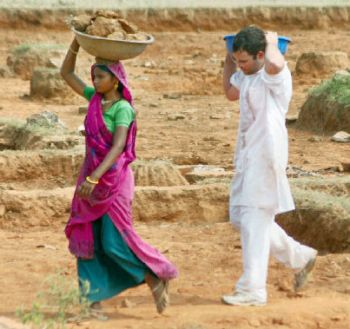
In practice, Mr. Krishna suggests that this means government programs need to include a strong degree of local control. They must be broad enough to work across nations and regions, but flexible enough to allow for local variance. As a model, he points to the Mahatma Gandhi National Rural Employment Guarantee Act, a public works program that allows villages to set their own priorities by choosing which projects receive government funds.

A few weeks ago, I wrote about the dangers of overly broad approaches to development, arguing that it was essential to stay close to the ground and focus on details. That argument is reinforced by Mr. Krishna’s work, which suggests the multiplicity of conditions included under the general rubric of poverty.

Like cancer, poverty is not a single disease. It is a scourge with many symptoms and causes. And it is for that reason that, also like cancer, it is so difficult to eradicate.

From Akash Kapoor's article in The New York Times. More Here

Barkha Dutt, Veer Sanghvi and Adolf Hitler

Translate

Related Posts Plugin for WordPress, Blogger...