Pages

Showing posts with label Akash Kapoor. Show all posts

Thursday, November 25, 2010

Shining India, Crying India and Rahul Gandhi!


Rahul Gandhi, the general secretary of India’s Congress party, often says that there exist “two Indias” — one of the rich, and one of the poor.
Those two Indias were in evidence a couple of weeks ago, when closely timed events on opposite sides of the planet brought into relief the deep divides that in many ways define this country.

In Mumbai on Nov. 7, President Barack Hussain Obama told a group of students that India was no longer a “rising power,” but rather an “already risen” power. He celebrated an economy that “has risen at a breathtaking rate.”

Three days earlier, in New York, the United Nations released the 20th edition of its Human Development Report, a publication that has in many ways become the authoritative measure of poverty and deprivation.
India ranked 119th of 169 countries. The nation’s eight poorest states contain as many poor as the 26 poorest African countries combined. In terms of life expectancy and even gender inequality, India rates below its neighbors of Bangladesh and Pakistan.
None of these figures deny the remarkable strides India has made in recent years. But if India is indeed a risen power, then it has risen despite its terrible poverty — despite lingering inequality and despite widespread deprivation that has left millions in conditions that are almost medieval.

After nearly two decades of economic changes that were to have ushered in an era of prosperity, it is clear that in some ways the nation has been naïve: high growth rates alone cannot cure poverty.

The problem, as Anirudh Krishna, a political scientist at Duke University in North Carolina, and the author of a remarkable new study on poverty, put it to me, is that “poverty in India has become very resilient. The numbers hardly budge.”

Indeed, while official estimates suggest that poverty has declined since the advent of reforms, other recent studies suggest that it is in fact far more widespread than had been thought.

At least three government committees have been formed to count the poor in India. The variance in their findings — ranging from 37.2 percent to 77 percent — suggests not only the prevalence of poverty, but also that its very nature is misunderstood. For all the attention directed at the issue, poverty remains something of a mystery.

Mr. Krishna’s study, published in September as “One Illness Away: Why People Become Poor and How They Escape Poverty,” is in large part an effort to peel away the layers of this mystery. The outcome of a decade of work in five countries, and the result of conversations and surveys with more than 35,000 families, one of its chief goals — and accomplishments — is to flesh out our understanding of economic deprivation.
There are several insights in this book, but one of Mr. Krishna’s more important is that, as he writes, “poverty is not an undifferentiated mass living beneath some theoretical or statistical line.” It is, rather, a constantly churning pool of deprivation, with those who escape being replenished by a new population that has fallen from relative prosperity.

In a 25-year study he conducted in Andhra Pradesh State, for example, Mr. Krishna found that while 14 percent of households escaped poverty, another 12 percent became poor. Overall, there was a 2 percent reduction in the poverty rate, but 26 percent of households had seen their status change.

While working as a government officer, Mr. Krishna said, he frequently found that closely located villages, benefiting from the same welfare programs, nonetheless had widely divergent levels of development. This led him to conclude that “it’s not just a question of getting the program right; there’s something about a village that mattered.”

In other words, poverty, and its cures, are highly context sensitive. Welfare schemes can only succeed if they take account of local conditions.

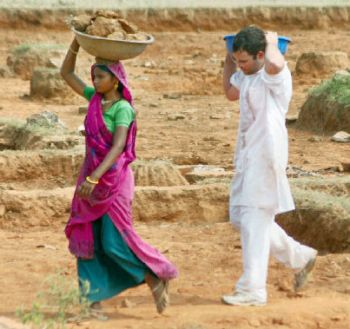
In practice, Mr. Krishna suggests that this means government programs need to include a strong degree of local control. They must be broad enough to work across nations and regions, but flexible enough to allow for local variance. As a model, he points to the Mahatma Gandhi National Rural Employment Guarantee Act, a public works program that allows villages to set their own priorities by choosing which projects receive government funds.

A few weeks ago, I wrote about the dangers of overly broad approaches to development, arguing that it was essential to stay close to the ground and focus on details. That argument is reinforced by Mr. Krishna’s work, which suggests the multiplicity of conditions included under the general rubric of poverty.

Like cancer, poverty is not a single disease. It is a scourge with many symptoms and causes. And it is for that reason that, also like cancer, it is so difficult to eradicate.

From Akash Kapoor's article in The New York Times. More Here

Friday, May 28, 2010

India's urban nightmare: Building inclusive cities, sustaining Economic growth


My brother-in-law was caught in an evening downpour in Bangalore not long ago. He was on a scooter, on his way home, and he found himself struggling through streets where water reached to his thighs. The city’s drains were overwhelmed. He was driving through a mix of rain and sewage.

At one particularly deep point, the water rose above his engine. His scooter sputtered. He swallowed a mouthful. About a week later, he developed jaundice. He wasn’t sure what caused it, but the doctors were certain of one thing: the sewage water he consumed couldn’t have helped.

I’ve written before about the deplorable state of Indian cities. My brother-in-law’s experience may have been egregious, but anyone who has spent time in urban India would recognize the basic elements of his story: a collapse of municipal infrastructure, chaotic roads, an environment filled with health hazards.

By virtually any measure, the quality of life in Indian cities is abysmal. Only 60 percent of municipal waste is collected. Just 30 percent of urban sewage is treated. According to a recent government study of 127 cities, 80 percent of them had at least one pollutant that exceeded air quality standards.

A few decades ago, when the vast majority of Indians lived in the countryside and when agriculture represented around a third of national income, all of this would perhaps have been cause for less concern. But today, with India rapidly urbanizing, moving to an economy where services represent more than half of gross domestic product, cities matter a lot more. They represent both the tremendous possibility of India, but also potential bottlenecks in its development.

A study released last month by McKinsey, the consulting firm, does a good job of capturing the critical role played by Indian cities. The report, titled “India’s Urban Awakening: Building Inclusive Cities, Sustaining Economic Growth,” contains an acute analysis of the opportunities and challenges presented by urban India.
As one would expect from a McKinsey study, the number-crunching is impressive — and the numbers themselves staggering. Between now and 2030, the report estimates, 250 million Indians will migrate to the cities, a figure that exceeds the current total population of all but three countries (China, India and the United States). As a result, India will have 68 cities with populations of more than one million (compared with 35 in all of Europe today).

Migration on that scale represents tremendous economic opportunity. The report’s authors calculate that, over the next 20 years, 70 percent of new jobs in India will be in urban areas and that the cities’ share of gross domestic product will rise to 70 percent from 58 percent. Fulfilling that potential, however, depends on managing the transformation well. And, given India’s abysmal record when it comes to even relatively modest rates of urbanization over the past few decades, the coming urban wave could just as well spell disaster as opportunity.

Shirish Sankhe, the report’s lead author, told me that the overarching message of the report was this: “India can basically take two paths. One path is the urban reform path, and one is the status quo path. One path leads to chaos and urban gridlock. The other can add up to 1.5 percent to G.D.P.”

In Mr. Sankhe’s view, there are two main challenges to the “reform path” — governance and financial. Perhaps surprisingly, the financial challenges appear less daunting. Although the sums of money required to modernize Indian cities are huge (around $10 billion a year, more than three times current levels of investment), the report argues that many of these funds can be generated by cities themselves through more efficient property taxes, unlocking the value of land assets and raising prices for things like water supply, mass transit and sewage treatment.

From Akash Kapoor's write up in The New York Times
To read the full write up click here

Saturday, May 08, 2010

The commercialization of the Indian media


PONDICHERRY, INDIA — A businessman I know was approached by representatives of a leading Indian national newspaper and offered a deal: Give us a stake in your company, and we’ll give you advertising space and favorable editorial coverage.

A publisher told me that she received a similar proposition: Pay us, and we’ll interview your authors and write features about them. Rumors about shady practices — unethical, possibly illegal — in the Indian media have circulated for years. Over the past year or so, and especially since the 2009 parliamentary elections, when the sale of media space was reported to have reached new heights, the issue has drawn more attention.

The commercialization of the Indian media takes many forms. It has been known for some time that a few of India’s leading media conglomerates — including Bennett, Coleman & Co., the publisher of The Times of India and The Economic Times — offer what that company calls “innovative” and “integrated” marketing strategies that blur the traditional line between advertising and article content. Bennett, Coleman’s Medianet division, for example, lets advertisers place articles on certain pages in the paper without clearly marking them as advertising.

One of the company’s more aggressive offerings is a product known as a Private Treaty, which offers companies a certain amount of advertising space in exchange for equity stakes in those companies. According to the Private Treaties Web site, Bennett, Coleman now holds such equity stakes in more than 100 companies. Officially, the companies are only given advertising space. But at least one businessman confirmed to me that it was made clear that he could also expect favorable news coverage.

At the very least, it seems evident that Private Treaties set up a very serious conflict of interest, a point highlighted last year when the Indian stock market regulator, the Securities and Exchange Board of India, wrote a letter to the chairman of the Press Council expressing concern about the business practice.
Private Treaties are an example of the commodification of business news. But much of the recent attention in India has focused on paid political content. Over the past year or so, there have been a growing number of reports of politicians paying media houses for favorable coverage or to skirt restrictions on campaign financing.


P. Sainath, the rural affairs editor of The Hindu, a national newspaper, has been instrumental in drawing attention to such practices. In a series of articles on elections in Maharashtra State last year, Mr. Sainath listed specific prices for different kinds of articles.

From Akash Kapoor's Letter from India in The New York Times
To read the full article click here

Translate

Related Posts Plugin for WordPress, Blogger...