Pages

Showing posts with label Nuclear plants. Show all posts

Monday, March 12, 2012

Nuclear power plants of Japan closed forever

THE LIGHTS ARE not going off all over Japan, but the nuclear power plants are. Of the 54 reactors in those plants, with a combined capacity of 47.5 gigawatts (GW, a thousand megawatts), only two are operating today. A good dozen are unlikely ever to reopen: six at Fukushima Dai-ichi, which suffered a calamitous triple meltdown after an earthquake and tsunami on March 11th 2011 (pictured above), and others either too close to those reactors or now considered to be at risk of similar disaster. The rest, bar two, have shut down for maintenance or “stress tests” since the Fukushima accident and not yet been cleared to start up again. It is quite possible that none of them will get that permission before the two still running shut for scheduled maintenance by the end of April.

Japan has been using nuclear power since the 1960s. In 2010 it got 30% of its electricity from nuclear plants. This spring it may well join the ranks of the 150 nations currently muddling through with all their atoms unsplit. If the shutdown happens, it will not be permanent; a good number of the reactors now closed are likely to be reopened. But it could still have symbolic importance. To do without something hitherto seen as a necessity opens the mind to new possibilities. Japan had previously expected its use of nuclear energy to increase somewhat. Now the share of nuclear power in Japan’s energy mix is more likely to shrink, and it could just vanish altogether.

In most places any foretaste of that newly plausible future will barely be noticed. Bullet trains will flash on; flat panels will continue to shine; toilet seats will still warm up; factories will hum as they hummed before. Almost everywhere, when people reach for the light switches in their homes, the lights will come on. But not quite everywhere. In Futaba, Namie and Naraha the lights will stay off, and no factories will hum: not for want of power but for want of people. The 100,000 or so people that once lived in those and other towns close to the Fukushima Dai-ichi nuclear power plant have been evacuated. Some 30,000 may never return. The triple meltdown at Fukushima a year ago was the world’s worst nuclear accident since the disaster at Chernobyl in the Ukraine in 1986. The damage extends far beyond a lost power station.
Oliver Morton in The Economist. Here

Sunday, September 25, 2011

People's power Vs Nuclear power


The broad-based ‘struggle committee’ against KNPP, spearheaded by anti-nuclear activists, S P Udhyakumar and Anton Gomez, have just ended a heroic 12-day long fast, thanks to a politically sagacious Chief Minister J Jayalalitha passing a Cabinet resolution, urging Prime Minister Manmohan Singh to suspend all work at KNPP until the local people’s apprehensions are fully allayed.

Equally, what turned the nation’s eyes towards an obscure ‘pandal’ overlooking the 110-year-old Saint Lourdes catholic church, the fasting venue at Idinthakarai coastal hamlet, 2 km north of the KNPP site, was the sudden upsurge of thousands of people from neighbouring districts including children and disabled, whose solidarity for the fasters bellowed like the boiling sea along this fragile 2004 tsunami-hit coastal stretch.

How come a motley crowd of fasters in a little known village suddenly took centre-stage? It cannot all be put down to anti-nuclear NGOs’ getting hyper-active overnight or committed social activists like Medha Patkar visiting them on a morale-boosting mission.
‘The affected people’s emotive response looks sudden, but this has been simmering from the late 1980s’,” says Father James Peter, pastor of a local parish. “Irrespective of caste, creed or religion, it is now a people’s fight for their survival and cultural identity,” he said.
A report in Deccan Herald. Here

Thursday, June 09, 2011

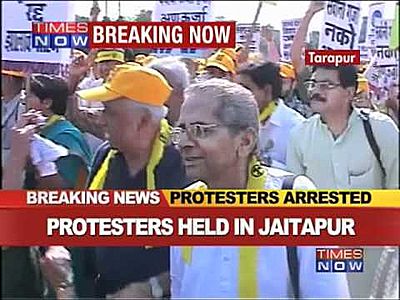
The March from Tarapur to Jaitapur


One thing is clear – anti-nuclear struggles are at present on the rise. On 26 March 2011, a silent demonstration of about 700 activists took place in Kudankulam in Tamil Nadu. The first two 1,000 MW reactors of this plant with Russian VVER-1000 technology are supposed to go critical in June. This is likely to be delayed, as the Coastal Regulation Zone clearance has not been obtained. The contract for this plant goes back to the 1980s and the process was held up due to the disintegration of the Soviet Union. Around two years ago, the prime minister announced proudly the acquisition of Russian submarines, which could keep safe our nuclear war heads. These submarines were indeed the reason why we bargained for a technology which was thought to be less safe than the Chernobyl type reactor before Chernobyl happened.

In the mean time, the people of Kudankulam can look forward to six such reactors. The fishing community has consistently protested and the final leg of the Coastal March of the NFF “Protect Waters Protect Life” ended in a shoot-out by the police, in which six fishermen were gravely injured on 1 May 1989 in Kanyakumari (Dietrich 1989). Today, fishermen’s organisations in Kerala are expressing their resistance against the Kudankulam project as well. The protest by the inland population has risen on and off, but has remained rather subdued.

In West Bengal, the struggle against the Haripur nuclear plant has a long-standing history and since recently, even Prakash Karat of the CPI-M has ventilated doubts whether this is the right place for such a project. The proposed Gorakhpur nuclear power plant at Fatehabad district in Haryana has been described as “Nuclear Madness at Delhi’s Doorsteps” by Bharat Jan Vigyan Jatha and Delhi Platform. Representatives of all these struggles were present in the march from Tarapur to Jaitapur.
To sell nuclear options as a solution to global warming and an anti-dote to peak oil is a blatant absurdity. However, the neo-liberal ruling classes are doing just that. The Germans, living on after two world wars, feel a greater sense of urgency to review their options and a southern state Baden-Württemberg, has just elected the Greens to power, after having been run by the Christian Democrats for 58 years. Yet, the fact that Japan is now queuing up to sell its nuclear technology abroad, shows how very difficult it is to get rid of the spectre of devastation. In order to break out of the vicious circle of denial, we need a much deeper analysis of the neo­colonial process of globalisation. The connection between energy options and warfare has to be recognised. The present approach towards growth, extraction and devastation of nature and human communities needs a drastic change. For this, the unorganised workers, peasants, subsistence producers, forest dwellers, dalits, adivasis, women, and indigenous people in the north-east need to build alliances. The ongoing warfare against the internal colonies has to be seen eye to eye. The marchers got a mild taste of this internal warfare. The anti-nuclear struggle is the tip of an iceberg, and we need less wasteful, less destructive and decentralised energy options. It is difficult to think these options today, but how many Fukushimas do we need to rekindle our imagination?
Gabriele Dietrich in Economic and Political Weekly. Here

Translate

Related Posts Plugin for WordPress, Blogger...