Pages

Showing posts with label Nuclear crisis. Show all posts

Thursday, June 09, 2011

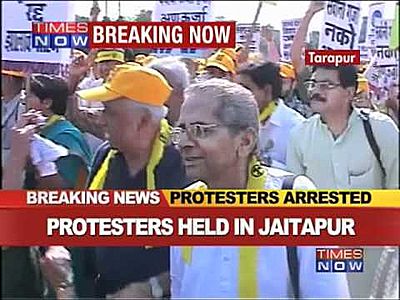
The March from Tarapur to Jaitapur


One thing is clear – anti-nuclear struggles are at present on the rise. On 26 March 2011, a silent demonstration of about 700 activists took place in Kudankulam in Tamil Nadu. The first two 1,000 MW reactors of this plant with Russian VVER-1000 technology are supposed to go critical in June. This is likely to be delayed, as the Coastal Regulation Zone clearance has not been obtained. The contract for this plant goes back to the 1980s and the process was held up due to the disintegration of the Soviet Union. Around two years ago, the prime minister announced proudly the acquisition of Russian submarines, which could keep safe our nuclear war heads. These submarines were indeed the reason why we bargained for a technology which was thought to be less safe than the Chernobyl type reactor before Chernobyl happened.

In the mean time, the people of Kudankulam can look forward to six such reactors. The fishing community has consistently protested and the final leg of the Coastal March of the NFF “Protect Waters Protect Life” ended in a shoot-out by the police, in which six fishermen were gravely injured on 1 May 1989 in Kanyakumari (Dietrich 1989). Today, fishermen’s organisations in Kerala are expressing their resistance against the Kudankulam project as well. The protest by the inland population has risen on and off, but has remained rather subdued.

In West Bengal, the struggle against the Haripur nuclear plant has a long-standing history and since recently, even Prakash Karat of the CPI-M has ventilated doubts whether this is the right place for such a project. The proposed Gorakhpur nuclear power plant at Fatehabad district in Haryana has been described as “Nuclear Madness at Delhi’s Doorsteps” by Bharat Jan Vigyan Jatha and Delhi Platform. Representatives of all these struggles were present in the march from Tarapur to Jaitapur.
To sell nuclear options as a solution to global warming and an anti-dote to peak oil is a blatant absurdity. However, the neo-liberal ruling classes are doing just that. The Germans, living on after two world wars, feel a greater sense of urgency to review their options and a southern state Baden-Württemberg, has just elected the Greens to power, after having been run by the Christian Democrats for 58 years. Yet, the fact that Japan is now queuing up to sell its nuclear technology abroad, shows how very difficult it is to get rid of the spectre of devastation. In order to break out of the vicious circle of denial, we need a much deeper analysis of the neo­colonial process of globalisation. The connection between energy options and warfare has to be recognised. The present approach towards growth, extraction and devastation of nature and human communities needs a drastic change. For this, the unorganised workers, peasants, subsistence producers, forest dwellers, dalits, adivasis, women, and indigenous people in the north-east need to build alliances. The ongoing warfare against the internal colonies has to be seen eye to eye. The marchers got a mild taste of this internal warfare. The anti-nuclear struggle is the tip of an iceberg, and we need less wasteful, less destructive and decentralised energy options. It is difficult to think these options today, but how many Fukushimas do we need to rekindle our imagination?
Gabriele Dietrich in Economic and Political Weekly. Here

Thursday, April 28, 2011

Nuclear power can never be made safe, never.

Victims of Chernobyl

With the ongoing disaster at the Fukushima nuclear plant in Japan, some people ask: can nuclear power be made safe? The answer is no. Nuclear power can never be made safe.
This was clearly explained by Admiral Hyman Rickover, the "father" of the U.S. nuclear navy and in charge of construction of the first nuclear power plant in the nation, Shippingport in Pennsylvania. Before a committee of Congress, as he retired from the navy in 1982, Rickover warned of the inherent lethality of nuclear power -- and urged that "we outlaw nuclear reactors."
The basic problem: radioactivity.

"I'll be philosophical," testified Rickover. "Until about two billion years ago, it was impossible to have any life on Earth; that is, there was so much radiation on earth you couldn't have any life -- fish or anything." This was from naturally-occurring cosmic radiation when the Earth was in the process of formation. "Gradually," said Rickover, "about two billion years ago, the amount of radiation on this planet ... reduced and made it possible for some form of life to begin."

"Now, when we go back to using nuclear power, we are creating something which nature tried to destroy to make life possible," he said. "Every time you produce radiation" a 'horrible force' is unleashed. By splitting the atom, people are recreating the poisons that precluded life from existing. "And I think there the human race is going to wreck itself," Rickover stated.

This was Rickover, a key figure in nuclear power history, not Greenpeace.

The problem is radioactivity -- unleashed when the atom is split. And it doesn't matter whether it's a General Electric boiling water reactor such as those that have erupted at Fukushima, or the Westinghouse pressurized water design, or Russian-designed plants like Chernobyl, or the "new, improved" nuclear plants being touted by U.S. Energy Secretary Steven Chu, a nuclear scientist and zealous promoter of nuclear technology. All nuclear power plants produce radiation as well as radioactive poisons like the Cesium-137, Iodine-131 and Strontium-90 that have been -- and continue to be -- spewed from the Fukushima plants.
Upon contact with life, these toxins destroy life. So from the time they're produced in a nuclear plant to when they're taken out as hotly radioactive "nuclear waste," they must be isolated from life -- for thousands, for some millions of years.

Karl Grossman in The Huffington Post. More Here

Friday, April 22, 2011

From Tarapur to Jaitapur: People's Yatra against nuclear plants


After the Fukushima incident in Japan, the anti nuclear movement has geared up in India too. Members of civil society, activists, educationists and journalists have come together to voice their opinion against the nuclear plants in India.

A national yatra has been decided from 23 to 25 April, from Tarapur to Jaitapur. A National Committee has been formed to lead this YATRA, comprising of: Radha Bhatt, Delhi (Convenor), Prof. Banwarilal Sharma, Allahabad, Vandana Shiva, Delhi, Praful Bidwai, Delhi, Bhai Vaidya, Pune and N. D. Patil, Mumbai

The accident at Fukushima has forced many countries to rethink their nuclear programs. However, the government of India is hell-bent on pursuing its nuclear power expansion program, including setting up a string of nuclear plants all along India's coast. The biggest of these is coming up in the earthquake-prone region of Jaitapur, in Ratnagiri district of Maharashtra. India's scientists are making the hilarious claim that India's safety standards are better than Japan's and that there is no cause to fear.

India's reactors are considered to be the most inefficient and dangerous in the world. And now we are importing reactors from the notorious French corporation Areva for the Jaitapur nuclear plant. These reactors are so dangerous that even pro-nuclear countries like the USA and UK have refused to give design clearance to this reactor. If there is a major accident at Jaitapur, the entire Ratnagiri district will have to be evacuated, permanently, and entire Western Maharashtra, including Pune and Mumbai would be radioactively contaminated! For tens of thousands of years.

This people’s initiative demands the government of India to:
  1. Scrap the Jaitapur nuclear power project! Scrap all new nuclear
  2. power plants!!
  3. End the reign of terror in Jaitapur area!
  4. Invest massively in energy saving and development of renewable
    technologies!
The yatra will begin tomorrow from Tarapur and will cover Mangaon ,Hiplun and Ratnagiri. This will conclude on 25th. Prof. Anil Sadgopal (Bhopal), Dr. S. P. Udaykumar (Nagercoil), Prof. Haragopal (Hyderabad), Soumya Dutta (Delhi), Rajiv Lochan Shah (Nainital), Shamsher Singh Bisht (Uttarakhand), Father Thomas Kocherry (Trivandrum), Mathani Saldhana (Goa), Dunu Roy (Delhi), Satinath Sarangi (Bhopal), Nityanand Jayaraman (Chennai), Prof. Trilochan Shastri (Bangalore) and many others will be attending the yatra.

More Here

Thursday, April 07, 2011

Fukushima : worldwide implications and global crisis


For several weeks, radioactive leaks from the Fukushima nuclear power plants have been incapacitating a large part of Japan. Information from the Japanese government and TEPCO, the power company that operates the site, has been sparse, often incomplete and sometimes contradictory. A confidential assessment by the Nuclear Regulatory Commission obtained by The New York Times suggests that the damaged Fukushima Daiichi plant is far from stable. The report concludes that the Fukushima plant is facing a wide array of fresh threats that could persist indefinitely.

The Fukushima disaster has become more than a local, regional or national Japanese event. The worldwide implications of the event are becoming apparent: though a major leak in a maintenance pit of the plant has been plugged, there is still a great likelihood that significant amounts of radioactive water will continue to be released into the Pacific Ocean; the worldwide Just-In-Time manufacturing cycle has been interrupted; and increased levels of radiation have been detected on the U.S. East Coast. Though the amount of radiation to reach the U.S. is small and poses no present danger, its presence demonstrates that the Fukushima event has global impact.

Circumstances are still evolving too fast and too out-of-control for the consequences to be fully appreciated in real time. Every day brings new revelations of failure and growing frustration in Japan and elsewhere. It has become obvious that not all the facts about the Fukushima tragedy will be known until the danger is long past.
In Japan, there continues to be uncertainty about the extent of the danger from radiation exposure and lack of information about how many people have already been exposed to health-impairing radiation. We don't know how much contamination has leaked into surrounding land and water or when and how those leaks can be repaired.

The Japanese government announced an evacuation zone extending 19 miles from the crippled Fukushima plants, the same distance as the exclusion zone around Chernobyl in Ukraine. But Japan is neither as large or as sparsely populated as Ukraine. Close to 73 percent of Japan is unsuitable for agricultural, industrial, or residential use. Millions of people could be dislocated in addition to those already homeless because of the quake. These people will need to be relocated and new homes will have to be created for them.

With the international challenge of wars in Iraq, Afghanistan and Libya, and national concerns about Congress being unable to agree on Federal Government funding, the U.S. news spotlight that was on Fukushima has been pointed elsewhere.

Stephen Brozak and Henry Bassman in abcnews. More Here

Sunday, March 20, 2011

Do we need nuclear power in India? At what cost?


The nuclear power emergency in Japan has raised two major questions regarding nuclear power.

First, can a disaster comparable to the one in Japan happen here? The answer, of course, is yes — whether caused by an earthquake or some other event or series of events. Nature is unpredictable and human beings are fallible. It could happen.

So the second question is whether it makes sense to follow through on plans to increase our reliance on nuclear power, thus heightening the risk of a terrible problem occurring here. Is that a risk worth taking?

There has been a persistent tendency to ignore the toughest questions posed by nuclear power: What should be done with the waste? What are the consequences of a catastrophic accident in a populated area? How safe are the plants, really? Why would taxpayers have to shoulder so much of the financial risk of expanding the nation’s nuclear power capacity, an effort that would be wildly expensive?

A big part of the problem at Japan’s Fukushima Daiichi power station are the highly radioactive spent fuel rods kept in storage pools at the plant. What to do, ultimately, with such dangerous waste material is the nuclear power question without an answer. Nuclear advocates and public officials don’t talk about it much. Denial is the default position when it comes to nuclear waste.

In New York, Gov. Andrew Cuomo said again this week that the 40-year-old Indian Point nuclear power plant in Westchester County, 35 miles north of New York City, should be closed. Try to imagine the difficulty, in the event of an emergency, of evacuating such an area with its millions of residents. “This plant in this proximity to New York City was never a good risk,” said the governor.

There are, blessedly, very few catastrophic accidents at nuclear power plants. And there have not been many deaths associated with them. The rarity of such accidents provides a comfort zone. We can look at the low probabilities and declare, “It can’t happen here.”

But what if it did happen here? What would the consequences be?
If Indian Point blew, how wide an area and how many people would be affected, and what would the cleanup costs be? 
Rigorously answering such questions is the only way to determine whether the potential risk to life and property is worthwhile.

The 104 commercial nuclear plants in the U.S. are getting old, and many have had serious problems over the years. There have been dozens of instances since 1979, the year of the Three Mile Island accident, in which nuclear reactors have had to be shut down for more than a year for safety reasons.

Building new plants can be breathtakingly expensive and requires government loan guarantees. Banks are not lining up to lend money on their own for construction of the newest generation of Indian Points.

In addition to the inherent risks with regard to safety and security, the nuclear industry has long been notorious for sky-high construction costs, feverish cost-overruns and projects that eventually are abandoned.

Nuclear power is hardly the pristine, economical, unambiguous answer to the nation’s energy needs and global warming concerns. It offers benefits and big-time shortcomings. Ultimately, the price may be much too high.

Bob Herbert in The New York Times. More Here.
Translate

Related Posts Plugin for WordPress, Blogger...