Pages

Showing posts with label Tarapur. Show all posts

Thursday, June 09, 2011

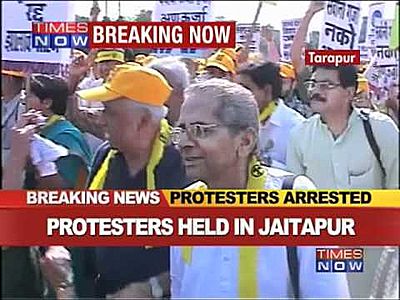
The March from Tarapur to Jaitapur


One thing is clear – anti-nuclear struggles are at present on the rise. On 26 March 2011, a silent demonstration of about 700 activists took place in Kudankulam in Tamil Nadu. The first two 1,000 MW reactors of this plant with Russian VVER-1000 technology are supposed to go critical in June. This is likely to be delayed, as the Coastal Regulation Zone clearance has not been obtained. The contract for this plant goes back to the 1980s and the process was held up due to the disintegration of the Soviet Union. Around two years ago, the prime minister announced proudly the acquisition of Russian submarines, which could keep safe our nuclear war heads. These submarines were indeed the reason why we bargained for a technology which was thought to be less safe than the Chernobyl type reactor before Chernobyl happened.

In the mean time, the people of Kudankulam can look forward to six such reactors. The fishing community has consistently protested and the final leg of the Coastal March of the NFF “Protect Waters Protect Life” ended in a shoot-out by the police, in which six fishermen were gravely injured on 1 May 1989 in Kanyakumari (Dietrich 1989). Today, fishermen’s organisations in Kerala are expressing their resistance against the Kudankulam project as well. The protest by the inland population has risen on and off, but has remained rather subdued.

In West Bengal, the struggle against the Haripur nuclear plant has a long-standing history and since recently, even Prakash Karat of the CPI-M has ventilated doubts whether this is the right place for such a project. The proposed Gorakhpur nuclear power plant at Fatehabad district in Haryana has been described as “Nuclear Madness at Delhi’s Doorsteps” by Bharat Jan Vigyan Jatha and Delhi Platform. Representatives of all these struggles were present in the march from Tarapur to Jaitapur.
To sell nuclear options as a solution to global warming and an anti-dote to peak oil is a blatant absurdity. However, the neo-liberal ruling classes are doing just that. The Germans, living on after two world wars, feel a greater sense of urgency to review their options and a southern state Baden-Württemberg, has just elected the Greens to power, after having been run by the Christian Democrats for 58 years. Yet, the fact that Japan is now queuing up to sell its nuclear technology abroad, shows how very difficult it is to get rid of the spectre of devastation. In order to break out of the vicious circle of denial, we need a much deeper analysis of the neo­colonial process of globalisation. The connection between energy options and warfare has to be recognised. The present approach towards growth, extraction and devastation of nature and human communities needs a drastic change. For this, the unorganised workers, peasants, subsistence producers, forest dwellers, dalits, adivasis, women, and indigenous people in the north-east need to build alliances. The ongoing warfare against the internal colonies has to be seen eye to eye. The marchers got a mild taste of this internal warfare. The anti-nuclear struggle is the tip of an iceberg, and we need less wasteful, less destructive and decentralised energy options. It is difficult to think these options today, but how many Fukushimas do we need to rekindle our imagination?
Gabriele Dietrich in Economic and Political Weekly. Here

Friday, April 22, 2011

From Tarapur to Jaitapur: People's Yatra against nuclear plants


After the Fukushima incident in Japan, the anti nuclear movement has geared up in India too. Members of civil society, activists, educationists and journalists have come together to voice their opinion against the nuclear plants in India.

A national yatra has been decided from 23 to 25 April, from Tarapur to Jaitapur. A National Committee has been formed to lead this YATRA, comprising of: Radha Bhatt, Delhi (Convenor), Prof. Banwarilal Sharma, Allahabad, Vandana Shiva, Delhi, Praful Bidwai, Delhi, Bhai Vaidya, Pune and N. D. Patil, Mumbai

The accident at Fukushima has forced many countries to rethink their nuclear programs. However, the government of India is hell-bent on pursuing its nuclear power expansion program, including setting up a string of nuclear plants all along India's coast. The biggest of these is coming up in the earthquake-prone region of Jaitapur, in Ratnagiri district of Maharashtra. India's scientists are making the hilarious claim that India's safety standards are better than Japan's and that there is no cause to fear.

India's reactors are considered to be the most inefficient and dangerous in the world. And now we are importing reactors from the notorious French corporation Areva for the Jaitapur nuclear plant. These reactors are so dangerous that even pro-nuclear countries like the USA and UK have refused to give design clearance to this reactor. If there is a major accident at Jaitapur, the entire Ratnagiri district will have to be evacuated, permanently, and entire Western Maharashtra, including Pune and Mumbai would be radioactively contaminated! For tens of thousands of years.

This people’s initiative demands the government of India to:
  1. Scrap the Jaitapur nuclear power project! Scrap all new nuclear
  2. power plants!!
  3. End the reign of terror in Jaitapur area!
  4. Invest massively in energy saving and development of renewable
    technologies!
The yatra will begin tomorrow from Tarapur and will cover Mangaon ,Hiplun and Ratnagiri. This will conclude on 25th. Prof. Anil Sadgopal (Bhopal), Dr. S. P. Udaykumar (Nagercoil), Prof. Haragopal (Hyderabad), Soumya Dutta (Delhi), Rajiv Lochan Shah (Nainital), Shamsher Singh Bisht (Uttarakhand), Father Thomas Kocherry (Trivandrum), Mathani Saldhana (Goa), Dunu Roy (Delhi), Satinath Sarangi (Bhopal), Nityanand Jayaraman (Chennai), Prof. Trilochan Shastri (Bangalore) and many others will be attending the yatra.

More Here

Sunday, March 20, 2011

Say NO to nuclear power. It is simply dangerous.


Let’s get this straight. The Fukushima crisis is the world’s worst nuclear accident since the Chernobyl meltdown in 1986. The earlier (partial, largely contained) meltdown at Three Mile Island (1979) pales beside it. The Fukushima reactors have spewed large amounts of radioactivity into the air. The vessel containing the core of Reactor 2, which fully lost water cover for hours, has been damaged. The fire in Reactor 4 released yet more radiotoxins. At the time of writing, only a miracle can prevent further radiation release.

The Fukushima disaster is the world’s first multi-reactor crisis; controlling it is more difficult. It also poses three special problems. Large quantities of spent fuel, containing extremely radioactive nuclear wastes, are stored in pools in the reactor building, following General Electric’s design. These are no longer being cooled. A spent fuel leak, spreading due to the flooding, could have unspeakably lethal effects.

Second, Fukushima reactors’ primary containment—similar to India’s Tarapur reactors, also GE-designed—has been found by a US laboratory to be vulnerable to molten fuel burning through the reactor vessel, eventually breaking out. Third, Reactor 3 burns a mix of uranium-plutonium oxide (MOX). Researchers say mox generally increases the consequences of severe accidents with large radioactivity releases, resulting in a five-fold increase in latent cancer fatalities.

Even if the Fukushima crisis doesn’t worsen further, it highlights the inherent hazards of nuclear power, in which small individual mishaps can precipitate a runaway crisis. The reactors were shut down by the earthquake; and their still-hot cores were no longer cooled. The diesel back-up came on, but went out in an hour. The loss of coolant led to the explosions and radioactivity releases.
That this happened in industrially advanced Japan, with high nuclear safety standards, underscores the gravity of the generic problem with nuclear reactors. They are all vulnerable to a catastrophic accident irrespective of safety measures. Nuclear power generation is also bound up with radiation exposure, harmful in all doses, and radioactive waste streams, which remain hazardous for thousands of years.
India’s nucleocrats have been in denial of these problems and suppressed their abysmal safety record. The list of failures is long: a serious fire at Narora, which moved from the turbine to the reactor room amidst panic-driven abandonment of fire-fighting procedures; collapse of a containment-dome safety system at Kaiga; frequent radiation exposure of workers and lay public to doses above the permissible; and the spiking of drinking water with deadly tritium in Kaiga. India has the distinction of running two of the world’s most contaminated reactors.

This necessitates a radical reform of the DAE, the government’s worst-performing department, which has never completed a project on time and within budget. We must have an independent, credible nuclear safety audit, with outside experts and civil society representatives. We must review our nuclear power policy for appropriateness, safety, costs, and public acceptance, based on a holistic view of the best ways of meeting our energy needs. If nuclear power emerges as the least desirable option, we should discard it. The environment ministry must also revoke all conditional clearances granted to nuclear projects, including Jaitapur.

Nuclear power has subjugated our energy policy and budgets to an unaccountable, self-perpetuating, pampered technocracy, imposed unacceptable hazards upon unwilling populations, and degraded our democracy. The juggernaut must be halted.

Praful Bidwai in Outlook. More Here. 
Translate

Related Posts Plugin for WordPress, Blogger...