Pages

Showing posts with label Hindutva Terror. Show all posts

Saturday, October 15, 2011

L. K. Advani, Jan Chetna Yatra and 500 Rupees


In India everything has a price. And L. K. Advani has fixed the price for coverage of his Jan Chetna Yatra. It is official now. The sum is Rs Five Hundred Only.

This cash for coverage scandal has marred the Jan Chetna Yatra and blackened the face of L. K. Advani. It also shows the real intention behind the Yatri and Yatra. It is for publicity, man. Nothing else. L. K. Advani wants to hog the limelight. He wants to be in the TV screens and newspaper day after day after day. A Yatra spanning 7500 kms fits the bill.

All this talk of eradication of corruption is humbug. Remember when he was at the helm of affairs of the nation we had series of scams and scamster. Kargil coffin scam, petrol bunk scam, helicopter deal scam, tehelka exposure etc. etc. Who could forget Bangaru Lakshman? The late leader of BJP had asked bribe in US dollors!
A report in Zee News: Senior BJP leader LK Advani's anti-graft road show, the Jan Chetna Yatra, has run smack into charges of cash inducements after reaching Madhya Pradesh on Thursday.

Reports said state BJP leaders tried to “bribe” journalists in order to do favourable coverage of the yatra, which is mainly targeting corruption and black money.

It was reported that envelopes containing money worth Rs 500-1,000 were given to journalists at a press conference called by local BJP MP Ganesh Singh at the district party office in Satna on Wednesday. That press conference was held a day before Advani’s press meet there.


State PWD Minister Nagendra Singh was also present at that controversial press conference.
More Here

Thursday, October 13, 2011

Who the hell is this Subramanian Swamy?


Consistency and credibility have never really been Subramaniam Swamy's virtues. He has accused Sonia Gandhi of smuggling antiques, Harkishan Singh Surjeet of corruption, former prime minister Atal Bihari Vajpayee and Congress leader Arjun Singh of conspiring to derail the Rajiv Gandhi assassination trial, Vajpayee of getting drunk at an official function, and much more, without ever proving these charges. Yet, Swamy is now in the news for digging up hard evidence exposing the sins of commission and omission of UPA ministers in the 2G spectrum allotment scandal.

Maverick for many, evil incarnate for his detractors, Swamy is the epitome of opportunism in public life.

Now he is a great friend of the Hindutva forces, an avowed soldier of the Sangh Parivar and a true ally of the BJP in his singleminded pursuit of the 2G scamsters. But not long ago, on March 29, 1999, he held a tea party at The Ashok in Delhi, where Sonia Gandhi was his guest of honour. The sole purpose of the party as Jayalalithaa described it then, was to bring down the first Sangh Parivar government at the Centre, which was not even a year old.

Vajpayee is a terribly consistent friend who never forgives his foes. He had fallen out with Swamy when they were together in the Jan Sangh during the Emergency, when Swamy's evasion of arrest gave him a hero's halo. Despite Swamy's Ph.D. from Harvard, his communication skills in English, Hindi and Tamil and his links abroad, the Sangh chose Vajpayee as foreign minister and L.K. Advani as information and broadcasting minister.
Now he wants to steal the voting rights of the minorities. But he has always been consistent in his opposition to the anti-Brahminical politics of Periyar in Tamil Nadu. When Jayalalithaa got the Kanchi Shankaracharya arrested for murder, Swamy defended the alleged murderer, which probably helped him build bridges with the RSS again. Right or wrong, reasonable or rabidly communal, Swamy always barges into the news rooms, grabbing eyeballs and headlines.

Rajesh Ramachandran in India Today. Here

Monday, September 12, 2011

Advani's Antim Yatra


The BJP conceded three goals in quick succession very much against the run of the play. Till a few weeks back, the party was in somewhat aggressive mood and tried to capitalize on the atmosphere created by Anna Hazare. It started appearing that the BJP would finally outplay the Congress. But then, like a bombshell, came the report of the Lokayukta and subsequent drama, which forced the party to get rid of Yeddyurappa. All this happened at the height of the Anna’s movement––that is a few days before and after his 12-day fast.
In the earlier two occasions the crusade against corruption has helped the BJP and erstwhile Jan Sangh. The party fully consolidated its position during the 1974 JP movement in Bihar and Navnirman movement in Gujarat. Thus gradually it emerged as the strongest of the five constituents of the Janata Party, which was formed in 1977. The conglomeration ruled the country for less than three years. The Janata Party disintegrated and in 1980 the Bharatiya Janata Party, instead of Bharatiya Jan Sangh, was formed. 
Similarly, the BJP fully capitalized the Bofors kickback issue for its own political end though it was V P Singh, who first raised the issue. Advani fully mixed the battle against corruption with the religious issue of Ram Mandir at Ayodhya. This ultimately paved the way for its victory. It thus led a 24 parties alliance and ruled the country for six years.
However, this time the crusade against corruption is not going to cut much ice. There is no Emergency in the country as in mid-1970s. Nor is there any scope to once again whip up the religious sentiment as in late 1980s and early 1990s. Now the voters of the country have tested the ‘honesty’ of the party with a difference too. Several scams rocked the country during its six years rule between 1998 and 2004. The then national president of the BJP, Bangaru Laxman, was caught in camera accepting Rs one crore from a fictitious arms dealers.
In the states, Karnataka has shown a new way to loot the country’s treasure. Octogenarian Advani finds his party in a very tight position. The second rung leadership of Sushma Swaraj and Arun Jaitley are no match to the stature of Vajpayee and Advani while there is no dearth of partymen who want to keep Narendra Modi away. In that way Advani once again had to take up the responsibility of leading his team and playing another innings. 
Advani’s position is like Australian cricketer Bobby Simpson, who had to come out from retirement and lead his team after almost the premier players rebelled and joined World Series Cricket organized by Kerry Packer between 1977 and 1979. But that was just a stop-gap arrangement. Advani knows his role and is no doubt too old to captain the team, which is now packed.
Soroor Ahmed in Two Circles. More Here.


Advani's Antim Yatra

There is nothing more revealing in politics than a old, doddering politician who buries his head in the sand and tries to gauge the prevailing wind of public opinion. And so it is with the “former future prime minister of India“, Lalchand Kishinchand Advani who has announced what many are derisively calling his “Antim Yatra“.
At one level, Advani’s impromptu announcement of a nationwide tour at the age of 84 is proof that the flame of ambition has flickered feverishly despite the renunciation of key posts (like leader of opposition and party president) at the less-than-gentle nudging of the extra-constitutional knicker lobby that really wears the pants in the BJP.
At another level, the “Antim Yatra” is proof that the BJP is now officially bereft of both ideas and leadership. That it took the success of Anna Hazare‘s campaign for the lead opposition party to take up corruption as an issue reveals plenty about what it has been doing these past two and a half years since the 2009 electoral defeat.
And that the BJP leadership thinks that it has the credibility to talk about corruption, when its own governments and leaders in Karnataka, Gujarat, Uttaranchal and Chhatisgarh are battling (or stalling investigation of) serious charges of corruption shows the hypocrisy of it all.
Above all, Advani’s announcement of a yatra throws cold water on the aspirations of almost the entire second generation of leaders in the BJP, all of whom privately envision themselves as national leaders and almost all of whom entertain dreams of becoming prime minister.
Questions: Will Advani’s “Antim Yatra” evoke any response? Is Advani’s “Antim Yatra” merely to save his skin now that the reprehensible cash-for-votes scandal has landed squarely in his court? Notwithstanding the Congress’s plight, does the BJP have the credibility to talk of clean, corruption-free governance? Will Advani be acceptable as the face of the BJP in 2014, when he will be 86?
Courtesy : Churumuri. Here 

Wednesday, July 20, 2011

Subramanian Swamy, Hindu Fascism and Tamil Brahmins


So, where does the Zionist way of Swamy’s thinking come from? It might be because Swamy is a Tamil Brahmin, and he feels that the social upsurge there which took the form of challenging and overthrowing the Brahmin domination in Tamil society from about the middle of the 19th century — no, it is not centuries old because the political elites in pre-colonial India were never Brahmins — and many Tamil Brahmins feel persecuted, intellectually and culturally at one level, and more acutely at the social and political levels. Many Tamil Brahmins are more receptive to the Hindutva thought than any other group in South India. Tamil Brahmins are in a continual intellectual sulk. Swamy personifies this.

He is not acceptable in the Bharatiya Janata Party, the natural party of Hindutva, because he cannot expand his intellectual horizon to include the complex Indian social mosaic. That is why he speaks so glibly of transcending caste barriers when caste identity is at the base of the social churning across the heartland of North India. Swamy shows that he has no clue about the Indian political reality.

All that Swamy can hope to get is to head the Rashtriya Swayamsevak Sangh, which is caught in a time warp much like the one Swamy is in.

Parsa Venkateshwar Rao Jr in DNA. More Here

Saturday, June 11, 2011

"Hindu Terror" could reduce the state to impotency : Bhanu Pratap Mehta


Which is the deeper faultline in India? The caste divide or the Hindu-Muslim divide?

The big promise of the Constitution is about what rights people have and what opportunities people have. Should we be independent of what identity we have?

The baseline is that your rights and opportunities that you have should not be decided by your identity. Both caste politics and communal politics take us away further and further away from those ideals of the Constitution. 

Caste politics was legitimate to an extent that the leaders were trying to bring injustices to the State's attention. The fact is that your opportunities are still structured on the basis of caste you belong to. Unfortunately, the system (reservations) that we created was such that opportunities that you got were more dependent on the caste you belong to.

The Hindu-Muslim divide is not a theological divide. It is a divide created on the basis of ideology where political parties want to use certain kind of nationalism for popular recognition. 

Common to both divides is that they exercise compulsory identities. These politicians want to see that each Indian can only be the caste that they belong to or be the community that they belong to. They are not emancipating us. 

In political terms, the Hindu-Muslim divide is deeper and takes away a lot from us. I am not saying that the caste divide is not polarising, but there are so many castes and sub-castes. 

The caste divide challenges us, polarises us and poses a question: Are our Constitutional aspirations possible to achieve or not?

The communal divide has, historically, manifested in much more virulent forms of violence. The big silver line is that after the Gujarat riots there has not been any major riot. But the worrying factor is the news of the so-called 'Hindu terror.' 

Even if it is a slight percentage, it is worrying because it can produce a chain reaction that could reduce the State to impotency. 

I also think that the social distance between Hindus and Muslims have grown in the last two decades. Particularly, in housing and jobs. Muslims are more into self-employment. They are not participating in new institutions. 

This is happening because the State is not seen as a fair and credible player. If you unjustly lock out some Muslims youth they will have a grudge. The State has to be a fair player. 
Bhanu Pratap Mehta in conversation with Sheela Bhatt for rediff.com. Here

Wednesday, June 08, 2011

Sushma's dance in Rajghat is disgusting


It is disgusting to watch that dance. She is a senior leader.
She was the one who successfully stalled the attempt of Sonia Gandhi to become PM. She was the one who confronted Sonia in Bellary the safest seat for Congress. She was the one behind the rise of notorious Reddy Brothers (Now BJP of Karnataka is described as Bellary Janata Party).
Still it is disgusting to watch her dance merrily in Rajghat. Who would like to dance in burial ground? Who would like to jeer, clap and wave in the memorial dedicated to the father of Nation?
It is simply nauseating. disgusting.

Sunday, May 22, 2011

Indian secularism has more affinities with multiculturalism


In contrast to most South Asian countries, modern India has always been officially “secular,” a word the country inscribed in its constitution in 1976. Secularism, here, is not synonymous with the French “laïcité,” which demands strong separation of religion and the state. India’s secularism does not require exclusion of religion from the public sphere. On the contrary, it implies recognition of all religions by the state. This philosophy of inclusion finds expression in one article of the constitution by which all religious communities may set up schools that are eligible for state subsidies.

India’s secularism, therefore, has more affinities with multiculturalism than with “laïcité.” Its emphasis on pluralism parallels the robust parliamentary democracy and federalism that India has been cultivating for 64 years.

But today, secularism is in jeopardy in India. The main threat comes from the rise of Hindu militancy and its consequences not only for electoral politics, but also for the judiciary and society at large.

The 1980s-90s were a turning point in the India’s secularism. This period could have been a parenthesis, since the Congress Party regained power in 2004, but India has never returned to the balance of religious co-existence and compromise that prevailed in its first three decades of independence.

The demolition of the Babri Masjid and the communal clashes that accompanied the BJP’s rise to power has never been addressed properly by the policy and judiciary. Muslims were massacred in numbers unprecedented since India’s 1947 partition; about 1,000 were killed in Bhagalpur in Bihar State alone in 1989, and violence rose to the level of pogroms in Gujarat State in 2002 when about 2,000 Muslims were killed after 59 Hindus burnt them alive in train coaches in Godhra, Gujarat. Inquiry commissions prepared reports that were either never made public or not followed by serious action. In most democracies, the kind of violence Gujarat experienced in 2002 would have resulted in at least a “Justice and Reconciliation” commission.

And minorities must cope with marginalization. Christian Tribals are victims of violence, especially in Orissa and Gujarat, where they are requested to reconvert to Hinduism. Muslims face discrimination in the job and housing markets, and Muslim ghettoization is increasing in northern and western India. On the political scene, Muslims are marginalized with less than 6 percent of MPs in the lower house of parliament while representing 13.4 percent of the population. In 2005, Prime Minister Manmohan Singh commissioned a report on the status of India’s Muslims by a committee named after its president, Justice Rajinder Sachar. But none of the Sachar Committee’s key recommendations to improve Muslims’ situation has been implemented perhaps from political fears that the BJP will again denounce “pseudo-secularism.”

India is gradually moving away from multiculturalism toward a type of democracy exemplified by Israel and Sri Lanka, known as “ethnic democracy,” where minorities are treated as second-class citizens. With this transformation, India may well lose one of the key pillars of its soft power, the quality of its multiculturalism, and more alarmingly, perhaps also its adherence to the rule of law.
Christophe Jaffrelot in Daily News & Economic review. More Here.

Thursday, May 19, 2011

Justice eludes the victims of Makkah Masjid Blast


If at all we keenly examine the Makkah Masjid bomb blast, it will be clear that this terrorist attack was on the democratic and secular fabric of the country. Today four years are being completed for the Makkah Masjid bomb blast and it is very sad affair that the criminals are still free. The sadhu, sadhvi, sant, swami and army colonel who are caught are small actors. The real captain of the Hindutva terrorist is still free. In fact their organization’s i.e. RSS camps are going on large scale all over the country especially at Hyderabad as well. The government is silent on these.

The government had constituted the Bhaskar Rao commission on the police firing after the Makkah Masjid bomb blast and the commission after three years submitted its report to the government. Now the governments work is to table it in the Assembly and present before people. but the government’s intention is not good because of which the government is not making it public. However, the government wants to protect the police officers involved in the firing. It should be remembered that the government has blessed the police personnel involved in the firing on innocent people with rewards and awards. This way by taking advantage of the bomb blast, Muslim youth were targeted on the name of investigation. On this the State Minority Commission had appointed advocate Ravichander as advocate commissioner to investigate into the illegal detention, torture and arrests of the Muslim youth. Even this report is submitted to the government. However, the government is sitting on both these reports.

Civil Liberties know that there are such facts in the Advocate Ravichander report that the congress government will not have any right to rule. It will not have any moral right to be in the ruling position. In this report, facts are mentioned such as to how the Muslim youth were given electric shock, were beaten mercilessly, confined them under illegal detention and labeled with fake cases. In his report Advocate Ravichander himself has written that, ‘If you have tears prepare to shed them now’, with this one can understand how mercilessly the police might have behaved with the Muslim youth. Even after this the government is neither ready to accept its fault nor presenting the report.

We question all the media houses, as to why they have not come forward to conduct a programme in memory of the victims Makkah Masjid bomb blast and police firing, whereas they have conducted memorial programmes at other places such as Lumbini Park and Gokul Chat. Here we want to remind them that the persons who died at Makkah Masjid are also Human beings, is this attitude towards them because they belonged to Muslim community?

We also strongly condemn the attitude of police personnel who are resisting the Muslim community from offering homage to the victims and martyrs of Makkah Masjid bomb blast. Don’t we have the right even to pay homage to our brothers who have sacrificed their lives in resisting the Hindutva terrorism and became the victim of police firing? We question the double standard of the government who make special arrangements for the programmes at Lumbini Park and Gokul Chat and on the other side resist the people in paying homage to the martyrs by placing the barbed wire and blocking the roads. Here we want to remind the Congress government that Muslims are also Human beings.

Today on the occasion of four years of the completion of Makkah Masjid bomb blast and subsequent police firing, we demand the following:
  • Demand to the government to present the Bhaskar Rao Commission report in the Assembly.
  •  Demand to the government to present Advocate Ravichander report before the people.
  • Demand to investigate the Makkah Masjid bomb blast and subsequent police firing seriously.
  • Government should put a full stop to the Hindutva terrorism and book these terrorists under rule of law.
  • The Secular parties and Muslim representatives should fulfill their responsibilities.
  • We strongly condemn the police attitude for not allowing paying homage to the Martyrs of Makkah Masjid blast.

Lateef Mohd Khan, General Secretary, Civil Liberties Monitoring Committee More Here

Wednesday, April 20, 2011

I would chose corruption over communalism


If you ask me to choose between corruption and communalism, I would say I am ready to tolerate corruption than live (or die) with communalism.
Corruption can be fought by vigilant activists but lives lost in communal violence cannot be brought back. Against corruption, the whole country will stand united but communalism will further polarise the nation.
J. Sidharthan,
Tuticorin

 A letter in The Hindu. Here

Monday, February 14, 2011

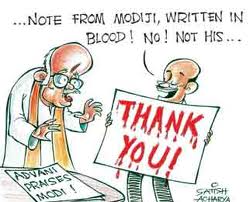
BJP is Brahmin Janata Party : Aakar Patel


The Bharatiya Janata Party (BJP) is sneeringly called the Brahmin-Baniya party, but this isn’t true. It is actually the party of Brahmins. BJP president Nitin Gadkari is Brahmin and so are the party’s leaders in both Lok Sabha (Sushma Swaraj) and Rajya Sabha (Arun Jaitley).

The BJP has always been a party of Brahmins. Founded in 1951 as Jana Sangh, the BJP’s first leader was Brahmin (Syama Prasad Mookerjee), its most important thinker was Brahmin (Deendayal Upadhyaya) and its most successful leader was Brahmin (Vajpayee).

The party’s top leadership is peppered with Brahmins (Murli Manohar Joshi, Ananth Kumar, Seshadri Chari, Kalraj Mishra, Bal Apte).
L.K. Advani is different, and from the Lohana caste.

The Brahmin gene is coded into the BJP by the Rashtriya Swayamsevak Sangh (RSS), whose founder (Hedgewar), most important thinker (Golwalkar), current leader (Bhagwat), and previous leader (Sudarshan) were Brahmin, as was the author of Hindutva (Savarkar).
Except for one man (Rajendra Singh), every RSS sarsanghchalak since its formation in 1925 has been Brahmin.

The RSS’ Hindi weekly Panchjanya is run by a Brahmin (Baldev Sharma) while English weekly Organiser stars the Brahmin duo of Jay Dubashi and M.V. Kamath. The BJP newspaper Kamal Sandesh is also edited by a Brahmin (Prabhat Jha).

The Bajrang Dal’s warriors are led by a Brahmin (Prakash Sharma). Even Bharatiya Mazdoor Sangh’s labourers are led by a Brahmin (Girish Awasthi). The Mazdoor Sangh’s leadership (see www.bms.org.in/representative.htm) is dominated by Brahmins, which is quite remarkable given India’s reality of caste in labour.

The RSS takes its Brahmins seriously and grooms them young. Student wing Akhil Bharatiya Vidyarthi Parishad is run by two Brahmins (Milind Marathe and Vishnudutt Sharma).

The organization’s female wing, Durga Vahini, is however run by a Brahmin (Mala Rawal).This concentration of Brahmins in central positions is for one reason: The Brahmin is the intellectual keeper of the Hindutva flame.


The Brahmin in caricature is wily when seen from the non-Brahmin perspective, and principled and uncompromising when seen from the Brahmin perspective. The Brahmin is also thought to be intellectual. But if intellectual means being open to ideas, he isn’t.

The word “ideologue” that our media uses for BJP leaders is correct. It must be understood in the narrow sense of holding a belief and not letting it go despite evidence. What is that belief? It is that India has one problem: Muslims.

The difference in orientation—Brahmin versus Baniya—shows in the priorities of the BJP and Congress.
The three big Congress ministers—Manmohan, Pranab and Chidambaram—are all economists. The three big BJP leaders—Advani, Swaraj and Jaitley—are none economically inclined.

We can read all 986 pages of Advani’s My Country, My Life and not encounter a thought or idea about his country’s illiteracy and poverty. Someone else will worry about them. Advani’s concerns are emotional—how Mother India is being ravaged by Muslims and Christians in Kashmir, Assam, North-East and so on.
The BJP isn’t interested in economics as a subject of politics, because Hindutva is not constructive but sullen. Though both Manu and Kautilya weigh in on it in their texts, economics has not been a Brahmin concern. The Brahmin’s concern has been keeping his identity pure.

The BJP’s electoral issues—Babri Masjid, Pakistan, uniform civil code and Article 370—are about identity. Specifically, about how Muslims must alter their behaviour. BJP social reform means demanding that others change.

The BJP’s ideology is not positive, in that it does not seek to create, but negative: Muslims should not keep that mosque, Muslims should not keep their civil law, Kashmir should not keep special status.

The BJP is the party of anger, and it represents our sentiment against Muslims, which is deep and universal. In that sense, the BJP has and will always have a larger constituency than the fifth it gets as its share of the vote.
The BJP represents Hindu chauvinism, which is quite ugly and which, as India grows muscular through the economy, the world will encounter with shock.

Like all parties in history that keep pointing to a minority as being the majority’s problem, the BJP’s leaders make their argument in reasonable terms.

The BJP’s rhetoric is calibrated and it always operates one notch below violence, though it understands what the consequences are. The BJP does the mischief and then steps back while violence visits Muslims and Christians.

In his autobiography Advani acquits himself of the murder of 3,000 Indians after his Rath Yatra by saying that the riots happened not along the Yatra’s trail, but elsewhere in India. The BJP sleeps comfortably with its actions, and the great Brahmin Kautilya teaches us in Arthashastra’s eighth chapter that citizens are expendable in the larger interest.

From Aakar Patel's analysis in livemint.com. More Here.
Monday, January 24, 2011

Malegaon blasts, media and Justice!

The 2006 Malegaon blasts are a watershed in the history of Indian Muslims. The trend of targeting mosques and Muslim localities originated like a sparkle in Nanded, Parbhani and Jalna in 2003 and the sparkle turned into fire when it reached Malegaon, Mecca Masjid, Ajmer and Samjhauta Express. The screaming voices of Indian Muslims to investigative these blasts from all possible angles were lost in wilderness and it came back like an echo at Mahabaleshwar’s Arthur point. Then all of a sudden 2008 blast took place. It was the honesty and integrity of a brave officer whose investigation turned the tables. There is a gap of five years between 2003 and 2008. The political voice of Indian Muslim is so weak that it took five years to travel from bylanes of Malegaon to power corridors of Delhi. The political Muslim dispensation is still living an age of defeat; they have yet to come out of slump of 1857.

The reinvestigation of 2006 Malegaon blasts will be litmus test for Central Bureau of Investigation. It remains to be seen which path CBI chooses to tread. Its battered image can get a fresh coat of paint if it applies the rule of common sense. It will not be unfair to suggest that Sadhvi Pragya Singh Thakur knew about the 2006 blasts. She visited former RSS pracharak Sunil Joshi’s house on December 30, 2007, the night after he was murdered by his “own” men in and took away a briefcase without telling the family members. The family was unaware of Joshi’s death and nobody questioned Sadhvi since she was “regular” visitor. Sadhvi has told investigators that the motorcycle used for the Malegaon blast was the one she had sold to Joshi. Aseemanand’s confession is a masterstroke in the sense that main accused Sunil Joshi has been murdered in mysterious circumstances. Both Sadhvi and Aseemanand seem to suggest that Sunil Joshi was the main player in 2006 and 2008 blast. It will be an uphill task for CBI to connect dots with a dead man. Which court in the world has successfully prosecuted a dead man? 

With Swami Aseemanand’s confession the mood in Malegaon seems to be celebratory. The same mood prevailed when 2006 blasts inquiry was mischievously handed to CBI after filing of chargesheet. The same mood prevailed when approver Abrar Ahmed turned hostile. The same mood prevailed when CBI told Bombay High Court that it has not found anything incriminating against the nine accused.  This vicious cycle of justice seems to be as evasive as a mirage of barren desert. At each episode, the key players involved in the struggle of justice have enjoyed their 15 minutes of fame but nothing has happened. Will January 28, 2011, the date of hearing for bail, turn out to be an extension of this vicious cycle?

Media is the mirror of society. It returns to Malegaon only when there is some ‘development’ in the bomb blast case. One cannot blame media for this trend because news-hunt is their job. Omair Ahmed sarcastically describes the role of media in covering Mozammabad thus, “Look at them, how they gather, descending like kites upon a fresh kill.” In doing so, media has greatly affected the collective behaviour of Malegaon: leaders only appear when on screen when there is any ‘development’. There is no persistent attempt for justice. The air-conditioned office of a chief minister or a home minister (be it RR Patil or Chidambaram) is not the ideal place to seek justice in a democracy. The days of Mughal Empire are long over! In a democratic setup, justice is sought in court of law. One understands the importance of building political ‘pressure’ but this exercise is always performed discreetly not in front of camera. No Kashmiri went to meet Home minister when SAR Geelani was wrongly convicted in 2001 Parliament attack case. Instead they turned to famous lawyer Ram Jethmalani who successfully fought Geelani’s case free of cost despite strong opposition from right-wing quarters.   
From Mubashir Mushtaq's post in his blog. More Here.

Saturday, January 22, 2011

Indian Media is soft on Hindutva Terror

“When Abdul Kaleem of Hyderabad and Imam of Haj House, Mumbai were arrested then it’s a national news and when they were released no one bothered in the media to make it news. This attitude of Media must change.”
- Maulana Burhanuddin Qasmi, Markazul Ma’arif


L-R: Nazar Mohammed Madu, President Jamaat-e-Islami Hind, Maharashtra, Abu Asim Azmi, President Samajwadi Party, Maharashtra, Maulana Azhari, Kul Jamaati Tanzeem, Malegaon and others

“Hemant Karkare has proved that Military camps and Ashrams are the breeding ground of Terror and not the Madarsas.”
- Maulana Abdul Hamid Azhari, president of Kul Jamati Tanzeem
''It’s a deadly combination of Brahmanical fascism and Zionist communalism which is not only dangerous for Muslims but for the nation. He reminded, “It’s not only Muslims but they are the first target of Brahmanism the rest, who are not Brahmin, will follow.”
-Nazar Mohammed Madu, President of Jamaat-e-Islami Hind, Maharashtra
"Media also played very communal role in profiling Muslims"
-Rashid Azeem from Movement for Peace and Justice MPJ.

Hyderabad youth Abdul Kaleem, already acquitted in the Mecca Masjid blast case and released on bail on Monday in another case, and whose good conduct and torture story moved Swami Aseemanad, also participated in the agitation. He told the media that he and many other Muslim youths were picked up after the 2007 Mecca Masjid blast not for investigation but to get their confession. He said, “I was brutally tortured by the police to get my confession. Even Swami Aseemanad ji had tears in his eyes when he heard that I was asked to sleep naked on ice, electric shocks were applied on secret parts of my body, and was hanged naked for hours, abused and beaten like an animal.”

Abdul Kaleem wants to pursue LLB to help the poor innocents who are unable to pay fees to advocate. He also shared his meetings with Swami and said, “I was behaving as a normal Muslim and practicing what is taught to me by my mother i.e. to respect elders.” He thanked God that he was released but is worried about his elder brother who is still in jail in some other case. He demanded the government that arrest must not be allowed before investigation.


Sheikh Abdul Kaleem (with a shawl) of Hyderabad at the Mumbai rally


Corrective and immediate legal actions must be taken to get these boys released, Amjedullah Khan, Lawyer of Abdul Kalim from Hyderabad suggested to the Mumbaities.
Advocate Zubair Azmi, Urdu Markaz termed Anti-Terrorist Squad as Anti-Muslim Terrorist Squad and demanded the resignation of RR Patel, home minister of Maharashtra for his anti-Muslim behavior.


The NGOs have given ultimatum to the Central and State Governments to take the corrective steps before the budget sessions of Parliament and Assemblies. Otherwise, they will gherao the assemblies and Parliament and will lie down in front of the vehicles of Ministers to press their demands.

From a report of Rehan Ansari in Two circles. More Here.

Tuesday, January 11, 2011

Now that Aseemanand has confessed, what about the innocent Muslim youth languishing in jails?

Whispers have become words. Murmurs have taken form of sentences. Private conversations and personal convictions are no longer confined within the four walls of a decrepit Muslim household. A quiet sign language has been replaced by a wild scream. The guilt-soaked eyes have got new sparkle of hope and redemption. The Indian Muslim has finally got the guilt-free-pass handed by a ‘devout’ Hindu priest Swami Aseemanand of Dangs, Gujarat.
 
Aseemanand’s judicial confession – that he and his Hindutva men were responsible for five major bomb blasts – has opened Pandora’s Box. The bees of the box have stung so many men in Khakhi. One confession has destroyed the credibility of countless police officers. It is safe to assume that Rajwardhan, the then Rural SP of Nasik, did not sleep properly on Friday night. He weaved a dangerous fictional tale in order to implicate 11 innocent Muslims in Malegaon’s 2006 blasts. It is equally safe to assume that the conscience of former ATS chief KP Raghuvanshi must be cursing himself. It was Raghuvanshi who proudly displayed sketches of two suspects who bought new cycles. How conveniently he forgot the fact that the sketches don’t match with the bearded Muslims languishing in jail! How conveniently he forgot the fact that Shabbir Masiullah, one of the accused, was already in Mumbai police custody since many months before the blasts! How conveniently he forgot the fact that Noorul-Huda, the accused number one, was under close police watch since many years! 

Aseemanand’s confession has brought open the divide within the CBI. The confession is an indictment CBI as well. CBI blindly followed the footprints of KP Raghuvanshi when it filed a supplementary chargesheet in Malegaon 2006 blasts repeating the lies woven by ATS. How conveniently CBI relied on ATS theory that Zahid, the Imam of Phoolsavangi, planted bomb when he was leading Friday prayers hundreds of miles away!  It is altogether a different matter that Aseemanand was arrested by CBI! Therefore it can be safely assumed that there are two kinds of CBI; one highly communal and the other secular. Does CBI stand for Communal Bureau of Investigation?

Harish Gupta, the then Hyderabad Joint Commissioner of Police, took inspiration from KP Raghuvanshi when he falsely implicated 19 Muslims in Mecca Masjid blast case.

The role of RSS has come on spotlight after Aseemanand’s confession. Ram Madhav, RSS spokesman, has said that confession was given under “duress”. He should know that it’s a judicial confession recorded as per the guidelines laid down in Section 164 of Criminal Procedure Code which says that confessions recorded before a magistrate are legally admissible evidence. Pakistani terrorist Ajmal Kasab had given confession under the same section. It is very difficult to retract the confession given under this section. If one retracts confession then it is quite possible that perjury charges will be slapped on him. Retired Bombay High Court judge Justice Hosbet Suresh is of the opinion that the accused can retract his statement. In a recent interview Justice Suresh remarked, “Even if the prosecution relies on it, the magistrate who recorded the confession is summoned and he will give evidence in the court. The magistrate can be cross-examined”.

The communal and biased role of investigating agencies must be fully examined by Prime Minister Manmoham Singh. There is an urgent need for a legislation which will hold our investigating agencies accountable for their misdeeds. Delivering the Fourth R.N. Kao Memorial Lecture on January 19, 2010 organised by the Research and Intelligence Wing (RAW), Vice-President Hamid Ansari had called for greater “oversight and accountability” in the operations of the country’s intelligence agencies. He had suggested setting up of a standing committee of Parliament on intelligence. He passionately argued that just like other democracies like the United States and the United Kingdom, the “concerned agencies should make public their mission statement, outlining periodically their strategic intent, vision, mission, core values and their goals”. It is high time to implement the suggestion of Hamid Ansari. 

Similarly we need to have a mechanism in place whose job is to keep watch that no innocent is falsely accused on terror charges. 32 Muslims have been wrongly imprisoned on terror charges. Four years of incarceration has ruined their lives; their families had literally given up the hope that they will get justice. It remains to be seen how the Indian government is going to right the wrongs done by law-enforcing agencies. Will the offending police officers be booked under the same stringent laws which were abused by them? This will be the biggest test of Indian democracy.   

Indian Muslim’s quest for inclusion in new India will remain a dream unless the guilty police officers are punished. The average Indian Muslim is still trapped between two keywords: Justice and survival.  

From Mubashir Mushtaq's article in Inquilab. More Here


Friday, December 24, 2010

Rahul Gandhi, Hindutva Terror and Indian Muslims

 Sadhwi Pragya Thakur with Rajnath Singh and senior BJP leaders
Rahul Gandhi’s comments that home-grown Hindu extremist groups are bigger threat to India than Pakistan-based Lashkar-e-Toiba and Muslim militants during his conversations with US Ambassador Timothy Roemer and leaked out by Wikileaks have provoked the Hindutva outfits and their sympathizers to accuse him of “dividing India again on communal lines” and “playing vote-bank politics.”
 Rahul Gandhi
We need to take a lesson from it. Now it is an open secret that it were Hindutva groups who were involved in terror incidents like bomb attack at Ajmer Sharif dargah in Rajasthan, Mecca Masjid in Hyderabad, bomb explosion in Malegaon(Maharashtra) and Modasa (Gujarat), and Samjhauta Express carrying Indian and Pakistan passengers to Pakistan.
 Uma Bharathi with Lalji Tandon
What has emerged as significant in the investigations conducted by various Indian investigative agencies is that the Hindu militants involved in these attacks were highly motivated by their religion and connected with religious groups, with direct and indirect support and sympathy from some unscrupulous elements of our Army. If such unscrupulous elements are not curbed immediately, we can well imagine the state of things to emerge in future in the country. With their pan-India presence and networking at grassroots level, they can do unimaginable damage and it will be very difficult task to check them if they are allowed to spread their tentacles like the terror outfits in Pakistan. This is what Rahul Gandhi wants to convey through his statements. As for threat from Pakistan-based militant outfits, they are operating from outside and it is easier to keep watch on them and their sympathizers in India. Moreover, while Lashkar-e-Toiba and other Pakistani outfits are mainly hitting the targets outside Pakistan, Hindutva outfits targeting their own countrymen though the activities of both the groups are anti-human.

We have already seen the horrors of the Hindutva groups inflicted in shape of the bulldozing of the Babri Masjid on December 6, 1992 and mass carnage of Muslims in Gujarat in 2002. The entire operation is so devised by the Hindutva groups that the blame is placed on Muslims for the crimes committed by them, with the media coverage of such events giving a perception that Muslims are attacking fellow Muslims and that too at venerable places like Masjids and dargah. If such elements get an upper hand in India, the safety and security of minorities, particularly Muslims, will be at great risk.

This crisis, if unattended, can lead to a total alienation of Muslims from the country. Oddly this is exactly what Hindutva desires. But it could be disastrous for Muslims as well as for the country.

From Syed Zeeshan Ahmed's article in Indian Muslims. More Here

(The writer can be reached at zeiahmed@gmail.com).

Friday, September 17, 2010

Babri Masjid demolition was preplanned by L K Advani


Let’s go back to what really happened on December 6. When BJP leaders tell us that the masjid was demolished by a spontaneous outpouring of public emotion, they are knowingly telling lies. You cannot bring down a huge structure and then construct a makeshift temple on the same spot with your bare hands or on the basis of public anger. You need a plan and you need implements.

On December 6, eye witnesses and video cameramen saw a band of men in yellow bandanas advancing determinedly towards the temple. They had rappelling ropes that allowed them to climb to the top and possessed spades, shovels and other implements with which they broke the masjid’s walls.

The BJP’s government in UP — then headed by Kalyan Singh — had promised the courts and the Centre that its policemen would ensure that no implements or weapons of any kind were allowed near the Babri masjid. We know from photographic evidence that either Kalyan Singh and his policemen were so inept that kar sevaks were able to smuggle construction tools into the area under their eyes or — and this is more likely — that Kalyan Singh simply lied and that his policemen looked the other way when implements arrived.

Within minutes of the men in yellow bandanas approaching the masjid, another group of kar sevaks targeted journalists and cameramen. The BJP would claim later that this too was an example of spontaneous anger. In fact, it was a well- coordinated operation to prevent any photographs of the actual demolition being taken. By the time the demolition was well under way, the vast majority of journalists had fled for their lives.

Who were these men in yellow bandanas? I was editor of Sunday at the time and my deputy Rajiv Bagchi (now editor of the HT’s Calcutta edition) was in Ayodhya. Rajiv wrote about drills at which Sangh parivar members practised using ropes to reach the top of a building and rehearsed the demolition. In the HT a few days ago, Vijay Jung Thapa recalled being taken to see a similar exercise.

Clearly all that stuff about spontaneous anger was nonsense. This demolition was planned down to the tiniest detail (including the assaults on journalists to prevent us from photographing the men who carried it out) and executed with military precision. After they had broken the masjid, the kar sevaks actually built a makeshift temple on the spot. Nobody can spontaneously generate cement from anger. Obviously the kar sevaks had brought everything required for the operation to the site.

CBI officers investigating the demolition came and spoke to such journalists as Rajiv Bagchi. I remember handing over photographs from the Sunday library that showed Kalyan Singh’s policemen helping kar sevaks cross the so-called police barriers.

I believed that one way or the other the Centre’s investigative agencies would crack the mystery of who it was that actually brought down the Babri masjid. I believed that they would uncover the conspiracy and identify the conspirators.
I was wrong. Nobody has been identified.

Then, I believed that Justice Liberhan who spent Rs 9 crore of taxpayers’ money and took 17 years to inquire into the demolition would tell us who the men in the yellow bandanas were and explain how the operation had been undertaken.
No such luck. The Liberhan report is a poorly written version of the kind of agitated editorials we were all writing in the week after the demolition. I’m sure the judge has enjoyed his 17 years at government expense.

I don’t wish to make too much of Advani’s pious hand-rubbing or his crocodile tears. But the furore about the demolition should serve to remind us that no matter how reasonable BJP leaders may seem on television, at the heart of the parivar, there lurks a nasty fascist core.

These are the religious soldiers who brought down the Babri masjid. Seventeen years later, we still don’t know who they are. And they lurk in the shadows, waiting for another opportunity.

From Vir Sanghvi's take on Babri Masjid in Hindustan Times. More Here

Babri Masjid, Muslims, Hindus and Basharat Peer


IN THE AFTERNOON of 6 December 1992, Tariq Masood, a ninth-grade student in Gorakhpur, western Uttar Pradesh, saw the television go black in the middle of a Doordarshan news bulletin. The electricity in the town was cut off for the rest of the day and the batteries in their radio were dead. A few hundred kilometres away, thousands of karsevaks led by various Bharatiya Janata Party (BJP) workers had converged on the disputed site of Babri Masjid-Ram Janambhoomi. Gorakhpur was under curfew. A phone call broke the news that the karsevaks had destroyed the Babri Mosque. Tariq sat quietly by his lawyer father, numb, watching him repeat the same words, “There must be a mistake. They must be lying.” In the days following 6 December, India was torn apart by a series of riots, which killed around 2,000 people, mostly Muslims. “For many years the destruction of the Babri Masjid shaped my life,” Tariq, now a 32-year-old IT consultant, told me when we met recently in Delhi’s Zakir Nagar area. “We went into a huddle. My father’s Hindu friends stopped inviting us home and we stopped inviting them to our ceremonies. I had no Hindu friends for years.”

After 17 years, 400 meetings, and 80 million rupees, the Liberhan Commission came out with its 1,029 page report in December, blaming the Rashtriya Swayamsevak Sangh (RSS) for organising the demolition of the mosque and naming 60 BJP, RSS and Vishwa Hindu Parishad (VHP) leaders, including former Prime Minister Atal Bihari Vajpayee. Riotous scenes followed in the parliament for a few days, but the commission’s disclosures were hardly a revelation. Videos of Atal Bihari Vajpayee inciting a crowd of karsevaks at a Lucknow rally on 5 December, two days before the masjid’s demolition, have become staples on YouTube. Soon after the Liberhan report was made public, VHP leader Vinay Katiyar bragged to a television channel that 6 December 1992 was the “proudest day of my life.” Katiyar’s voice seemed to have an edge of desperation, a world away from the confidence of the 1990s, when he was a man journalists wanted to interview, when the Ram Temple movement had its last burst of fervour. He reminded me of March 2002, when a few weeks after the Gujarat pogrom, Ramchandra Paramhans, who headed the Ram Janambhoomi Nyas Trust, was leading thousands of karsevaks from across India in an attempt to defy a Supreme Court ban on construction at the disputed site by laying a foundation stone for the Ram Temple.

I had travelled to Ayodhya, along with hundreds of other journalists. The city was barricaded and flooded with policemen, but hordes of karsevaks were sneaking in and converging there. The atmosphere was frenetic with slogans of “Jai Shree Ram” and “Ram Lalla Jaynege, Mandir Wahin Banayenge.” Ramchandra Paramhans, a robust man with long matted hair and an ageing prize fighter’s body, held regular press conferences in the Karsevakpuram compound, a couple of kilometres from the disputed site. Paramhans headed the militant Digambhar Akhara and was instrumental in installing a statue of Ram under the dome of the Babri mosque in 1949 and initiated in 1950 the legal battle to reclaim the Babri Masjid for the Hindus. “Even if Bhagwan Rama comes and says he was not born in Ayodhya, I will not believe him,” Paramhans was famously quoted as saying. Paramhans was a confident yet mercurial man, giving assurances of peaceful conduct one moment, telling jokes the other, and soon after threatening to drink poison and kill himself if he was not allowed to carry the foundation stones to the disputed site.

Scores of craftsmen worked full time, chiselling floral designs and figurines of Ram on the pink sandstone slabs that would come together to form the Ram Temple. Vajpayee was the prime minister, the worldwide condemnation of the Gujarat pogrom a fortnight earlier and the complexities of being in power had tamed the BJP. After a long series of negotiations, Paramhans’ boys were allowed a token ceremony, wherein a crowd of sadhus and four ten year-old boys from a Hindu gurukul led the procession carrying a sandstone slab from the temple workshop to a place near the disputed site, where they were made to hand over the stones to district authorities. “All we need is 24 hours and a few machines can put the temple together,” one heard often those days.

Seven years later, on a foggy December morning in 2009, I drove from Lucknow to Ayodhya to see what remained of that old fervour for the Ram temple. The repeated defeats of the BJP in the elections seemed to suggest the end of a phase of Hindu nationalism, anti-Muslim rhetoric and riots – from the demolition of the Babri Mosque in 1992 to the massacres of Muslims in Gujarat in 2002. Over the last few years, there has been much talk about India’s great power status and the surge in its economy. Thousands of Indian professionals based in the United States have returned home to cash in on the boom. India is pushing aggressively on the world stage, trying to make its presence felt through investments in Africa and buying influence in Afghanistan by providing trillions of rupees in aid and helping build infrastructure, sending sophisticated scientific expeditions to Antarctica and producing even more expensive movies. I wondered: how do India’s Muslims relate to the New India? Were they finding a way to a share in the growing economy? Had they made peace with the ghosts of Babri? Did they see an end to the rampant suspicion and arrests in the name of anti-terrorism measures? I decided to travel to a few cities and towns in Uttar Pradesh, where 31 million of India’s 154 million Muslims live to gauge how much the recent past mattered, how they saw the present and hear their hopes for a future. 


From Basharat Peer's piece in Caravan. More Here

Thursday, June 17, 2010

An highly provocative, mischievous article by Subramanian Swamy


According to the latest Union home ministry Annual Report to Parliament, of the 35 states in India, 29 are affected by terrorist acts carried out by all kinds of forces. Terrorism, I define here as the illegal use of force to overawe the civilian population to make it do or not do an act against their will and well-being.

There are about 40 reported and unreported terrorist attacks per month in the country. That is why the recent US National Counter-Terrorism Centre publication A Chronology of International Terrorism states: ‘India suffered more terrorist acts than any other country’. 

While the PM thinks that Maoists’ threat is most serious, I think Islamic terrorism is even more serious. If we did not have today the present Union home minister, PM, and UPA chairperson, then Maoists can be eliminated in a month, much as I did with the LTTE in Tamil Nadu, as a senior minister in 1991, or MGR did with the Naxalites in the early 1980s.

Why is Islamic terrorism our number one problem of national security? About this there will be no doubt after 2012. By that year, I expect a Taliban takeover in Pakistan and the Americans to flee Afghanistan. Then, Islam will confront Hinduism to ‘complete unfinished business’.

Let us remember that every Hindu-Muslim riot in India since 1947, has been ignited by Muslim fanatics — if one goes by all the commissions of inquiry set up after every riot. By today’s definition these riots are all terrorist acts. Muslims, though a minority in India, still have fanatics who dare to lead violent attacks against Hindus. Other Muslims of India just lump it, sulk or rejoice. That is the history from Babar’s time to Aurangzeb. There have been exceptions to this apathy of Muslims like Dara Shikoh, in the old days, or like M J Akbar and Salman Haidar today who are not afraid to speak out against Islamic terror, but still they remain exceptions. 

Blame the Hindus

In one sense, I do not blame the Muslim fanatics for targeting Hindus. I blame us Hindus who have taken their individuality permitted in Sanatana Dharma to the extreme. Millions of Hindus can assemble without state patronage for Kumbh Mela completely self-organised, but they all leave for home oblivious of the targeting of Hindus in Kashmir, Mau, Melvisharam and Malappuram and do not lift their little finger to help organise Hindus. For example, if half the Hindus vote together rising above their caste and language, a genuine Hindu party will have a two-thirds majority in Parliament and Assemblies.

The secularists now tout instances of Hindu fanatics committing terrorist attacks against Muslims or other minorities. But these attacks are mostly state sponsored, often by the Congress itself, and not by Hindu ‘non-state actors’. Muslim-led attacks are however all by ‘non-state actors’ unless one includes the ISI and rogue elements in Pakistan’s army which are aiding them, as state sponsoring.

Fanatic Muslim attacks have been carried out to target and demoralise the Hindus, to make Hindus yield that which they should not, with the aim of undermining and ultimately to dismantle the Hindu foundation of India. This is the unfinished war of 1,000 years which Osama bin Laden talks about. In fact, the earliest terror tactics in India were deployed in Bengal 1946 by Suhrawady and Jinnah to terrorise Hindus to give in on the demand for Pakistan. The Congress party claiming to represent the Hindus capitulated, and handed 25 per cent of India on a platter to Mohammed Ali Jinnah. Now they want the remaining 75 per cent.

Forces against Hindus 

This is not to say that other stooges have not targeted Hindus. During the last six decades since Independence, British imperialist-inspired Dravidian movement led by E V Ramaswamy Naicker, in the name of rationalism tried to debunk as irrational the Hindu religion, and terrorised the Hindu priestly class, ie, the Brahmins, for propagating the Hindu religion.

The movement’s organisational arm, the Dravida Kazhagam (DK), had venerated Ravana for 50 years to spite the Hindu adoration of Rama and vulgarise the abduction of Sita, till the DK belatedly learnt that Ravana was a Brahmin and a pious bhakta of Lord Shiva too. Abandoning this course of defaming Ramayana, the DK have now become stooges of the anti-Indian LTTE which has specialised in killing the Hindu Tamil leadership in Sri Lanka. Of course the DK has now been orphaned by the decimation of the LTTE. 

Civil war situation 

In the 1960s, the Christian missionaries had inspired the Nagas. The Nagas also wanted to further amputate Bharat Mata by seeking secession of Nagaland from the nation. In the 1980s, the Hindus of Manipur were targeted by foreign-trained elements. Manipuris were told: give up Hinduism or be killed. In Kashmir, since the beginning of the 1990s, militants in league with the Pakistan-trained terrorists also targeted the Hindus by driving the Hindu Pandits out of the Valley, or killing them or dishonouring their women folk.

Recognising that targeting of Hindus is being widely perceived, and that Muslims of India are largely just passive spectators, the foreign patrons of Islamic terrorists are beginning to engage in terrorist acts that could pit Muslims against Hindus in nation-wide conflagration and possible civil war as in Serbia and Bosnia. Muslims cannot be divided into ‘moderates’ and ‘extremists’ because the former just capitulate when confronted. Recently, Pakistan civilian government capitulated on ‘kite flying’ and banned it because Taliban considers it as ‘Hindu’. Moderate governments of Malaysia and Kazhakstan are now demolishing Hindu temples. 

Collective response 

Hence, the first lesson to be learnt from recent history, for tackling terrorism in India is that the Hindu is the target and that Muslims of India are being programmed by a slow reactive process to become radical and thus slide into suicide against Hindus. It is to undermine the Hindu psyche and create fear of civil war that terror attacks are organised. 

And hence since the Hindu is the target, Hindus must collectively respond as Hindus against the terrorist and not feel individually isolated or worse, be complacent because he or she is not personally affected. If one Hindu dies merely because he or she was a Hindu, then a bit of every Hindu also dies. This is an essential mental attitude, a necessary part of a virat Hindu (for fuller discussion of the concept of virat Hindu, see my Hindus Under Siege: The Way Out Haranand, 2006).

Therefore we need today a collective mindset as Hindus to stand against the Islamic terrorist. In this response, Muslims of India can join us if they genuinely feel for the Hindu. That they do, I will not believe, unless they acknowledge with pride that though they may be Muslims, their ancestors are Hindus. 

It is not easy for them to acknowledge this ancestry because the Muslim mullah and Christian missionary would consider it as unacceptable since that realisation would dilute the religious fervour in their faith and also create an option for their possible re-conversion to Hinduism. Hence, these religious leaders preach hatred and violence against the kafir ie, the Hindu (for example read Chapter 8 verse 12 of the Quran) to keep the faith of their followers. The Islamic terrorist outfits, eg the SIMI, has already resolved that India is Darul Harab, and they are committed to make it Darul Islam. That makes them free of any moral compunction whatsoever in dealing with Hindus. 

Brihad Hindu Samaj 

But still, if any Muslim does so acknowledge his or her Hindu legacy, then we Hindus can accept him or her as a part of the Brihad Hindu Samaj, which is Hindustan. India that is Bharat that is Hindustan is a nation of Hindus and others whose ancestors are Hindus. Even Parsis and Jews in India have Hindu ancestors. Others, who refuse to so acknowledge or those foreigners who become Indian citizens by registration can remain in India, but should not have voting rights (which means they cannot be elected representatives). 

Hence, to begin with, any policy to combat terrorism must begin with requiring each and every Hindu becoming a committed or virat Hindu. To be a virat Hindu one must have a Hindu mindset, a mindset that recognises that there is vyaktigat charitra (personal character) and a rashtriya charitra (national character).

It is not enough if one is pious, honest and educated. That is the personal character only. National character is a mindset actively and vigorously committed to the sanctity and integrity of the nation. For example, Manmohan Singh, our prime minister, has high personal character (vyaktigat charitra), but by being a rubber stamp of a semi-literate Sonia Gandhi, and waffling on all national issues, he has proved that he has no rashtriya charitra.

The second lesson for combating the terrorism we face today is: since demoralising the Hindu and undermining the Hindu foundation of India in order to destroy the Hindu civilisation, is the goal of all terrorists in India we must never capitulate and never concede any demand of the terrorists. The basic policy has to be: never yield to any demand of the terrorists. That necessary resolve has not been shown in our recent history. Instead ever since we conceded Pakistan in 1947 under duress, we have been mostly yielding time and again. 

Bowing to terrorists 

In 1989, to obtain the release of Mufti Mohammed Sayeed’s daughter, Rubaiyya who had been kidnapped by terrorists, five terrorists in Indian jails were set free by the V P Singh’s government. This made these criminals in the eyes of Kashmiri separatists and fence sitters heroes, as those who had brought India’s Hindu establishment on its knees. To save Rubaiyya it was not necessary to surrender to terrorist demands.

The worst capitulation to terrorists in our modern history was in the Indian Airlines IC-814 hijack in December 1999 staged in Kandahar. The government released three terrorists even without getting court permission (required since they were in judicial custody). Moreover, they were escorted by a senior minister on the PM’s special Boeing all the way to Kandahar as royal guests instead of being shoved across the Indo-Pakistan border.

Worse still, all the three after being freed, went back to Pakistan and created three separate terrorist organisations to kill Hindus. Mohammed Azhar, whom the National Security Advisor Brijesh Mishra had then described as “a mere harmless cleric”, upon his release led the LeT to savage and repeated terrorist attacks on Hindus all over India from Bangalore to Srinagar. Since mid-2000, Azhar is responsible for the killing of over 2,000 Hindus and the attack on Parliament on December 13, 2001. Omar Sheikh who helped al-Qaeda is in jail in US custody for killing US journalist Daniel Pearl, while the third, Zargar is engaged today in random killings of Hindus in Doda and Jammu after founding Al-Mujahideen Jingaan. 

This Kandahar episode proves that we should never negotiate with terrorists, never yield. If you do, then sooner or later you will end up losing more lives than you will ever save by a deal with terrorists. 

Moment of truth 

The third lesson to be learnt is that whatever and however small the terrorist incident, the nation must retaliate—not by measured and ‘sober’ responses but by massive retaliation.  Otherwise what is the alternative? Walk meekly to death expecting that our ‘sober’ responses will be rewarded by our neighbours and their patrons? We will be back to 1100 AD fooled into suicidal credulity. We should not be ghouls for punishment from terrorists and their patrons. We should retaliate.

For example, when Ayodhya temple was sought to be attacked,  this was not a big terrorist incident but we should have massively retaliated by re-building the Ram temple at the site. 

This is Kaliyug, and hence there is no room for sattvic responses to evil people. Hindu religion has a concept of apat dharma and we should invoke it. This is the moment of truth for us. Either we organise to survive as a civilisation or vanish as the Persian, Babylonian, and Egyptian civilisations did centuries ago before the brutal Islamic onslaught. For that our motto should be Saam, Dhaam, Bheda, Danda. 

Poverty is no factor 

What motivates the Islamic terrorists in India? Many are advising us Hindus to deal with the root ‘cause’ of terrorism rather than concentrate on eradicating terrorists by retaliation. And pray what is the root ‘cause’?

According to bleeding heart liberals, terrorists are born or bred because of illiteracy, poverty, oppression, and discrimination. They argue that instead of eliminating them, the root cause of these four disabilities in society should be removed. Only then terrorism will disappear. Before replying to this, let us understand that I have serious doubts about the integrity of these liberals, or more appropriately, these promiscuous intellectuals. They seek to deaden the emotive power of the individual and render him passive (inculcate ‘majboori’ in our psyche). A nation state cannot survive for long with such a capitulationist mentality.

It is rubbish to say that terrorists who mastermind the attacks are poor. Osama bin laden for example is a billionaire. Islamic terrorists are patronised by those states that have grown rich from oil revenues. In Britain, the terrorists arrested so far for the bombings are all well-to-do persons. Nor are terrorists uneducated. Most of terrorist leaders are doctors, chartered accountants, MBAs and teachers. For example, in the failed Times Square New York episode, the Islamic terrorist Shahzad studied and got an MBA from a reputed US university. He was from a highly placed family in Pakistan. He certainly faced no discrimination and oppression in his own country. The gang of nine persons who hijacked four planes on September 11, 2001 and flew them into the World Trade Towers in New York and other targets were certainly not discriminated or oppressed in the United States. Hence it is utter rubbish to say that terror is the outcome of the poverty terrorists face.

If we accept the Left-wing liberals argument, does it mean that in Islamic countries, the non-Islamic religious minority who are discriminated and oppressed can take to terrorism? In the Valley, where Muslims are in majority, not only Article 370 of the Constitution provides privileges to the majority but it is the minority Hindus who have been slaughtered, or raped, and dispossessed. They have become refugees in squalid conditions in their own country.

It is also a ridiculous idea that terrorists cannot be deterred because they are irrational, willing to die, and have no ‘return address’. Terrorist masterminds have political goals and a method in their madness. An effective strategy to deter terrorism is therefore to defeat those political goals and to rubbish them by counter-terrorist action. How is that strategy to be structured? In a brilliant research paper published by Robert Trager and Dessislava Zagorcheva this year (‘Deterring Terrorism’ International Security, vol 30, No 3, Winter 2005/06, pp 87-123) has provided the general principles to structure such a strategy. 

Goal-strategy 

Applying these principles, I advocate the following strategy to negate the political goals of Islamic terrorism in India, provided  the Muslim community fail to condemn these goals and call them un-Islamic:

Goal 1: Overawe India on Kashmir.
Strategy: Remove Article 370, and re-settle ex-servicemen in the Valley. Create Panun Kashmir for Hindu Pandit community. Look or create opportunity to take over PoK. If Pakistan continues to back terrorists, assist the Baluchis and Sindhis to struggle for independence.

Goal 2: Blast our temples and kill Hindu devotees. 
Strategy: Remove the masjid in Kashi Vishwanath temple complex, and 300 others in other sites as a tit-for-tat.

Goal 3: Make India into Darul Islam. 
Strategy: Implement Uniform Civil Code, make Sanskrit learning compulsory and singing of Vande Mataram mandatory, and declare India as Hindu Rashtra in which only those non-Hindus can vote if they proudly acknowledge that their ancestors are Hindus. Re-name India as Hindustan as a nation of Hindus and those whose ancestors are Hindus.

Goal 4: Change India’s demography by illegal immigration, conversion, and refusal to adopt family planning. Strategy: Enact a national law prohibiting conversion from Hindu religion to any other religion. Re-conversion will not be banned. Declare caste is not birth-based but code of discipline based. Welcome non-Hindus to re-convert to the caste of their choice provided they adhere to the code of discipline. Annex land from Bangladesh in proportion to the illegal migrants from that country staying in India. At present, northern one-third from Sylhet to Khulna can be annexed to re-settle the illegal migrants.

Goal 5: Denigrate Hinduism through vulgar writings and preaching in mosques, madrassas, and churches to create loss of self-respect amongst Hindus and make them fit for capitulation.
Strategy: Propagate the development of a Hindu mindset (see my new book Hindutva and National Renaissance, Haranand, 2010).

India can solve its terrorist problem within five years by such a deterrent strategy, but for that we have to learn the four lessons outlined above, and have a Hindu mindset to take bold, risky, and hard decisions to defend the nation. If the Jews can be transformed from lambs walking meekly to the gas chambers to fiery lions in just 10 years, it is not difficult for Hindus in much better circumstances (after all we are 83 per cent of India), to do so in five years.

Guru Gobind Singh has shown us the way already, how just five fearless persons under spiritual guidance can transform a society. Even if half the Hindu voters are persuaded to collectively vote as Hindus, and for a party sincerely committed to a Hindu agenda, then we can forge an instrument for change. And that ultimately is the bottom line in the strategy to deter terrorism in a democratic Hindustan at this moment of truth. 

From a highly provocative, inflammatory, mi article - full page article with illustrations - written by Subramanian Swamy in The New Indian Express. More Here.
It evoked feeble response from the readers. Only one or two letters admiring Dr. Swamy were published. Muslims refused to get provoked and fall in the trap. Nobody responded.

Translate

Related Posts Plugin for WordPress, Blogger...