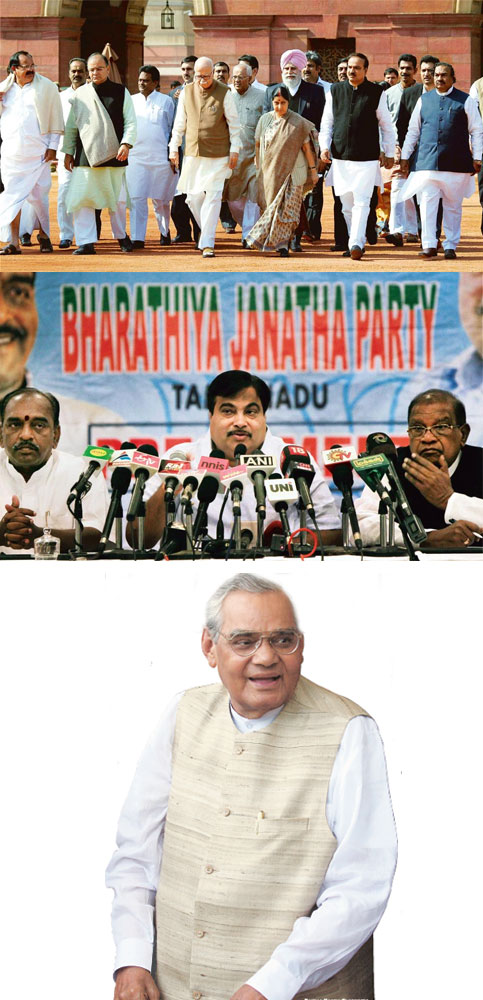
The Bharatiya Janata Party (BJP) is sneeringly called the Brahmin-Baniya party, but this isn’t true. It is actually the party of Brahmins. BJP president Nitin Gadkari is Brahmin and so are the party’s leaders in both Lok Sabha (Sushma Swaraj) and Rajya Sabha (Arun Jaitley).
The BJP has always been a party of Brahmins. Founded in 1951 as Jana Sangh, the BJP’s first leader was Brahmin (Syama Prasad Mookerjee), its most important thinker was Brahmin (Deendayal Upadhyaya) and its most successful leader was Brahmin (Vajpayee).
The party’s top leadership is peppered with Brahmins (Murli Manohar Joshi, Ananth Kumar, Seshadri Chari, Kalraj Mishra, Bal Apte).
L.K. Advani is different, and from the Lohana caste.
The Brahmin gene is coded into the BJP by the Rashtriya Swayamsevak Sangh (RSS), whose founder (Hedgewar), most important thinker (Golwalkar), current leader (Bhagwat), and previous leader (Sudarshan) were Brahmin, as was the author of Hindutva (Savarkar).
Except for one man (Rajendra Singh), every RSS sarsanghchalak since its formation in 1925 has been Brahmin.
The RSS’ Hindi weekly Panchjanya is run by a Brahmin (Baldev Sharma) while English weekly Organiser stars the Brahmin duo of Jay Dubashi and M.V. Kamath. The BJP newspaper Kamal Sandesh is also edited by a Brahmin (Prabhat Jha).
The Bajrang Dal’s warriors are led by a Brahmin (Prakash Sharma). Even Bharatiya Mazdoor Sangh’s labourers are led by a Brahmin (Girish Awasthi). The Mazdoor Sangh’s leadership (see www.bms.org.in/representative.htm) is dominated by Brahmins, which is quite remarkable given India’s reality of caste in labour.
The RSS takes its Brahmins seriously and grooms them young. Student wing Akhil Bharatiya Vidyarthi Parishad is run by two Brahmins (Milind Marathe and Vishnudutt Sharma).
The Brahmin in caricature is wily when seen from the non-Brahmin perspective, and principled and uncompromising when seen from the Brahmin perspective. The Brahmin is also thought to be intellectual. But if intellectual means being open to ideas, he isn’t.
The word “ideologue” that our media uses for BJP leaders is correct. It must be understood in the narrow sense of holding a belief and not letting it go despite evidence. What is that belief? It is that India has one problem: Muslims.
The difference in orientation—Brahmin versus Baniya—shows in the priorities of the BJP and Congress.
The three big Congress ministers—Manmohan, Pranab and Chidambaram—are all economists. The three big BJP leaders—Advani, Swaraj and Jaitley—are none economically inclined.
We can read all 986 pages of Advani’s My Country, My Life and not encounter a thought or idea about his country’s illiteracy and poverty. Someone else will worry about them. Advani’s concerns are emotional—how Mother India is being ravaged by Muslims and Christians in Kashmir, Assam, North-East and so on.
The BJP isn’t interested in economics as a subject of politics, because Hindutva is not constructive but sullen. Though both Manu and Kautilya weigh in on it in their texts, economics has not been a Brahmin concern. The Brahmin’s concern has been keeping his identity pure.
The BJP’s electoral issues—Babri Masjid, Pakistan, uniform civil code and Article 370—are about identity. Specifically, about how Muslims must alter their behaviour. BJP social reform means demanding that others change.
The BJP’s ideology is not positive, in that it does not seek to create, but negative: Muslims should not keep that mosque, Muslims should not keep their civil law, Kashmir should not keep special status.
The BJP is the party of anger, and it represents our sentiment against Muslims, which is deep and universal. In that sense, the BJP has and will always have a larger constituency than the fifth it gets as its share of the vote.
The BJP represents Hindu chauvinism, which is quite ugly and which, as India grows muscular through the economy, the world will encounter with shock.
Like all parties in history that keep pointing to a minority as being the majority’s problem, the BJP’s leaders make their argument in reasonable terms.
The BJP’s rhetoric is calibrated and it always operates one notch below violence, though it understands what the consequences are. The BJP does the mischief and then steps back while violence visits Muslims and Christians.
In his autobiography Advani acquits himself of the murder of 3,000 Indians after his Rath Yatra by saying that the riots happened not along the Yatra’s trail, but elsewhere in India. The BJP sleeps comfortably with its actions, and the great Brahmin Kautilya teaches us in Arthashastra’s eighth chapter that citizens are expendable in the larger interest.


