Pages

Showing posts with label Livemint. Show all posts

Saturday, May 14, 2011

Like a teenage girl, Advani scatters “worst”, “most” and “biggest” with little restraint: Aakar Patel

 LK Advani is an extremist. By this I mean he has little sense of proportion. His words occupy the extreme end of language, what is called hyperbole. It is unwise for Indians, reporters especially, to accept what Advani says because he uses the same apocalyptic formulation for everything. Let his own words demonstrate this.

ECONOMY WORST
29 December 2008 (speech to mark the Prem Kumar Dhumal government anniversary): “2008 has ushered in one of the worst economic recessions in recent times”.
24 November 2008 (a press conference in Indore): “Worst victims are the poor”.
22 September 2008 (a speech at the Vijay Sankalp Yatra, Jharkhand): “Worst neglected are the Adivasis”.
22 January 2009 (a chat on Rediff.com): “Aam aadmi experienced the worst kind of price rise in his life”.

TERRORISM WORST
26/11? 9/11? Mumbai train blast?
Advani likes to weigh in strongly on terrorism, his favourite subject. That is fine. But he also feels the urge to both use his extreme vocabulary and assign an order of importance to the attacks. This has created problems in the hierarchy.
3 October 2008 (Lkadvani.in): “India is the worst victim of terrorism in the world”.
12 September 2010 (Lkadvani.in): “9/11 was the worst ever terrorist attack in human history”.
29 December 2008 (BJP.org): “2008 was the worst year in terms of terrorist violence.”
19 May 2003 (The Economic Times): “Suicide bomber has become the worst ever device”.
19 December 2001 (Frontline): “The attack on Parliament is undoubtedly the most audacious, and also the most alarming, act of terrorism in the history of Pakistan-sponsored terrorism in India”.
15 July 2006 (PTI): “Mumbai train blast is the worst-ever terror strike that hit India”.
27 November 2008 (The Economic Times): “26/11 is the most ferocious terrorist attack in India since independence”.

INDEPENDENCE WORST
One set piece Advani is comfortable with is describing something as being the worst since independence. Since he is old enough (born 1927), he may possibly be qualified to know.
30 December 2007 (UNI): “Agriculture is facing the worst crisis since independence”.
27 January 2010 (Sify.com): “Rise in prices is the worst since independence”.
27 April 2009 (PTI): “Corruption by UPA is the worst since independence”.

SCAM BIGGEST
Which is India’s worst scandal? Let Advani tell you.
Spectrum? Cash for votes? Wikileaks?
21 November 2008 (IANS): “Cash for votes scam is the worst scandal in the history of independent India”.
18 October 2010 (The Pioneer): “Spectrum scam is the biggest scandal since independence”.
19 March 2011 (The Hindu): “WikiLeaks was the biggest scandal in independent India”.

GOVERNMENT WORST
7 March 2009 (The Indian Express): “UPA government is the worst people have had”.
30 October 2007 (IANS): “UPA is the worst example of a coalition.”
30 September 2008 (a speech at the Vijay Sankalp Yatra, Washim, Maharashtra): “Amarnath pilgrim issue was one of the worst failures of the UPA government”.
17 March 2009 (NDTV): “Manmohan Singh is the weakest prime minister of India”.
Manmohan Singh is Nikkamma No 1
28 September 2008 (The Economic Times): “Manmohan Singh is the most incompetent prime minister of India”.

MISCELLANEOUS WORST
Retired judges are the worst kind of arbitrators
25 November 2005 (The Times of India): “Retired judges are the worst kind of arbitrators”.
11 December 2006 (The Financial Express): “Sachar Committee findings are the worst kind of vote bank politics”.
12 January 2009 (speech on National Youth Day): “Colonialism of the mind is always the worst form of colonialism”.
7 August 2009 (speech at the release of his autobiography): “The joint statement contains two of the worst blunders in India’s diplomatic history”.
6 April 2006 (a speech during the Bharat Suraksha Yatra, Rajkot): “Naxalites are the worst enemies of the poor”.
My Country My Life (his autobiography, Page 3): Partition was “the worst of all tragedies”.

Advani scatters Like a teenage girl
Leaders should be measured. Their opinion must be calibrated, because they bring perspective. Like a teenage girl, however, Advani scatters “worst”, “most” and “biggest” with little restraint. To be fair to Advani, many middle-class Indians talk in this manner. Things are best or worst. But there is a difference between our uncle and his drawing-room certitude about everything and a politician wielding power. In speaking like this, Advani’s purpose is not leadership. In the language of our newspapers, this is “lashing out”.

21 February 2004 (The Indian Express): “Congress would deliver its worst-ever performance and win less than 100 seats”.
He said this before the election, and he was wrong, of course. Might Advani have made our worst prime minister?
 Aakar Patel in Livemint. More Here

Sunday, May 01, 2011

A rainy day with Ruskin Bond


Bond’s cottage, built circa 1860s, is like his writing: elemental and homely. The walls are made of rocks from the hills. The ceilings are of wood. The small drawing room is filled with books and awards. A single lamp casts a dim glow on the shelves, which are stacked with detective books such as Tales of Suspense, Dread and Delight, Victorian Ghost Stories and Great Cases of Scotland Yard. Emily Bronte and P.G. Wodehouse sit next to a red hardbound edition of David Copperfield, Bond’s favourite novel.

Ahmedabad-based author Esther David’s The Book of Esther, which he is currently reading, is on the chair. “It is unpretentious and has got a nice feeling of family history done in the form of a novel.”

One wall has a framed portrait of Jeanette MacDonald and Nelson Eddy, American singers and movie stars of the 1950s. On the mantelpiece are black and white photos of Bond’s parents. They had separated when he was 8. Bond’s father lies buried in a Kolkata cemetery and his mother was cremated in Delhi. The survivor of a lonely childhood, experiences of which are reflected in his novels and short stories, Bond now heads a joint family of nine—children and grandchildren of his former help Prem Singh, who came with his wife to work for him in 1969. Bond never married.

In contrast to the chaos of the dining room with its noisy children, small eating table and a giant bukhari heater, Bond’s writing room—where he also sleeps—has the sparseness of a monastic cell. It has nine flower pots, two windows, three paintings, one bed, one chair, one cassette player, one unused typewriter and a wooden almirah. The plaque of the Sahitya Akademi Award has come off its wooden stand and is now used as a paperweight.

“My room is like a railway compartment,” says Bond, whose early stories were set in trains. “When there is a storm, the room is like a ship in a stormy sea.” Pointing to the door, he says, “This is my computer.” On it are pasted paper scraps of publishers’ phone numbers and cuttings of book reviews. A steel trunk below the bed has some of Bond’s most treasured possessions: old issues of the Indian State Railways magazine, The Madras Mail newspaper, and the first edition of The Room on the Roof, his first novel.

The light spray of the day’s unexpected rain wets us as Bond opens a window. Waving at the forested slopes, he says: “All these are oak trees, and the winding road down there is going towards Badrinath.” Closing the windows, he says, “I spend a lot of time gazing at this view: the sky above, the hills before me and the garbage dump below. In the night, I can see the twinkling lights of the Doon Valley.”

Bond wakes up daily at 5. From his bed, he watches the dawn breaking through the hills and the sky turning to a light blue. When the first rays of the sun fall on his bed, he goes to sleep again for another hour. His breakfast consists of toast with butter, cheese, marmalade, or parathas with pickles. “As you can see, I don’t diet,” says Bond, who has a weakness for fish curry and mutton koftas. “I eat all the things I like. That is the secret of my happiness.”

Mayank Austen Soofi's gripping write-up in livemint. More Here.

Monday, February 14, 2011

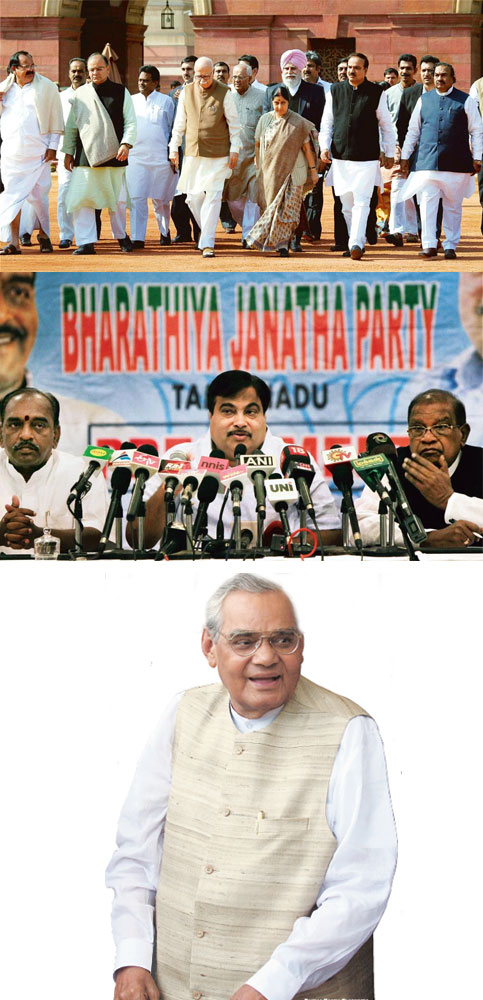
BJP is Brahmin Janata Party : Aakar Patel


The Bharatiya Janata Party (BJP) is sneeringly called the Brahmin-Baniya party, but this isn’t true. It is actually the party of Brahmins. BJP president Nitin Gadkari is Brahmin and so are the party’s leaders in both Lok Sabha (Sushma Swaraj) and Rajya Sabha (Arun Jaitley).

The BJP has always been a party of Brahmins. Founded in 1951 as Jana Sangh, the BJP’s first leader was Brahmin (Syama Prasad Mookerjee), its most important thinker was Brahmin (Deendayal Upadhyaya) and its most successful leader was Brahmin (Vajpayee).

The party’s top leadership is peppered with Brahmins (Murli Manohar Joshi, Ananth Kumar, Seshadri Chari, Kalraj Mishra, Bal Apte).
L.K. Advani is different, and from the Lohana caste.

The Brahmin gene is coded into the BJP by the Rashtriya Swayamsevak Sangh (RSS), whose founder (Hedgewar), most important thinker (Golwalkar), current leader (Bhagwat), and previous leader (Sudarshan) were Brahmin, as was the author of Hindutva (Savarkar).
Except for one man (Rajendra Singh), every RSS sarsanghchalak since its formation in 1925 has been Brahmin.

The RSS’ Hindi weekly Panchjanya is run by a Brahmin (Baldev Sharma) while English weekly Organiser stars the Brahmin duo of Jay Dubashi and M.V. Kamath. The BJP newspaper Kamal Sandesh is also edited by a Brahmin (Prabhat Jha).

The Bajrang Dal’s warriors are led by a Brahmin (Prakash Sharma). Even Bharatiya Mazdoor Sangh’s labourers are led by a Brahmin (Girish Awasthi). The Mazdoor Sangh’s leadership (see www.bms.org.in/representative.htm) is dominated by Brahmins, which is quite remarkable given India’s reality of caste in labour.

The RSS takes its Brahmins seriously and grooms them young. Student wing Akhil Bharatiya Vidyarthi Parishad is run by two Brahmins (Milind Marathe and Vishnudutt Sharma).

The organization’s female wing, Durga Vahini, is however run by a Brahmin (Mala Rawal).This concentration of Brahmins in central positions is for one reason: The Brahmin is the intellectual keeper of the Hindutva flame.


The Brahmin in caricature is wily when seen from the non-Brahmin perspective, and principled and uncompromising when seen from the Brahmin perspective. The Brahmin is also thought to be intellectual. But if intellectual means being open to ideas, he isn’t.

The word “ideologue” that our media uses for BJP leaders is correct. It must be understood in the narrow sense of holding a belief and not letting it go despite evidence. What is that belief? It is that India has one problem: Muslims.

The difference in orientation—Brahmin versus Baniya—shows in the priorities of the BJP and Congress.
The three big Congress ministers—Manmohan, Pranab and Chidambaram—are all economists. The three big BJP leaders—Advani, Swaraj and Jaitley—are none economically inclined.

We can read all 986 pages of Advani’s My Country, My Life and not encounter a thought or idea about his country’s illiteracy and poverty. Someone else will worry about them. Advani’s concerns are emotional—how Mother India is being ravaged by Muslims and Christians in Kashmir, Assam, North-East and so on.
The BJP isn’t interested in economics as a subject of politics, because Hindutva is not constructive but sullen. Though both Manu and Kautilya weigh in on it in their texts, economics has not been a Brahmin concern. The Brahmin’s concern has been keeping his identity pure.

The BJP’s electoral issues—Babri Masjid, Pakistan, uniform civil code and Article 370—are about identity. Specifically, about how Muslims must alter their behaviour. BJP social reform means demanding that others change.

The BJP’s ideology is not positive, in that it does not seek to create, but negative: Muslims should not keep that mosque, Muslims should not keep their civil law, Kashmir should not keep special status.

The BJP is the party of anger, and it represents our sentiment against Muslims, which is deep and universal. In that sense, the BJP has and will always have a larger constituency than the fifth it gets as its share of the vote.
The BJP represents Hindu chauvinism, which is quite ugly and which, as India grows muscular through the economy, the world will encounter with shock.

Like all parties in history that keep pointing to a minority as being the majority’s problem, the BJP’s leaders make their argument in reasonable terms.

The BJP’s rhetoric is calibrated and it always operates one notch below violence, though it understands what the consequences are. The BJP does the mischief and then steps back while violence visits Muslims and Christians.

In his autobiography Advani acquits himself of the murder of 3,000 Indians after his Rath Yatra by saying that the riots happened not along the Yatra’s trail, but elsewhere in India. The BJP sleeps comfortably with its actions, and the great Brahmin Kautilya teaches us in Arthashastra’s eighth chapter that citizens are expendable in the larger interest.

From Aakar Patel's analysis in livemint.com. More Here.

Monday, June 21, 2010

What is wrong with the Indian media?


Bihar’s police blinded a dozen undertrials with cycle spokes and acid in Bhagalpur (the story of this casual act of punishment took weeks to emerge). Government engineers on deputation regularly abused tribal women, and there was no end to stories about the barbarism in the Indian village (there still is no end).

But there was always something missing from this journalism, and it is this: You could read Indian newspapers every day for 30 years and still not know why India is this way. The job of newspapers is, or is supposed to be, to tell its readers five things: who, when, where, what and why. Most newspapers make do with only three of these and are unlikely to really tell you “what”. This is because urban Indians are tired now of reading the horror stories that come out of our villages. Only a couple of newspapers, such as TheIndian Express, persist in reporting news that isn’t pleasant, and they haven’t much circulation.

No newspaper at all can tell you “why”, because they do not know themselves. The same stories from 30, 50, 100 or 500 years ago keep repeating here, and the peasant will still murder his daughter for falling in love. The happenings in the city are also difficult to understand. The news from May was that Delhi University sold radioactive Cobalt-60 as scrap. This killed the merchant who bought it and crippled another. The university, which is supposed to be a research body, had unthinkingly buried some of the other Cobalt-60 earlier and this will poison the ground.

Why are we so casual? Nobody can say, and there will be an explanation along the lines that it was an accident. But this will happen again, of course.

Union Carbide’s plant in Bhopal was owned by Americans. But it was managed, staffed and run by Indians. Its foreman was Indian and its workers were Indian. Why were they so casual about their own safety? The media doesn’t know, but it is convinced the solution lies with getting Warren Anderson.

From Aakar Patel's article in Livemint. More Here.

Tuesday, June 15, 2010

Bhopal Gas Tragedy: A tragic business


Jahar Lal doesn’t remember the night of the Bhopal gas tragedy, but he can’t forget it either. He was born on the side of a road, as his mother fled from the poisonous gases that swept through old Bhopal. When she finally reached a hospital with her newborn son, the doctors there christened him Jahar, or poison. The name stuck.

He doesn’t like his name much. He has often thought of changing it but, he says, “It’s the name I’m famous by.” It draws 10-15 people every month to his small jhuggi in the mud-spattered lanes of Oriya basti.
Click here to view a slideshow of some of the businesses that have sprung up in the aftermath of the gas leak in Bhopal

More has been written on the Bhopal gas tragedy than any other disaster in India. In the 25 years that have elapsed, activists and government officials have surveyed the affected areas numerous times; curious tourists have wandered through the bastis in search of survivors’ tales; and journalists from around the world have scoured Bhopal for stories.

From Akshai Jain's article in livemint. More Here.

Translate

Related Posts Plugin for WordPress, Blogger...