Of late, it is not uncommon for political leaders the world over to flaunt their superb educational pedigrees or prestigious qualifications as evidence of their eligibility to govern. We are often reminded that Barack Obama is a graduate of the renowned Law School at Harvard; Britain’s David Cameron lists Eton College – described as the most famous independent school in the world, as his alma mater; whilst Robert Mugabe of Zimbabwe is distinguished as the holder of no less than 7 professional degrees from a myriad of noteworthy institutions.Ebrahim Moosa in CIIbroadcasting. Here
Judged on those criteria, the credentials of the world’s newest Head of State are no less impressive. Egypt’s President-elect Mohammed Morsi is a qualified engineer, who pursued his Bachelor’s and Master’s Degrees in Cairo before receiving his PhD in engineering from the University of Southern California. He even served as an Assistant Professor for 3 years in the US, before his return to Egypt in 1985.
However, as it turns out, Morsi’s main title to leadership may not lie in any of these respected seats of higher learning, but rather in a far more obscure institution commonly associated with wrongdoing and correctional behavior. The great Turkish Reviver, Said Nursi once called it Medrese-i Yusufiye(The School of Yusuf), after the Prophet Yusuf(PBUH) who spent years behind bars for a crime he did not commit. In the very land of Egypt he served his sentence, setting in motion a tradition that has destined the ordeals of prison to become a common, almost universal, ‘subject’ in the syllabus of Muslim thinkers and activists across the ages. For many of them, it has meant not only suffering, but also the opportunity to reflect on past struggles, review strategies, enhance spirituality, sharpen insights and reorganise their mission. For the Prophet Yusuf, the ordeal culminated in him being exonerated and appointed to an influential position of leadership in the land.
In contemporary history this tradition is no better illustrated, than by the chronicles of the Ikhwan al Muslimoon(Muslim Brotherhood). Born in 1928, by the untiring efforts of an Aalim and schoolteacher, the son of a watch repairer, it grew from a base of six members with no formalities to become one of the most influential Islamic Movements of the last century. It was the lifelong dream of founder, Imam Hasan al Banna to guide people to the truth of Islam in concept and practice. Despite setbacks and betrayals, he laboured on, delivering lectures and Khutbahs widely and engaging in discussions with people of all persuasions. The selfless reviver worked day and night and never knew what it was like to relax or go on vacation. His efforts soon paid off. By 1948, the Brotherhood base grew to some 500 000 and hundreds of branches mushroomed across Egypt. Concerned about the movement’s increasing assertiveness and popularity, Prime Minister Mahmoud al Nukrashi Pasha disbanded it in the same year. Assets were impounded and scores were imprisoned.
Showing posts with label Egypt revolution. Show all posts
Sunday, September 16, 2012
Egypt: Where prisoners become Presidents
Friday, January 06, 2012
FJP's twelve steps to a new Egypt
Mohamed Morsi, President Freedom and Justice Party in ikhwanweb. Here
There are many challenges facing the Egyptian society, at the present time, which the FJP seeks to remedy in the coming period, through the objective visions detailed in the party’s program. The most important of these challenges are as follows:
First, the principles of liberty and equality: the FJP emphasizes that it seeks to grant citizens the freedoms they deserve, to safeguard the fundamental rights of every Egyptian, and change all practices or legislation that challenge or restrict these freedoms or violate these rights. Freedom is one of Islam’s duties. “Indeed We have honoured the Descendants of Adam” (Quran, 17:70).
Second, security: Since the revolution, Egypt suffers an almost total lack of security. On the other hand, security is essential for life, work and production. The FJP, therefore, stresses the need for restructuring the Ministry of Interior, purging it of all officers who were involved in the oppression of the people and the practices of corruption, and changing the prevailing strategic doctrine – starting with students of the police academy and honorable officers; to provide security and protection for people, not for the ruler alone; to prepare and adopt a security policy for the protection of all national institutions; to raise the financial standard of soldiers and low-income people, and to put a cap on the remuneration of senior officers; and to monitor the ministry through the parliament to ensure good performance.
Third, high-priority economic problems: The FJP believes that the Egyptian citizen is both the basis and the target of Egypt's development. Hence, it is essential that extricate the people from the mire of poverty, poor health and deficient educational services.
The party believes that human dignity and freedom depend on the citizen earning a decent living with freedom from exploitation and poverty.
The party emphasizes that response to the unemployment problem requires the concerted efforts of many of society's institutions to provide employment opportunities, such as the banking system, educational institutions, civil society and the business community, as well as the adoption of large national projects, and at the same time motivating and supporting young people to develop their own small business projects. Thus we can increase rates of economic growth to absorb entrants to the labor market, so that we can provide jobs to the jobless and adequate remuneration for every worker, and social security for every disabled person.
Fourth, social problems: The FJP bears in mind that there are members of the community whose material resources prevent them from fulfilling the needs of dignified living. The party’s economic program, therefore, suggests that – in addition to what is now available in the community of charitable organizations and solidarity among its citizens – there is need for activating the mechanisms of Zakat (giving of alms) to address aspects of deficiencies in economic and social life. Waqf (endowment) mechanisms should be utilized side-by-side with mechanisms of Zakat.
Fifth, treatment of the imbalance in the structure of wages: The FJP attaches great importance to the issue of wage structure imbalance in the Egyptian market. The party will endeavor to set minimum and maximum wages to ensure a decent life for the Egyptian citizen, with increase in wages linked to inflation rates, and to prevent senior management personnel from taking more than one job or being on the boards of more than one company or Fund, to give the opportunity for others to benefit from remuneration made for those posts.
Sixth, the issue of environmental pollution: With regard to the problem of environmental pollution, the FJP believes that the ecological balance between man and what he builds in his urban environment on the one side and between God's creation in the natural environment on the other, is the basic framework that should govern and control the process of populating the world. Hence, the party has set priorities and policies to deal with all types of environmental pollution, from reducing the impact of pollution, to treatment mechanisms, and safeguard policies to prevent recurrence. This is to be achieved through the establishment of a national council for the protection of the Nile River, bringing together all relevant bodies to allocate responsibilities and avoid conflicts of authority and work to enact a package of legislation, laws that criminalize contamination of this great river, with firmness in the implementation of this legislation.
Seventh, the housing issue: The FJP believes that this critical issue is of major concern to every family and every young person. Therefore, the party was keen to find a viable solution to it through geographical re-distribution of construction development and population, to match human resources quality and quantity with development essentials and national security requirements, through the division of the state into development regions, and working to attract people and talent from regions with denser populations and less resources to regions with the less dense populations and greater resources.
Eighth, the problem of transportation: In its program, the FJP adopts the concept of integration of the four methods of transport: road, river, sea and air, so as to raise the performance efficiency of this sector domestically and internationally, through the Ministry of Transport playing a key role in overseeing all the various activities of the sector, setting the necessary policies for this sector to efficiently play the role it is entrusted to do, to avoid conflicts among the different bodies currently overseeing the sector, including the Ministry of Interior, Ministry of Tourism, Ministry of Environment, local authorities... etc.
Ninth, the issue of education and scientific research: The FJP has paid special attention to human development that ensures human dignity and recognizes the right of every citizen to education, so as to build a generation capable of carrying the banner of progress and development of this homeland.
The party believes that reforming and developing education, research institutes and scientific institutions will strengthen national unity and deepens the Arab and Islamic identity, because that is the way to intellectual and cultural unity within Egypt and among the Arab and Muslim countries, as it maximizes development in order to achieve progress and leadership and puts the nation at the forefront of the world.
The party aims to make education and scientific research the main tool to meet the needs of the community and the nation and to achieve its ambitions and progress at home and abroad, through various programs and mechanisms, including: providing education for all members of society, injecting moral values into education at all stages, expanding education quantitatively, qualitatively and geographically using ‘open’ learning and distance education as well as e-learning etc, providing training and ‘continuing education’ to keep abreast of accelerating scientific and technical progress, focusing on the development of innovative thinking and building skills, and developing and updating curricula and activities commensurate with the era, developing capacities and talents and achieving the required goals and specifications with the adoption of an approach of thinking, dialogue, research and discussion in education, instead of the rote alone.
In the same context, the party has prepared solutions for the treatment of the problem of illiteracy, which is an affront to the community, through the following means: development of a national project to completely eliminate illiteracy within a few (5) years, while stimulating all resources for its implementation, adoption of a budget commensurate with this project, compelling large companies and factories to organize literacy classes for their employees, and giving adequate tax breaks for the purpose, and encouraging children, especially in the countryside, not to drop out of education, providing special care for poor families so they would not be forced to withdraw their children from education and into work in order to bring in money.
Tenth, the development of the health sector: The FJP has prepared an ambitious program for the development of the health sector’s conditions through the provision of mechanisms for health care for all citizens, regardless of their financial status or place of residence, to ensure the citizen's freedom to choose where to receive medical treatment and service, with emphasis on those who cannot afford medical costs, to improve the quality of health service and ensure fair distribution so as to provide access to adequate health care for low-income families, and to expand health insurance coverage to include all Egyptians within a specified period of time.
Eleventh, the development of tourism: Tourism occupies its rightful place in the party platform, as Egypt's cultural and historical, Pharaonic, Grecian, Roman, Coptic, Islamic heritage as well as its temperate climate and the charming and hospitable nature of its people are all unrivaled in the whole world. Tourism, as an industry and an export activity, is a very important source of foreign currency, an essential component of national income, and a key component for the creation of productive employment opportunities for hundreds of thousands of our youth, through the protection of tourist areas in ancient Egyptian cities, and on the coasts of the country’s Mediterranean and Red seas, on modern tourism bases, and the prevention of unplanned urban growth in these areas, encouraging the private sector and attracting foreign investments in the tourism industry, and directing all service ministries related to tourism – such as Ministries of Aviation, Transport, Media, Culture, Environment and other ministries and agencies concerned with tourism activities in Egypt – to support promote tourism amongst the most important objectives of their annual plans. All this, necessarily, requires better care for workers in this area and for tour guides as well as public and private tourism companies and adoption of their problems and finding substantive and comprehensive solutions to such problems.
Twelfth, deepening of cooperation with Arab countries: The FJP has stressed that it seeks to support plans and mechanisms for integration and joint Arab action in all areas, and emphasized the right of the Palestinian people to liberate their land and the right of peoples to obtain their rights and to have free will to govern themselves in the way they consider appropriate. The nation must truly be the source of authority and power.
In conclusion, we hope that with the brief outline above we have succeeded in answering some questions raised in the minds of everyone, asserting that the FJP will work with diligence and dedication during the coming period to turn their hopes and aspirations for the great people of Egypt to a practical reality that benefits everyone, without discrimination, for the rejuvenation and advancement of Egypt and the establishment of the modern Egyptian civic, constitutional state, based on freedom and democracy – a truly new Egypt.
Labels:
current affairs,
Dr Mohamed Morsi,
Egypt revolution,
Ikhwanal Muslimeen,
Ikhwanweb,
Muslim Ummah,
Twelve steps to a new Egypt,
World Affairs
Location: Chennai, India
Chennai, Tamil Nadu, India
Saturday, December 24, 2011
Biggest winner of the world in 2011 was Islam : Patrick Buchanan
This year, clearly, one of the world's big winner was -- Islam.
From Morocco to Pakistan, a great awakening is occurring. The most dramatic example of Islam rising again came in Egypt, with the fall of the 60-year-old military dictatorship. The West hailed the coming of democracy but democracy delivered a rude shock. In the first round of voting, over 60 percent of ballots were for the Muslim Brotherhood or the radical Islamist Nour Party. In the second round, 75 percent voted Islamist. In Tunis and Tripoli, too, the overthrow of autocrats revealed a silent majority sympathetic to Islamism.
Worldwide, the Muslim population has surpassed Catholicism as the world's largest religion, with 48 members of the U.N. General Assembly now boasting a Muslim plurality or majority.
India, with 150 million Muslims, has more than both Egypt and Iraq. Russia, with 25 million, has more Muslims than Libya and Jordan combined. China has more than Syria. Five percent of Europe is Muslim, and the numbers continue to rise.
If demography is destiny, the future would seem to belong to Islam.Patrick Buchanan in an article titled "Second Period of Islamic Powrer" in Realclearpolitics. Here
Wednesday, December 14, 2011
Mideast uprisings: A lesson for strong men and counterfactual historians
Ruchira in Accidental Blogger. Here.Manipulated over the past century and a half by greedy outsiders and their own repressive leaders, many Arabs in the middle east and north Africa are saying, "Enough already!" In country after country from Morocco to Bahrain, popular uprisings are now a raging fire. The long simmering resentment of ordinary people against widespread corruption, unemployment, grotesque inequalities and curtailment of freedom which is now a growing explosive anger, is said to have been sparked by the self-immolation of a young Tunisian man who refused to be cowed down by the brutality of a corrupt police force. The wave of protests has caught the world by surprise, especially the recent events in Egypt where the stunning removal from power of Hosni Mubarak, the long time dictator and US ally was unimaginable just a few short months ago. Egyptians themselves are probably among the most surprised. This time the bogeyman for the mass demonstrators is not the US or Israel, but their own leaders who have long exploited anti-US sentiments to control the citizenry while doing the bidding of the west for their own profit. I have no special insights to add to what we are hearing in the news about the middle east. Things are in a ferment; it is hard to predict how the present and future will shape up in Egypt or elsewhere, and what the implications are for the coming trends in geo-politics. At this moment, the hottest spot in the Arab fire storm is in Libya where the crazy colonel has threatened to become a martyr while inciting a civil war among his countrymen with the help of foreign mercenaries. A map of the region shows the time line and the current status of events in the affected areas.
Wednesday, December 07, 2011
The beginning of the end of the Western hegemony
![]() |
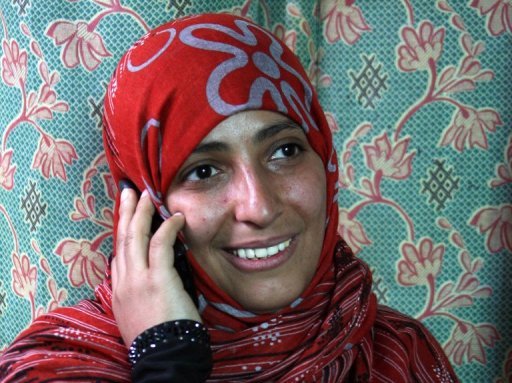
| Tawakul Karman |
The Arab liberation revolution will fundamentally change the Middle East. The acceleration of the West's decline will change the world. One outcome will be a surge toward China, Russia and regional powers like Brazil, Turkey and Iran. Another will be a series of international flare-ups stemming from the West's lost deterrence. But the overall outcome will be the collapse of North Atlantic political hegemony not in decades, but in years. When the United States and Europe bury Mubarak now, they are also burying the powers they once were. In Cairo's Tahrir Square, the age of Western hegemony is fading away.Ari Shavit in Haaretz. Here and Here
Sunday, December 04, 2011
"Egypt revolution is Youthquake": Sadat Husseini
Here is the most powerful speech given by Br Sadat Husseini on "Middle East revolutions: Impacts and expectations".
Sadat Husseini is member of Central Advisory Council of Jamaat-e-Islami Hind. In his speech he has listed out five lessons to be learnt from the Middle East revolutions. It is worth watching.
I heard the full speech in one session. This is the first time that I have spent so much time in viewing a speech. The subject is alluring and Sadat captivates you with shers, arabic slogans, Quranic verses and english quotations.
Saturday, December 03, 2011
Mohamed Badie, the man who matters most in Egypt
Maryam Ishani in Majalla. Here and HereWho is the man at the helm of Egypt's Muslim Brotherhood, now poised to lead Egypt in the post-Mubarak era?
Liberals view him as an uncompromising religious conservative and even within the Muslim Brotherhood some doubt his ability to lead. Will Mohamed Badie succeed in uniting the Muslim Brotherhood and forming a parliamentary majority?
The press conference was set to start at noon, but at one the long table at the front of the tightly packed room remained empty. The cameramen were still jostling to set up their equipment, jamming their heavy tripods into what remained of the spaces along the walls.
It almost didn’t matter, everyone knew the story they were there for. It was all about the man who would finally take his seat at the table at 2 PM: The Muslim Brotherhood’s General Masul, the General Guide, Mohamed Badie. It was September 2010 and parliamentary elections, were on everyone’s minds, as they are today. Especially when it came to predicting the power of the Muslim Brotherhood in those elections.
Mohamed Badie Abdul Mageed Samy, a highly educated man with roots in labour rights and a strong commitment to outreach, is poised to become one of the most influential powers in the ‘new Egypt.’ Yet, his rise from relative obscurity to the forefront of national politics has left many Egyptians perplexed. Liberals view him as an uncompromising religious conservative and even within the Muslim Brotherhood some doubt his ability to lead. Will Mohamed Badie succeed in uniting the Muslim Brotherhood and forming a parliamentary majority?
Monday, April 18, 2011
The significance of popular uprisings in the Middle East
The popular uprisings in the Middle East have brought the question of political Islam to the center stage of America’s policy debate. How do Islamist thinkers view the political transitions underway in Egypt and Tunisia, and what are they saying about the turmoil in places such as Libya and Yemen? What role will Islamist political groups play in countries opening up to democratic reforms, and what are the implications for U.S. policy in the Middle East.
A discussion of these questions and issues with one of the foremost scholars of Islam and the modern world, Tariq Ramadan with Hussein Ibish, Brian Katulis and Susan Brooks organised by Center for American Progress.
More Here
Wednesday, March 23, 2011
The speech by Asmaa Mahfouz which triggered the Egyptian Revolution
Asmaa Mahfouz is the one who started it all.
She recorded a vlog on January 18th and posted it in the net. It sparked everything. Tahrir Square became most known place in the entire world. She had shared it on her Facebook, and it had gone viral. It was so powerful and so popular, that it drove Egyptians by the thousands into Tahrir Square, and drove the Egyptian government to block Facebook . I’ll shut up now and let Asma talk. It is just four minutes.
Transcripts of the speech :
Four Egyptians have set themselves on fire to protest humiliation and hunger and poverty and degradation they had to live with for 30 years. Four Egyptians have set themselves on fire thinking maybe we can have a revolution like Tunisia, maybe we can have freedom, justice, honor and human dignity.
Today, one of these four has died, and I saw people commenting and saying, “May God forgive him. He committed a sin and killed himself for nothing.”
People, have some shame.
I posted that I, a girl, am going down to Tahrir Square, and I will stand alone. And I’ll hold up a banner. Perhaps people will show some honor. I even wrote my number so maybe people will come down with me.
No one came except three guys—three guys and three armored cars of riot police. And tens of hired thugs and officers came to terrorize us. They shoved us roughly away from the people. But as soon as we were alone with them, they started to talk to us. They said, “Enough! These guys who burned themselves were psychopaths.”
Of course, on all national media, whoever dies in protest is a psychopath. If they were psychopaths, why did they burn themselves at the parliament building?
I’m making this video to give you one simple message: we want to go down to Tahrir Square on January 25th. If we still have honor and want to live in dignity on this land, we have to go down on January 25th. We’ll go down and demand our rights, our fundamental human rights.
I won't even talk about my political rights. We just want our human rights and nothing else.
This entire Government is corrupt - acorrupt President and a corrupt security force!
The self-immolators were not afraid of death. But they were afraid of the security forces!
Can you imagine that? Are you like that? Are you going to kill yourselves too? Or are you completely clueless?
Iam going down on January 25th and from now till then, I am going to distribute fliers in the streets.
I will not set myself on fire! If the security forces want to set me on fire let them come and do it!
If you think yourself a man, come with me on January 25th
Whoever says women shouldn't go to protest because they will get beaten
Let him have some honor and manhood and come with me on January 25th
Whoever says it is not worth it because there will be only a handful of people, I want to tell him, you ar the reason behind this.
And you are a traitor, just like the President or any security cop who beats us in the streets
Your presence with us will make a difference, a BIG difference
Talk to your neighbours, your colleagues, friends and family and tell them to come
They don't have to come to Tahrir Square, just go down anywhere and say it, that we are free humanbeings
Sitting at home and just following us on news or Facebook leads to our humiliation
Leads to my own humiliation!
If you have honor and dignity as a man, come. Come and protect me and other girls in the protest.
If you stay at home, then you deserve all that is being done to you. And you will be guilty before the nation and your people. And you will be responsible for what happens to us on the street while you sit at home.
Go down to the street, sen SMS's, post it on the net, make people aware. You know your own social circle, your building, your family, your friends. Tell them to com with us.
Bring 5 people, or 10 people if each of us manages to bring 5 or 10 to Tahrir Square and talk to people and tell them, THIS IS ENOUGH!!
Instead of setting ourselves on fire, let us do something positive. It will make a difference, a BIG difference!
Never say there is no hope! Hope disappears only when you say there is no hope! So long you come down with us, there will be hope.
Don't be afraid of the Government, Fear none but God!
God says that He ''will not change the condition of a people until they change what is in themselves" (Quran 13 : 11)
Don't think you can be safe anymore! None of us are!
Come down with us, and demand your rights, my rights, your family's rights
Iam going down on January 25th and I will say "NO" to corruption. "NO" to this regime!
For More Here and Here. and Here
Thursday, March 03, 2011
Who was behind the Egyptian revolution?
Future historians will long puzzle over how the self-immolation of a Tunisian street vendor, Mohamed Bouazizi, in protest over the confiscation of his fruit stand, managed to trigger popular uprisings across the Arab/Muslim world. We know the big causes — tyranny, rising food prices, youth unemployment and social media. But since being in Egypt, I’ve been putting together my own back-of-the-envelope guess list of what I’d call the “not-so-obvious forces” that fed this mass revolt. Here it is:
THE OBAMA FACTOR Americans have never fully appreciated what a radical thing we did — in the eyes of the rest of the world — in electing an African-American with the middle name Hussein as president. I’m convinced that listening to Obama’s 2009 Cairo speech — not the words, but the man — were more than a few young Arabs who were saying to themselves: “Hmmm, let’s see. He’s young. I’m young. He’s dark-skinned. I’m dark-skinned. His middle name is Hussein. My name is Hussein. His grandfather is a Muslim. My grandfather is a Muslim. He is president of the United States. And I’m an unemployed young Arab with no vote and no voice in my future.” I’d put that in my mix of forces fueling these revolts.
GOOGLE EARTH While Facebook has gotten all the face time in Egypt, Tunisia and Bahrain, don’t forget Google Earth, which began roiling Bahraini politics in 2006. A big issue in Bahrain, particularly among Shiite men who want to get married and build homes, is the unequal distribution of land. On Nov. 27, 2006, on the eve of parliamentary elections in Bahrain, The Washington Post ran this report from there: “Mahmood, who lives in a house with his parents, four siblings and their children, said he became even more frustrated when he looked up Bahrain on Google Earth and saw vast tracts of empty land, while tens of thousands of mainly poor Shiites were squashed together in small, dense areas. ‘We are 17 people crowded in one small house, like many people in the southern district,’ he said. ‘And you see on Google how many palaces there are and how the al-Khalifas [the Sunni ruling family] have the rest of the country to themselves.’ Bahraini activists have encouraged people to take a look at the country on Google Earth, and they have set up a special user group whose members have access to more than 40 images of royal palaces.”
ISRAEL The Arab TV network Al Jazeera has a big team covering Israel today. Here are some of the stories they have been beaming into the Arab world: Israel’s previous prime minister, Ehud Olmert, had to resign because he was accused of illicitly taking envelopes stuffed with money from a Jewish-American backer. An Israeli court recently convicted Israel’s former president Moshe Katsav on two counts of rape, based on accusations by former employees. And just a few weeks ago, Israel, at the last second, rescinded the appointment of Maj. Gen. Yoav Galant as the army’s new chief of staff after Israeli environmentalists spurred a government investigation that concluded General Galant had seized public land near his home. (You can see his house on Google Maps!) This surely got a few laughs in Egypt where land sales to fat cats and cronies of the regime that have resulted in huge overnight profits have been the talk of Cairo this past year. When you live right next to a country that is bringing to justice its top leaders for corruption and you live in a country where many of the top leaders are corrupt, well, you notice.
Thomas L Friedman in The NewYork Times. More Here.
UPDATE
This is just the start
I am Thomas Friedman and I write a column in the New York Times.
I started my last extremely important column with an introduction in which I listed tyranny, rising food prices, youth unemployment and social media as the “big causes”. Rather than just stop there, I did a Google “surprise me” search and chose five of the random results for my special “mix of forces” which inspired the Arab mass revolts. These included Barack Obama, Google Earth and the Beijing Olympics.
But there are other critical factors integral to an understanding of my bollocks theory on the Middle East.
Here they are:
MY MOUSTACHE – Americans have never really appreciated what a radical thing I did in growing a moustache, long the symbol of Arab male virility. I’m convinced that when Arab men catch a glimpse of my moustache as they bring me my breakfast in my hotel they are inspired and say to themselves: “Hmmm. Let’s see. He’s middle-aged. I’m middle-aged. He’s slightly tanned. I’m roughly the same colour. His name is Thomas. My name is Hussein. He is a prick. I sometimes act like a prick. He is not president of the United States. I am not president of the United States. Lincoln is the capital of Nebraska. Water boils at 100 degrees centigrade. He has a moustache. I have a moustache. Both our moustaches have no voice in my future”. I’d put that in my special mix of hallucinogenic drugs and ingest it.
ISRAEL – The Arab TV network Al Jazeera has a big team covering Israel today. They frequently report Israeli incursions on Palestinian towns, illegal settlements on Palestinian land, Israeli killings, torture and illegal detention of Palestinians as well as Israel’s continual transgression of international law. I will ignore this and focus on a few incidents of domestic housekeeping (and include a completely irrelevant reference to Google maps!) in order to prop up my theory and ignore the fact that if Egyptians are in any way inspired by anything that happens in Israel, it is their ability to identify with Israeli oppression of the Palestinians. When you write a column for the New York Times and your name is Thomas Friedman, well, that’s what you do.
THE MUBARAK FACTOR – Former Egyptian president Hosny Mubarak introduced a new form of government thirty years ago, something I, and others, have dubbed “enlightened Western-friendly leader” and others call “oppressive, corrupt dictator in bed with the West”. It says: judge me on my foreign policy towards Israel, not how I treat my own people. Every Arab could relate to this. Chinese had to give up freedom but got economic growth and decent government in return. Arabs had to give up freedom and got the Arab-Israeli conflict and my columns and books in return.
Add it all up and what does it say? It says you have a major US newspaper whose editor either has low standards or is taking backhanders so that my stuff gets published. It says that I am a huge, pompous twat. And it says that the difference between a good day a bad day for informed New York Times readers will continue to hinge on whether they open the opinion section and see my face staring out smugly at them.
Sarah Carr's response to Thomas L Friedman. More Here.
Monday, February 28, 2011
The Arab world will not be the same again...!
The upheaval in the Arab World these days is the second attempt within half a century to bring down the treacherous Sykes-Picot regime imposed on the region after the First World War. It was a secret Anglo-French treaty to usurp, divide and rule the region. During the same period Britain had promised freedom to the Arabs, through the Sharif of Mecca, if they joined its war effort against the Ottoman State. The same power had promised Arab Palestine to the Jews if they too helped it out during that war.
As a result of that war, not only was the Ottoman Empire dismantled, caliphate finally extinguished, Arabs betrayed and enslaved, and Jews rewarded, but also a cruel dependency regime was imposed on the divided Arab World where ruthless local satraps presided over police states with full support of London and Paris. After the Second World War, the masters changed. Now Washington was the qibla of these local nawabs. Russians too enjoyed a small period in the sun during the 1950s and 1960s. The Arab defeat in 1967 slowly drove away the Russians and Washington became the sole beneficiary and benefactor of these regimes especially after the collapse of the Soviet Union.
West had in 1948 succeeded in implanting “Israel” at the meeting point of the eastern and western flanks of the Arab World, thereby cutting it into two disjointed parts. A clear Western policy was devised to keep the tiny Israel more powerful than all the Arab countries together. Denial of arms and nuclear power to the Arabs was a basic constituent of this western policy while Israel was allowed to acquire an arsenal of unprecedented proportions complete with nuclear power and nuclear warheads pointed towards all major Arab countries.
When Egypt tried in the mid-1950s to rebel against this arms embargo, it was threatened, humiliated and finally taught a lesson in June 1967. Slowly, Arab satraps accepted Israel too which had all-along dreamt of emerging as the major power of the Middle East and tried this most disastrously in 1982 when it invaded Lebanon. That fiasco may have put paid to the power of Fateh but it also led to the emergence of new powers like Hamas and Hizbullah which emerged and evolved firmly outside the satrap-master equation prevailing in the region.
Arab people had earlier, during the 1950s, tried to change this equation. “Revolutions” erupted in Egypt, Syria, Algeria, Iraq, Yemen and Sudan etc., but somehow the local armies were able to replace the old satraps.
The current revolution which started in Tunisia and soon spread to Egypt, Yemen, Jordan, Libya, Iraq, Algeria, Bahrain and Mauritania etc., is the second popular attempt to dislodge and break free of the Sykes-Picot shackles. Apart from Washington (and West), the only big loser today is a trembling Israel whose long labour to become the sole imperial power of the Middle East suddenly has come to a naught. The revolution is still unfinished. Washington seems to be maneuvering to replace the old faces with new ones. But a lot of water has flowed down the Nile and Euphrates these past decades. Arabs are no longer an illiterate and innocent lot. Once the current upheaval settles down, the Middle East will not be the same again.
Zafarul Islam Khan in The Milli Gazette. More Here.
Subscribe to:
Posts (Atom)