This is perhaps the best time to be in the Gulf right now. And coming from a warm region, the colder it is the better for me. I just can’t have enough of this magical, absolutely rejuvenating weather, forever talking about it with anyone who cares to listen. The air is incredibly sweet and pure. And to live it and breathe in it all seems like the greatest blessing nature could offer one. I am not very religiously inclined but right now I feel like bowing my head in total submission and thank Him for all His precious gifts.
But not everyone appears to enjoy the nature in its full glory and breathtaking splendor. Some can still manage to come up with enough excuses to endlessly grumble and whine about the ways of the world in general and the weather in particular. They huff and puff and sniffle as they complain of cold weather conditions, fog and even the divine breeze flowing from up north and across the Gulf. They almost long for the humid and oppressive weather conditions of an Arabian summer as they go on and on about their wretched flu and all sorts of allergies and diseases that the Arab spring conspires to bring them every year.
And I feel nothing but pity for them. Do they realise what they are missing? Okay, it is a bit chilly perhaps for the thin-skinned and overly sensitive. But it’s not cold-cold as in a depressing English or European winter with overcast, gloomy skies. These low temperatures in the Middle East go with a warm and bright sunlight. This morning when I went down to pick up my phone, forgotten as usual in my car, the burst of sunshine outside took my breath away. It was another clear and bright day with a light breeze caressing those fortunate enough to be up and about, instead of being chained to their desks.
More important, Sharjah has resisted the reckless, blind development and growth that came with the dawn of the oil era in most Gulf countries. In its quest for a balanced growth, it has remained faithful to its Islamic identity and Arab traditions even as it has actively encouraged the pursuit of knowledge and arts and culture. Perhaps, it is because Sharjah’s ruler is himself an accomplished poet, historian and holder of a PhD from a distinguished British university.
Perhaps it’s a stretch but I find in the contemporary Sharjah – and the UAE to some extent – the echoes of the 8th century Baghdad under the legendary Abbasid caliph Harun al-Rashid–the land of the thousand and one tales, the land of Scheherazade. Those were the times when the Muslim civilization was at its peak and Baghdad had been the greatest city on earth, not just the capital of the most powerful and richest empire of the time but also a great centre of scientific learning and knowledge, home to Dar Al Hikmah, the House of Wisdom founded by Harun al-Rashid that functioned as a research centre and library, in addition to translating the best and brightest minds from around the world, including from ancient Greece and India, into Arabic. That treasure trove of learning played a critical role in both the Islamic Golden Age and the European Renaissance. Whatever happened to that craving for knowledge that drove the Arabs to far corners of the world? There are lessons to be drawn from Baghdad’s past and Sharjah’s present.
Aejaz Zaka Syed in The News. Here

This year, clearly, one of the world's big winner was -- Islam.
From Morocco to Pakistan, a great awakening is occurring. The most dramatic example of Islam rising again came in Egypt, with the fall of the 60-year-old military dictatorship. The West hailed the coming of democracy but democracy delivered a rude shock. In the first round of voting, over 60 percent of ballots were for the Muslim Brotherhood or the radical Islamist Nour Party. In the second round, 75 percent voted Islamist. In Tunis and Tripoli, too, the overthrow of autocrats revealed a silent majority sympathetic to Islamism.
Worldwide, the Muslim population has surpassed Catholicism as the world's largest religion, with 48 members of the U.N. General Assembly now boasting a Muslim plurality or majority.
India, with 150 million Muslims, has more than both Egypt and Iraq. Russia, with 25 million, has more Muslims than Libya and Jordan combined. China has more than Syria. Five percent of Europe is Muslim, and the numbers continue to rise.
If demography is destiny, the future would seem to belong to Islam.
Patrick Buchanan in an article titled "Second Period of Islamic Powrer" in Realclearpolitics.
Here

Manipulated over the past century and a half by greedy outsiders and their own repressive leaders, many Arabs in the middle east and north Africa are saying, "Enough already!" In country after country from Morocco to Bahrain, popular uprisings are now a raging fire. The long simmering resentment of ordinary people against widespread corruption, unemployment, grotesque inequalities and curtailment of freedom which is now a growing explosive anger, is said to have been sparked by the self-immolation of a young Tunisian man who refused to be cowed down by the brutality of a corrupt police force. The wave of protests has caught the world by surprise, especially the recent events in Egypt where the stunning removal from power of Hosni Mubarak, the long time dictator and US ally was unimaginable just a few short months ago. Egyptians themselves are probably among the most surprised. This time the bogeyman for the mass demonstrators is not the US or Israel, but their own leaders who have long exploited anti-US sentiments to control the citizenry while doing the bidding of the west for their own profit. I have no special insights to add to what we are hearing in the news about the middle east. Things are in a ferment; it is hard to predict how the present and future will shape up in Egypt or elsewhere, and what the implications are for the coming trends in geo-politics. At this moment, the hottest spot in the Arab fire storm is in Libya where the crazy colonel has threatened to become a martyr while inciting a civil war among his countrymen with the help of foreign mercenaries. A map of the region shows the time line and the current status of events in the affected areas.
Ruchira in Accidental Blogger. Here.
 |
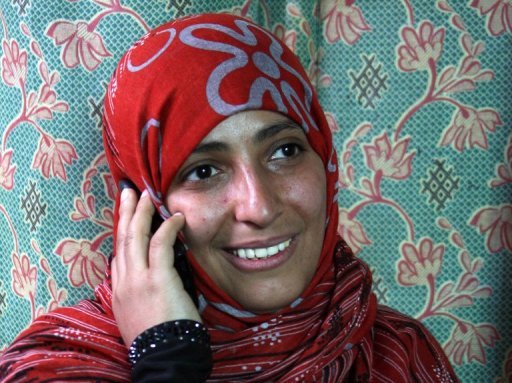
| Tawakul Karman |
The Arab liberation revolution will fundamentally change the Middle East. The acceleration of the West's decline will change the world. One outcome will be a surge toward China, Russia and regional powers like Brazil, Turkey and Iran. Another will be a series of international flare-ups stemming from the West's lost deterrence. But the overall outcome will be the collapse of North Atlantic political hegemony not in decades, but in years. When the United States and Europe bury Mubarak now, they are also burying the powers they once were. In Cairo's Tahrir Square, the age of Western hegemony is fading away.
Ari Shavit in Haaretz.
Here and
Here
Here is the most powerful speech given by Br Sadat Husseini on "Middle East revolutions: Impacts and expectations".
Sadat Husseini is member of Central Advisory Council of Jamaat-e-Islami Hind. In his speech he has listed out five lessons to be learnt from the Middle East revolutions. It is worth watching.
I heard the full speech in one session. This is the first time that I have spent so much time in viewing a speech. The subject is alluring and Sadat captivates you with shers, arabic slogans, Quranic verses and english quotations.

Who is the man at the helm of Egypt's Muslim Brotherhood, now poised to lead Egypt in the post-Mubarak era?
Liberals view him as an uncompromising religious conservative and even within the Muslim Brotherhood some doubt his ability to lead. Will Mohamed Badie succeed in uniting the Muslim Brotherhood and forming a parliamentary majority?
The press conference was set to start at noon, but at one the long table at the front of the tightly packed room remained empty. The cameramen were still jostling to set up their equipment, jamming their heavy tripods into what remained of the spaces along the walls.
It almost didn’t matter, everyone knew the story they were there for. It was all about the man who would finally take his seat at the table at 2 PM: The Muslim Brotherhood’s General Masul, the General Guide, Mohamed Badie. It was September 2010 and parliamentary elections, were on everyone’s minds, as they are today. Especially when it came to predicting the power of the Muslim Brotherhood in those elections.
Mohamed Badie Abdul Mageed Samy, a highly educated man with roots in labour rights and a strong commitment to outreach, is poised to become one of the most influential powers in the ‘new Egypt.’ Yet, his rise from relative obscurity to the forefront of national politics has left many Egyptians perplexed. Liberals view him as an uncompromising religious conservative and even within the Muslim Brotherhood some doubt his ability to lead. Will Mohamed Badie succeed in uniting the Muslim Brotherhood and forming a parliamentary majority?
Maryam Ishani in Majalla. Here and
Here
What role have women played in the Islamic Awakening of the Arab region?
They were the catalysts of change and they were in the forefront in the struggle against dictators.
Tariq Ramadan discusses this amazing dimension of the Islamic Awakening with Khola Hasan, Director, Albatross Consultancy in this 24 minutes video. It is worth watching and enlightening.
Watch Here

Too often, you consumers of mainstream media are victims of a fraud. You think you can trust the articles you read - why wouldn't you? You think you can sift through the ideological bias and just get the facts. But you don't know the ingredients that go into the product you buy. It is important to understand how knowledge about current events in the Middle East is produced before relying on it. Even when there are no apparent ideological biases, such as those one often sees when it comes to reporting about Israel, there are fundamental problems at the epistemological and methodological level. These create distortions, falsehoods and justify the narrative of those with power.
The American media always want to fit events in the region into an American narrative. The recent assassination of Osama bin Laden was greeted with a collective shrug of the shoulder in the Middle East, where he had always been irrelevant, but for Americans and hence for the American media it was a historic and defining moment which changed everything. Too often contact with the West has defined events in the Middle East, but the so-called Arab Spring with its revolutions and upheavals evokes anxiety among white Americans. They are unsettled with the autogenetic liberation of brown people.
The American media has been obsessed with Israel. And all too often, it just comes down to "what does this mean for Israel's security?" The aspirations of hundreds of millions of freedom-seeking Arabs are subordinated to the security concerns of five million Jews who colonised Palestine.
A student of the Arab world once commented that any self-appointed terrorism expert must first pass the Um Kulthum test - meaning, has he heard of Um Kulthum, the iconic Egyptian diva of Arab nationalism whose music and lyrics still resonate throughout the Middle East? If they hadn't heard of her, then they obviously were not familiar with Arab culture. In Iraq an equivalent might be the Hawasim test. Saddam called the 1991 war on Iraq "Um al-Maarik", or the mother of all battles. And he called the 2003 war on Iraq "Um al-Hawasim", or the mother of all decisive moments. Soon, the looting that followed the invasion was called Hawasim by Iraqis, and the word became a common phrase, applied to cheap markets, to stolen goods, to cheap products. If you drive your car recklessly like you don't care about it, another driver might shout at you, "what, is it hawasim?" If you don't make an effort to familiarise yourself with these cultural phenomena, then just go back home.
Nir Rosen in AlJazeera. More Here